To be privately owned
CastleRoma
Castello di Torrenova
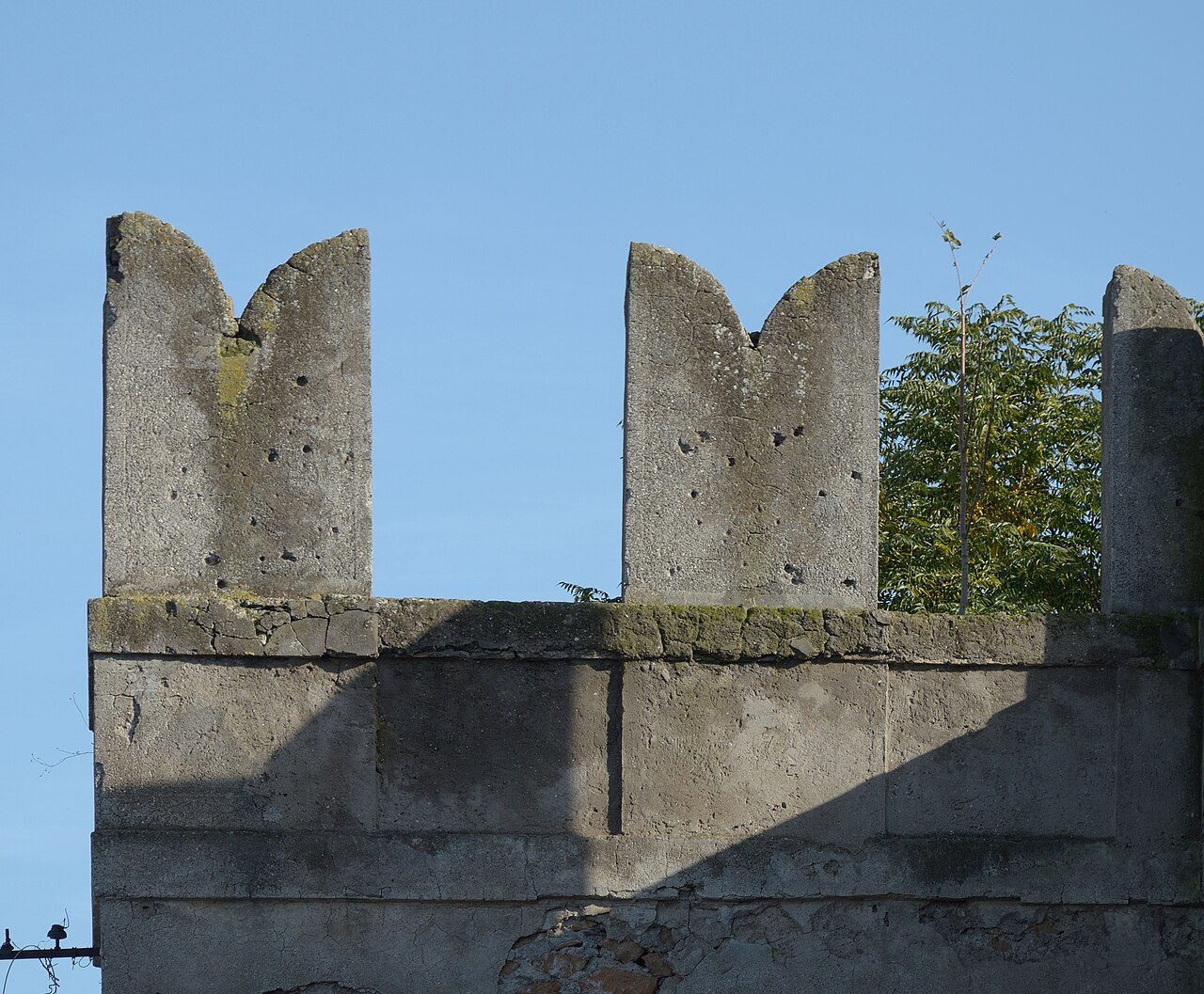
The castle of Torrenova is a building that takes its name from its tower, with a rectangular base, in the shape of a keep, about twenty meters high and crowned with swallowtail merlons (5 on the sides parallel to Via Casilina, 4 on those perpendicular to it). Many Roman neighborhoods owe their name to "towers" or "castles" that in antiquity represented their visual and historical-social reference point. This is the case of Torrenova, which owes its name to the "New Tower", meaning restored and rebuilt in place of a previous one.
History+
Today located on Via Casilina at civic number 1390, the farmhouse, improperly called "castle", stands on an older Roman-era settlement, perhaps a villa, believed by some (but without certain documents) to belong - along with the surrounding estate - to Fabius Cilo, an intimate friend of Emperor Septimius Severus and tutor of his sons Caracalla and Geta, Consul and Prefect of Rome, from whom the toponym Grotta Celoni (anciently called Cryptae Cellorum then Cellonis then Cilonis) would have taken its name. This conjecture arises from a hypothesis written by Nibby in the first half of the 19th century and then accepted, without any verification, as historical truth. For about a decade, the historic complex, although protected as a national historic monument, has been divided into mini-apartments and also sold to private individuals, thus forming a real condominium, with negative repercussions for any total recovery of the structures and for any openings and visits to the public. In what was the walled "garden" of the farmhouse (and which gave its name to the ditch of the Garden and then to the nearby hamlet Giardinetto then called Giardinetti) there are still the remains of a nymphaeum from the early sixteenth century called "Bath of the Beautiful Cenci", but which is impossible to access as it is a permanent residence for homeless people. The history of the farmhouse is certainly documented only from the second half of the 13th century, when it belonged to the Bove or Bobone family and was known as the farmhouse or tower of Giovanni Bove. In 1500, the property was ascertained to the Roman family of the Capranica. In 1562 the estate and the entire farmhouse were sold to Cristoforo, a prominent member of the Cenci family of the Arenula branch, whose son Francesco Cenci incorporated three other nearby properties into the estate: the pediche of San Matteo, delle Forme and del Torraccio. In just eight years (1562-1600) Francesco Cenci managed to incorporate such a number of properties into the original and modest medieval farmhouse, that the latifundium extended from the initial 258.5 rubbia to 925 rubbia in 1600, equivalent to over 1700 hectares. Forced to flee Rome to avoid a conviction, Francesco took refuge in Petrella Salto, at the estate of the Colonna family (patrons of the Cenci), where he was murdered. Francesco's children and all his relatives were accused of the plot: Beatrice, his daughter, his second wife Lucrezia, his sons Giacomo and Bernardo, the castellan Olimpio Calvetti and the farrier Marzio da Fioran, known as "the Catalan". After the execution, which took place on September 11, 1599, the Cenci family's properties were confiscated by the Apostolic Camera and sold at auction for 91,000 scudi. The large estate of Torrenova was purchased by an Aldobrandini, Gian Francesco (Florentine, son of a Giorgio Aldobrandini belonging to a cadet branch of the family), a relative of Pope Clement VIII, who had decreed the death sentence.
From the Aldobrandini to the Borghese+
Aldobrandini, after transforming the tower by building a real crenellated castle around it in imitation of older fortresses and the adjacent church of San Clemente for himself and his family, was forced to leave Italy to go and fight against the Turks in Hungary where he died on September 17, 1601. His wife Olimpia Aldobrandini (niece of Pope Clement VIII Aldobrandini) further enlarged the property with the annexation in 1607 of the Casa Calda estate and, ten years later, the last portion of the S. Matteo property. The last acquisition finally dates back to 1637, the year in which Olimpia's children added the Tor Vergata farmhouse. With the death of Ippolito Aldobrandini in 1638, the main branch of the Aldobrandini dynasty died out and all the wealth passed to the only remaining heir, Olimpia juniore (1623-1682), Princess of Rossano, daughter of her brother Giovanni Giorgio. The young Olimpia first married Paolo Borghese (1624-1646), nephew of Pope Paul V, but was widowed very young and in 1647 contracted a second marriage with Camillo Pamphili (1622-1666). On February 20, 1683, Giambattista Borghese took possession of Torrenova.
19th and 20th century+
The estate remained with the Borghese family until the early 1900s and, not being strategic or central to the family's assets, information from the subsequent two centuries is decidedly scarce. The Torrenova estate reappears in notarial writings in 1848, when Don Marcantonio V Borghese ceded to the Municipality of Republican Rome the territory between the modern area of Torre Maura and Torrenova, which was destined for an Agricultural Institute for the orphans of the S. Maria degli Angeli hospice. At the turn of the new century, an economic crisis also affected the fortunes of the Borghese and Torrenova passed into the ownership of Annamaria de Ferrari Borghese, wife of Scipione Borghese and daughter-in-law of the old owner, Paolo. The reclamation of Torrenova and other Borghese lands, carried out by Prince Scipione, dates from the period 1909-1914. On March 29, 1923, Giuseppe Migliorelli purchased the castle and surrounding park, while the estate was subdivided and sold separately, passing through several owners until the subdivision of the years 1950-1952. In the immediate post-war period, a wing of the castle (the one facing Via Casilina) was used as a classroom, while the old stables and stalls were transformed into shops and the innermost wings (those facing the estate) became private residences.
Bibliography+
Rita Pomponio, Il castello di Torrenova, in Il Lazio tra antichità e medioevo: studi in memoria di Jean Coste, Rome, Edizioni Quasar, 1999, pp. 541-544, ISBN 978-88-7140-150-8. Rita Pomponio, Torrenova felix. La campagna romana da agro Pupinio a proprietà Borghese (sec. VII a.C.XX), Rome, Gangemi, 2000, ISBN 978-88-492-0036-2. Rita Pomponio, Roma Municipio VIII. Storia Antichità Monumenti, Tivoli, Publi Dragon, 2006, ISBN 978-88-902336-0-9. Rita Pomponio, "Il Papa che bruciò Giordano Bruno" (biography of Clement VIII), Ed. PIEMME, Casale Monferrato 2003 Vannozzi Stefano, historical appraisal in support of private legal case, 2000; http://stefanovannozzi.wordpress.com/2011/10/23/per-una-storia-di-torrenova-oggi-torre-angela/ Vannozzi Stefano, "Casale del Torraccio di Torrenova, Casale Conforti (...) Casale di Ocilenda", (s.i.), in «Cinquantesimo anniversario della Parrocchia Santi Simone e Giuda Taddeo:Torre Angela Roma», with the patronage of Roma Capitale, C.I.S.U., Rome, 2011, pp. 238-243; 246. Vannozzi Stefano,"Scene di caccia alla volpe nell'agro romano", in «GABINUS Rivista Culturale», quarterly, published by the Cultural Association O.N.L.U.S. "Valle di Castiglione in Gabii", Year I, n.0, Jul-Aug-Sep. 2003. Nibby Antonio,“Analisi storico-topografica-antiquaria della carta dei dintorni di Roma”, I-III, Rome 1937 (1948). Ashby Thomas, “The classical Topografy of the Roman Campagna”, in “ Papers of the British School at Rome” I, 1902, pp.125-138; III,1906, pp.1-212; IV,1907, pp.4-159. Giuseppe Tomassetti, La campagna romana, antica, medioevale e moderna, edited by Luisa Chiumenti and Fernando Bilancia, vol. I - La Campagna romana in genere, Florence, Leo Samuele Olschki, 1979, ISBN 978-88-222-2878-9. Lorenzo Quilici, Collatia, in Forma Italiae I, vol. 10, Rome, De Luca, 1974. Coste Jean,“I casali della Campagna romana all'inizio del seicento”, Rome, 1969. De Rossi Giovanni Maria,“Torri e Castelli Medievali della Campagna Romana”, Rome, 1969. Quilici Lorenzo, “Inventario e localizzazione dei beni culturali archeologici nel territorio del comune di Roma”, in “Urbanistica”, LIV-LV,1969, pp. 82-108 - L. Quilici, A.P. Frutaz, Le carte del Lazio, Rome 1972. Coste Jean,“I casali della Campagna romana nella seconda metà del cinquecento”, Rome, 1973. Coarelli Filippo,“Dintorni di Roma”, Rome-Bari, 1981. The Suburbium of Rome, in “American Journal of Ancient History”, 7, 1982, pp.97-112 - E. Champlin -“Misurare la terra. Centuriazione e coloni nel mondo romano. Città, agricoltura, commercio: materiali da Roma e dal suburbio”, Modena 1985. Coarelli Filippo,“L'urbs e il suburbio, in Giardina”, Società romana e impero Tardo Antico, II, Rome 1986. -“Carta Storica Archeologica Monumentale e Paesistica del suburbio e dell'Agro Romano”, Rome 1990. “Luoghi estremi della città. Il progetto archeologico tra memoria e uso pubblico della storia”, in “Topos e progetto”, 1, 1999, pp.97-127. A. Ricci (edited by M. Manieri Elia) “Una carta delle preesistenze per la pianificazione urbanistica: il suburbio sud-orientale di Roma e il caso del Comprensorio di ‘Tor Vergata’”, in B. Amendolea (edited by) “Carta archeologica e pianificazione territoriale. Un problema politico e metodologico” Atti del Convegno Roma CNR, 10-12 marzo 1997, Rome 1999. - A. Ricci Volpe Rita,“Il suburbio, in Storia di Roma dall'antichità a oggi. Roma antica”, Bari 2000, pp. 183-210. “Il patrimonio archeologico e la ‘Carta della Qualità’, in “Urbanistica”, 9, 2001” - A. Ricci
External links+
Municipality Rome VI, on Roma Capitale. The Castle of Torrenova, on Roma Capitale.
Take Mobile History with you
You are reading this text for free. Premium adds what matters on the road: descriptions read aloud, sites found through your camera, whole regions taken offline.
- Every description, including the ~17,700 Premium sites
- Audio guide: have descriptions read to you on location
- AR finder: see sites through your camera, with distance and bearing
- Unlimited saved sites
14 days free, then from €2.99 a month. Cancel anytime.
Source: Wikipedia · Licence: CC BY-SA 4.0 · Image: Livioandronico2013 / CC BY-SA 4.0 via Wikimedia Commons
This description draws on the facts documented in the linked Wikipedia article; Wikipedia content is licensed under CC BY-SA 4.0. Wording and editing: Mobile History.
Location: 41.8627, 12.6177