The Memorial can be visited
MemorialEisenach
Burschenschaftsdenkmal
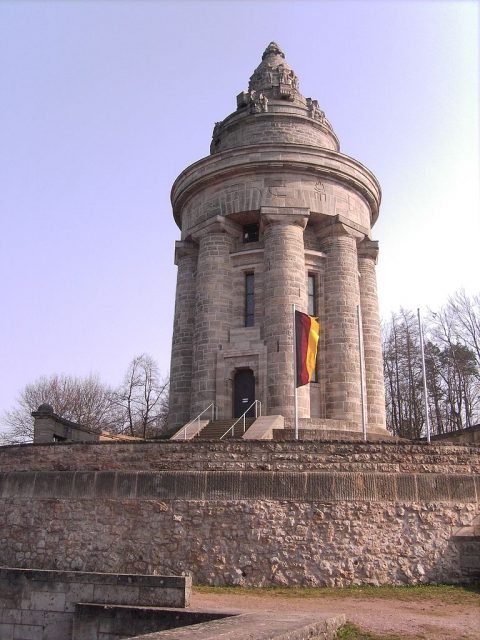
The Burschenschaftsdenkmal (Fraternity Monument) in the south of Eisenach on the Göpelskuppe is the war memorial for the 87 fraternity members who fell in the Franco-Prussian War of 1870/71. It was erected in 1902 as a national monument of the German Burschenschaft (student fraternities) in remembrance of the unification of the Reich.
Origin
After the establishment of the German Empire in 1871 and the implementation of the "kleindeutsche Lösung" (Lesser German Solution) for the unification of Germany, the vision of the Jena Urburschenschaft of 1815 was fulfilled for parts of the student fraternities, especially for the Burschenschaft associations.
The construction of the Burschenschaftsdenkmal was based on the original idea of erecting a "memorial" to the brothers who fell in 1870/71. But it was not until 1889 and 1890 that the idea took on a more tangible form, when Eisenach was chosen as the monument's destination and a committee was tasked with developing proposals. In 1894, an executive committee with its seat in Berlin was founded, to which members from seven Burschenschaften were delegated. The monument's underlying idea was now expanded to include all men who had contributed to the unification of Germany.
On June 8, 1897, the foundation stone was laid on the Wartenberg. For this location, government architect Oskar Zeiß had developed a plan for a mighty tower culminating in an imperial crown. At Pentecost of the following year, the seat of the executive committee was moved to Eisenach, and the committee was reorganized into the "Burschenschaftsdenkmalsverein in Eisenach" (Burschenschaft Monument Association in Eisenach) under the chairmanship of Medical Councilor Dr. Wedemann. Instead of a "simple" tower, a monumental building was now to be constructed. With the death of the national hero, Prince Otto von Bismarck, on July 30, 1898, all prominent cities in the Empire immediately began the prompt erection of Bismarck monuments; Eisenach could not lag behind, and only the exposed Wartenberg – opposite the Wartburg – was considered worthy enough for this purpose, and the Eisenach Bismarck Tower was erected there. The plans for the Burschenschaftsdenkmal were therefore postponed again. In this precarious situation for the city, the heirs of the brick factory owner and geologist Johann Georg Bornemann, who had died in Eisenach, helped by gratuitously ceding an area of 1.925 hectares on the Göpelskuppe to the Burschenschaft, and also provided the necessary area for the access road free of charge, while the city of Eisenach approved 4,000 marks for the construction of the road.
The 33-meter-high monument was designed according to the plans of architect Wilhelm Kreis from Blasewitz near Dresden and, after 2 years of construction, was solemnly inaugurated on May 22, 1902. Approximately 2,000 people are said to have participated in the procession from the city up to the monument. The keys were handed over by architect Kreis to the Deutsche Burschenschaft, on whose behalf the representative of the presiding Burschenschaft Marchia-Bonn, E. Lucks, handed it over to the Burschenschaftsdenkmalverein. The inauguration ceremony became a general German Burschenschaft festival, in which Burschenschaften from technical universities and Austrian Burschenschaften also participated.
The total costs for the erection of the monument amounted to approximately 250,000 marks.
Decay and Restoration
The monument survived the Second World War undamaged. However, for the new rulers, it was a symbol of feudalism and "reaction." Therefore, the Burschenschaftsdenkmal was wantonly damaged, with windows and statues destroyed. The ceiling painting, in particular, suffered severe damage due to the lack of ventilation after the window openings were bricked up.
In addition to plans for its demolition, there was later also the idea of establishing a public observatory within the monument.
After the return of the Burschenschaftsdenkmal and the associated "Berghof" hotel to the Deutsche Burschenschaft following the political change and reunification, the building's structure was secured and the building renovated. It can be visited again today.
On March 24, 2007, after approximately one year of reconstruction, the ceiling painting, originally created by the painter Otto Gussmann and restored by the painter and graphic artist Gert Weber, was officially inaugurated with festive events. The monument is open daily from 10 AM to 6 PM.
In 1932, a memorial for the fallen fraternity brothers of the First World War was erected below the Burschenschaftsdenkmal and inaugurated in 1933. The relief of a sword-bearing youth, inscriptions, and the coat of arms of the Burschenschaft were demolished by order of the Soviet occupation forces starting in 1946. After several years of renovation by the Denkmalerhaltungsverein Eisenach (Monument Preservation Association Eisenach) – financed by donations from the Burschenschaft – the fallen memorial was re-inaugurated on April 16, 2011. It is now the "Central Memorial Site of the Deutsche Burschenschaft" for the German victims of the First and Second World Wars. A restoration of the youth relief, which was chipped off in 1946, was foregone as a reminder of the desecration. During the renovation, a plate with a symbolic grave in a recess was rediscovered and left as is.
Characteristics of the Monument+
The monument, made of shell limestone, represents a round temple, rising on a wide terrace. This terrace is square in shape with curves on three sides. To its platform, a staircase with mighty ramps leads from the front to the right and left. From the platform, a wide staircase with 22 steps leads to the portal of the temple hall. The round temple itself rests on three steps; above the portal, the dedication can be read. Nine columns are connected by the masonry of a monumental hall, broken by tall, narrow windows. At the top, the columns are held together by an architrave, on which the motto of the German Burschenschaften, "Ehre, Freiheit, Vaterland" (Honor, Freedom, Fatherland), is written in giant letters. The architrave is crowned by the elaborate main cornice, from which three steps lead to the drum. On this rise six massive corbels with the heads of the Cheruscan prince Arminius, Charlemagne, Luther, Albrecht Dürer, Goethe, and Beethoven. Then follows the helmet with nine eagles, which bear a Germanic crown as the uppermost finial. Strong stone posts connected by capstones enclose the rear of the monument in a semicircle. Above the portal is the dedication of the monument, namely the inscription "DEM GEEINTEN VATERLANDE" (TO THE UNITED FATHERLAND).
Historical Features
One enters the hall through the heavy, ornate gate. In the hall are the statues of German Emperor Wilhelm I (by sculptor Selmar Werner), Grand Duke Karl August of Saxe-Weimar (by sculptor Hermann Hosaeus), Bismarck, Moltke (both by sculptor August Hudler), and Albrecht von Roon (by sculptor Selmar Werner).
Between these statues, four plaques with the names of the 87 German Burschenschafter who fell in 1870/71 are affixed to the wall of the hall. Below the plaques, sacrificial flames rise from altars adorned with the heads of dying warriors. Above the statues and plaques are the names of predecessors, co-founders, and defenders of the Burschenschaft: Johann Gottlieb Fichte, Ernst Moritz Arndt, Friedrich Ludwig Jahn, Heinrich Arminius Riemann, Horn, Karl Hermann Scheidler, Lorenz Oken, Jakob Friedrich Fries, Heinrich Luden.
The tall, narrow windows are made of colored antique and opal glass. Above them, pairs of eagles are enthroned on golden ornaments. The dome of the hall shows, on a gold background, the painting of Ragnarök, the Twilight of the Gods, the battle of the Germanic divine race of the Aesir against the forces of darkness, created by the Dresden Art Nouveau painter Otto Gussmann. The unity of the visual arts, architecture, sculpture, and painting, harmoniously confronts the visitor in this hall.
Inside the hall, an extensive dedication is placed above the entrance. In the column to the right of the entrance to the hall, a staircase leads up to the six balconies, which are located between the heads in the upper part of the monument and from which one has a magnificent view of Eisenach, the Wartburg, and the Thuringian Forest.
Take Mobile History with you
You are reading this text for free. Premium adds what matters on the road: descriptions read aloud, sites found through your camera, whole regions taken offline.
- Every description, including the ~17,700 Premium sites
- Audio guide: have descriptions read to you on location
- AR finder: see sites through your camera, with distance and bearing
- Unlimited saved sites
14 days free, then from €2.99 a month. Cancel anytime.
Source: Wikipedia · Licence: CC BY-SA 4.0
This description draws on the facts documented in the linked Wikipedia article; Wikipedia content is licensed under CC BY-SA 4.0. Wording and editing: Mobile History.
Location: 50.9665, 10.3351