The remains of the Castle can be visited
CastleBad Teinach - Zavelstein
Zavelstein Castle
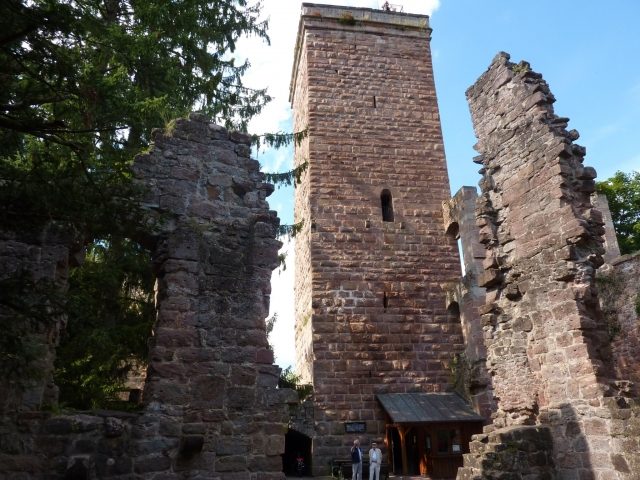
The castle ruin Zavelstein is the ruin of a hilltop castle on a 560 m above sea level mountain spur above the Teinach valley on the south-eastern edge of the municipality of Bad Teinach-Zavelstein in the district of Calw in Baden-Württemberg.
Archaeological investigations revealed that the castle was probably built around the middle of the 13th century. The first documented mention can be dated to the year 1303. It shows that from about 1280, a Lord Richelin, knight in Zavelstein, had inhabited the castle. Already in 1311, Zavelstein appears in documents as a Württemberg castle and was thus in the possession of the Counts of Württemberg. Together with the castles of Neuenbürg, Calw, Fautsberg, Wildberg and Nagold, influence over the newly acquired territories in the northeastern Black Forest could thus be maintained.
The castle was frequently given as a fief or pledge in the 14th century. In 1342, Paul von Giltlingen sold the fief of the castle for 1530 pounds Heller to Count Götz von Tübingen. Three years later, Zavelstein passed as a pledge of 5000 pounds Heller from Counts Ulrich IV and Eberhard II of Württemberg to Count Palatine Wilhelm von Tübingen. Since Wilhelm died without heirs a year later, Zavelstein reverted to Württemberg according to the contract. Wilhelm's brother, Götz von Tübingen, was entitled to the castle in 1365 as a life annuity. He gave this up only a year later.
Zavelstein Castle gained significance in 1367 when the Württemberg Count Eberhard II, known as the Greiner, and his son Ulrich, were able to escape capture by fleeing to the castle during an attack in Wildbad by the noble society Martinsvögel. Due to the poor financial situation of the House of Württemberg, the lordship of Zavelstein was constantly passed on.
A document from 1396 shows that the pledge had passed from Gerhard von Straubenhardt to his legal successors Straub von Straubenhardt and Schimpf von Gültlingen. Only in 1468, with the pledging of the income of the castle and town of Zavelstein for 2600 guilders to Burkhard von Ehingen, did orderly conditions arise. The knightly family von Ehingen held the property rights until 1552. During the Peasants' War, the castle was damaged in 1525, but not occupied. Duke Christoph von Württemberg redeemed the pledge from Hans von Ehingen in 1552.
In 1554, Jordan von Braitenbach auf Rossnitz was enfeoffed with the castle. He renovated the castle complex from 1554 to 1589 for 3500 guilders, which was proven by building accounts. After his death in 1593, his widow Agnes von Braitenbach probably continued to live there. After her death in 1612, the fief was transferred by Duke Johann Friedrich von Württemberg to Baron Benjamin Buwinghausen von Wallmerode. In 1620, the Baron bought Zavelstein and began extensive construction work, which lasted until 1630. During this time, the castle was converted into a palace. After the Battle of Nördlingen, the palace was plundered in 1634. After the Baron died of the plague in Stuttgart in 1635, his son Jakob Friedrich Buwinghausen took over the property. He later became known as the Calw Obervogt, particularly for some witch trials. In 1686, Eberhard Friedrich Buwinghausen took over the property and his father's offices.
After the destruction of Hirsau and Calw, Zavelstein was destroyed in 1692 by troops of Melac. Only a few parts of the palace remained habitable, Zavelstein was abandoned by the Buwinghausens. Eberhard Friedrich Buwinghausen sold the property in 1710 for 20000 guilders to Duke Eberhard Ludwig von Württemberg. However, the palace was not rebuilt and remained a ruin. In 1844, the stairs of the keep were renewed and it has since been used as an observation tower. In 1991, archaeological investigations accompanied the construction during renovation work.
Layout+
Only the late Romanesque core castle of the former Staufer castle remains. The two neck ditches, the gate system, the palace ruin, a cellar vault, parts of the shield wall, and other wall remains of ring walls and the Zwinger system, and the 28-meter-high keep are still visible.
Take Mobile History with you
You are reading this text for free. Premium adds what matters on the road: descriptions read aloud, sites found through your camera, whole regions taken offline.
- Every description, including the ~17,700 Premium sites
- Audio guide: have descriptions read to you on location
- AR finder: see sites through your camera, with distance and bearing
- Unlimited saved sites
14 days free, then from €2.99 a month. Cancel anytime.
Source: Wikipedia · Licence: CC BY-SA 4.0 · Image: Joachim Schneeleopard
This description draws on the facts documented in the linked Wikipedia article; Wikipedia content is licensed under CC BY-SA 4.0. Wording and editing: Mobile History.
Location: 48.6923, 8.6912