The remains of the Castle can be visited
CastleBaden-Baden
Yburg Castle
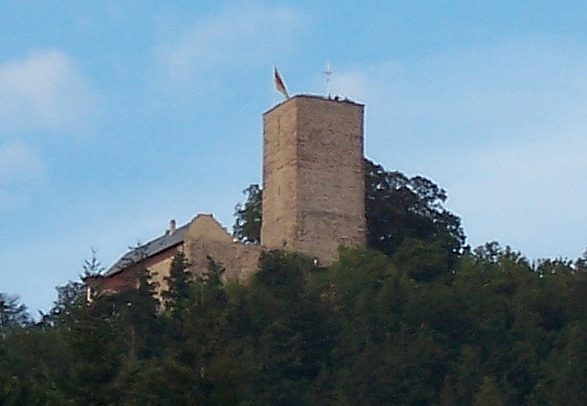
The Yburg is a ruin on the western edge of the Black Forest near Baden-Baden. The hilltop castle is located at the transition from the Upper Rhine Plain to the Black Forest on the summit of the high Yberg. It is the landmark of the Baden-Baden wine region and the villages of Steinbach, Neuweier, and Varnhalt. From the castle, one has an excellent panoramic view of the Rhine plain and the Black Forest.
The exact timeline of its origin is not known. The former knight's castle was probably built around 1200, at least there was a lively building activity around this time. In the first known construction phase, the western keep and the curtain wall were built. Only remnants of walls and the tower remain from the original castle.
The Margraves of Baden held the castle as an imperial fief. Margrave Hermann V inherited the lordship of Iberg in 1190 with the parishes of Steinbach and Sinzheim. His widow founded the Lichtenthal Abbey in 1245; the document on the occasion of a donation to the monastery contains the first written mention of the castle. It states that the bailiffs Burkhard and Heinrich Röder held the castle as a fief from Margraves Hermann VI and Rudolf I. The next mention in 1309 is the transfer of the castle to Margrave Friedrich II, as a result of an inheritance division. For 3140 pounds Heller, the castle changed hands in 1328, along with Sinzheim and Steinbach, from Margrave Friedrich II to his cousin Rudolf III. However, Margrave Friedrich II reserved a right of repurchase for the castle.
The Yburg is named after the Yberg on which it stands, and according to the information board in front of the castle, the name Yberg goes back to Eibenberg, meaning a mountain covered with yew trees.
First Destruction of the Castle
In 1333, Steinbach was pledged to the Count of Öttingen; he was in dispute with the Bishop of Strasbourg. It is suspected that the Knights of Bach and von Stein, the bailiffs Röder of the Yburg, as well as three owners of manor houses from Steinbach, ambushed a convoy of goods belonging to the Bishop. In this raid, not only were the goods seized, but the merchants were also taken hostage to extort a ransom. The Bishop of Strasbourg was so enraged that he declared war on the knights, as a result of which the manor houses, noble estates, and the Yburg were destroyed.
In the following period, there are several documentary mentions of changes in the ownership of the castle. The last knight of the Yburg is Knight Konrad in 1442. From 1510 onwards, the old spelling Iburg is no longer used, and the current spelling Yburg is adopted.
Second Destruction of the Castle
Between 1450 and 1525, there were repeated attacks by the lords of the Yburg and other princes on farmers and workers; several raids by the more than 80-man strong garrison of the Yburg on workers in the Varnhalt quarry are documented. In 1525, the farmers retaliated in the Peasants' Revolt and plundered the Yburg.
In the inheritance division of 1535, the Yburg came to the Margraviate of Baden-Baden. Margrave Eduard Fortunat attempted in 1594 to increase his fortune at the Yburg through counterfeiting and by operating an alchemist's workshop in the cellar vaults; for this purpose, he had employed the alchemist Francesco Muskatelli and his assistant Paul Pestalozzi. In 1598, the Yburg came under the administration of the Baden-Durlach line as part of the Upper Baden occupation, which had the eastern keep and the gate zwinger with the bastion refortified and cannons placed from 1617 to 1622. Since 1622, the Yburg again belonged to Baden-Baden.
Third Destruction of the Castle
In the Palatinate War of Succession in 1689, the Yburg suffered a devastating destruction, the consequences of which remained for 200 years. In addition to the castle, Steinbach and Baden-Baden and the two Baden castles were also laid in ruins. The French destroyed the roofs of the houses, plundered the supplies, and finally set everything on fire. Citizens who resisted were shot. A lightning strike split the east tower in 1781, and from 1792, the inhabitants of Steinbach were allowed to use the castle as a quarry for the construction of the Neuweierer Bridge. Two further lightning strikes in 1840 and 1987 caused additional damage to the tower.
Between 1888 and 1913, various restoration measures were carried out on the walls of the Yburg. Various carved dates in the masonry bear witness to this. The current restaurant was built in 1892, the last construction activities were restorations to the masonry and in 1977 the closing of a breach in the northern curtain wall.
Layout+
The complex covers an area of 150 by 32 meters. The current entrance to the tower was broken open by miners in 1883, and a staircase was installed in the tower; the western keep has been accessible again as an observation tower since 1985.
Current Use+
The Yburg is open for visits. It is one of the state-owned monuments and is managed by the "State Palaces and Gardens of Baden-Württemberg" institution.
Take Mobile History with you
You are reading this text for free. Premium adds what matters on the road: descriptions read aloud, sites found through your camera, whole regions taken offline.
- Every description, including the ~17,700 Premium sites
- Audio guide: have descriptions read to you on location
- AR finder: see sites through your camera, with distance and bearing
- Unlimited saved sites
14 days free, then from €2.99 a month. Cancel anytime.
Source: Wikipedia · Licence: CC BY-SA 4.0 · Image: Com1 manu at German Wikipedia / CC BY-SA 2.0 de via Wikimedia Commons
This description draws on the facts documented in the linked Wikipedia article; Wikipedia content is licensed under CC BY-SA 4.0. Wording and editing: Mobile History.
Location: 48.7306, 8.2003