The remains of the Castle can be visited
Cultural Events
CastleWindeck-Altwindeck
Windeck Castle
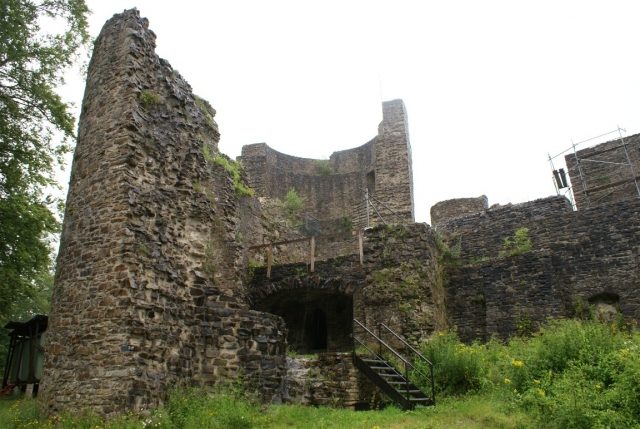
Windeck Castle is a ruin in Windeck in the Rhein-Sieg district. The castle ruin is located on the Schlossberg (Castle Hill) above Altwindeck. The castle was first mentioned in a document as "castrum novum in windeke" as early as 1174, but archaeologists consider it probable that it is older than this date suggests.
Counts of Thuringia
Two castles are known to have existed on the castle hill in the 12th century. Alt-Windeck (not to be confused with the village of Altwindeck, formerly Windeck), a tower castle on the spur of the castle hill, and Neu-Windeck, which is known today as Windeck Castle. Both were in the possession of the Landgraves of Thuringia in 1174, at the time of their first documented mention. The castrum novum was given as a fief by Count Heinrich Raspe III, brother of the Thuringian Landgrave Ludwig III, to Count Engelbert I of Berg.
Archbishops of Cologne
Between 1185 and 1188, Ludwig III sold his Westphalian allodial possessions, including Alt- and Neuwindeck, for 3,700 marks to the Archbishop of Cologne, Philipp von Heinsberg. After payment of the remaining purchase amount, the property was formally handed over in 1197 with the acceptance of new oaths of allegiance. The contracting parties were now the new Archbishop of Cologne, Adolf I, and Count Dietrich von Landsberg, who had married the daughter and heiress of Ludwig III.
Dukes of Brabant
In 1247, Duke Heinrich of Brabant, who was by then also Landgrave of Thuringia, enfeoffed Count Adolf IV of Berg with Windeck Castle. Soon after, in a settlement, he received Windeck, Bensberg, and half of the revenues of the County of Berg. Later, Count Adolf also bought Alt-Windeck. When Countess Mechthild von Sayn sold Windeck Castle to the Archbishopric of Cologne in 1250, Adolf von Berg refused his consent, but in turn offered the estates of Musbach and Merten as compensation in 1267, which was accepted by the Archbishopric of Cologne. These then fell as a fief to Gerhard von Wildenburg, a vassal of the Sayn family, instead of the intended Windeck Castle.
Counts of Elberfeld
Claims by the Lords of Elberfeld were settled in a compromise. They renounced control of the keys to Windeck Castle and in return received a castle fief in Windeck and a house in Neu-Windeck.
Dukes of Berg
Knights of Holstein
In 1388, a knight named Wilhelm Stael von Holstein was the local bailiff. The castle, land, and people had been pledged to him. He had to maintain the castle and support eight armed men. The bailiffs were initially knights, later service nobility and representatives of the territorial lords.
Counts of Kleve and von der Mark
In 1397, after the lost Battle of Kleverham, the castle was pledged by Duke Wilhelm II of Berg to Counts Adolf of Kleve and Dietrich von der Mark until the ransom was paid, but it was reoccupied as early as 1398 by Count Adolf of Berg, Wilhelm's son, after Dietrich von der Mark had fallen in a feud with him near Elberfeld.
Dukes of Berg
Adolf had been Duke of Berg since 1408 and also Duke of Jülich since 1423.
Landgraves of Hesse
In 1433, Duke Adolf concluded an alliance with Landgrave Ludwig of Hesse and in return handed over the castles of Denklingen, Neuenberg near Lindlar, and Windeck. The Hessians had previously been part of the Thuringian regional community.
Counts of Nesselrode
Due to financial difficulties caused by many feuds, Adolf of Jülich and Berg also pledged Windeck Castle and its lordship in 1435 to Wilhelm von Nesselrode the Younger (his bailiff since 1431) for 10,000 Rhenish florins. As such, Wilhelm was obliged to maintain the castle complex. Between 1443 and 1445 alone, he spent 5530 Upper Rhenish guilders on this. Further costly repairs by the Nesselrode family followed until 1515. Successors were Bertram von Nesselrode, the youngest son (1474-1510), his nephew Heinrich von Nesselrode (1510-1513), and his underage son Wilhelm von Nesselrode in partial union with his brother Mauritius von Nesselrode (1515-1528).
Johann von Seelbach
From 1542 to 1549, Johann von Seelbach zu Crottdorf held office. He received an official salary of 100 florins, 300 hundredweights of oats, and the tithe. In return, he had to employ a chaplain, a cellarman, a baker, a cook, a messenger, a gatekeeper, and four guards.
Johann von Nesselrode
Wilhelm's son was bailiff until 1561. During this time, Dattenfeld and Much became part of the Windeck district.
Johann von Lützenrode
When Johann von Nesselrode died and left no adult descendants, Johann von Lutzenrath was appointed bailiff of Windeck (1561 to 1586).
In 1583, the Cologne or Truchsessian War broke out. On August 20, the Rhenish Count Palatine Johann Casimir marched through the Windeck district with 7,000 German, Lorraine, and French soldiers. On January 1, 1584, Eitel Heinrich von Braunschweig and Ludtwich Stumpf marched through Windeck with 5,000 soldiers.
Bailiff Johann, Bertram IV von Lützenrode (Gebhardshain). He had been bailiff of Blankenberg in the present-day Sieg district since 1537. Died 1589. Johann von Lutzenrode (also Lutzenrath is noted in history) was bailiff of Windeck from 1561 to 1586. The name Gebhardshain was mentioned less and less frequently; they were simply called von Lützenrode.
The dukes employed officiati for their administration, as did Wilhelm Duke of Berg. The term referred to the legal status of the territorial officials. Initially, they were 'Meier' (villici), 'judges' (indices or iusticicarii), 'bailiffs' (advocati), 'Drosten' (dapiferi), but at the same time also 'officials' (officiati). Many or even most came from the lower nobility. The bailiff, see the ancestors of this period, represented the sovereign in all rights and duties. He had to ensure national defense and internal peace. He was responsible for jurisdiction and took care of the collection and use of the sovereign's income. This eventually overwhelmed the bailiff, especially when the bailiff also became responsible for the drafting of documents. Jurisdiction was outsourced; instead of the bailiff, there were salaried judges such as the Vogt or Schultheiß. All of them were directly accountable to the central authority. The court, the 'house' of the prince or duke, remained the center of the regional administration.
"On the History of Rhenish Noble Families? The Noble Seats in the Windeck District" mentions Oswald Gerhard on page 25, referring to the year 1581: "I, Joh. v. Lutzenrodt (bailiff of Windeck) have begun to build a noble seat in Enselkampf (near Marienhagen)." It continues: "In the Kirspel (parish) Much lies an old stump (remains of a wall) and noble seat, called Hillesheim, which is now inhabited by Tonis Hillesheim. Also, in Markelspach lies an old stone stump in a moat and belongs to the children of Nesselrodt zu Erishoven."
Windeck Castle is first mentioned in 1174 as a military fortress. Windeck seems to have only been built around 1350 and was, from 1740, the southernmost tip of the Duchy of Berg. Being a bailiff or district administrator was perhaps equivalent to a district chief executive. After 1555, Windeck was one of 18 administrative districts (Ämter or Vogteien) between the Ruhr and Sieg in the Duchy. In 1624, Windeck ranked high in tax revenue among all districts. Blankenberg was at the top with 1192 Reichstaler, 76 Albus, and four Heller (1 Reichstaler = 80 Albus, 1 Albus = 12 Heller). Windeck was therefore not an insignificant administrative district.
Church wedding after 1521 with Barbara Scheiffart von Merode zu Bornheim. She was the daughter of Gerhard and Elisabeth Beissel v. Gymnich. The marriage produced four children. The family is said to descend from Scheiffart von Merode zu Weilerswist. His sons are said to have sold an hereditary annuity of five Malter of grain to Knight Goswin Brent von Vernich in 1429. The spelling Vernich also appeared later. Vernich is a term in this respect, as later descendants lived here (Minten, Münchmeyer, etc.). From this marriage came: Wilhelm Bertram V. v. Lützenrath/Lutzerode (Gebhardshain).
In 1562, he was enfeoffed by Duke Wilhelm of Berg with 'Manngeburn' from the office of Blankenberg. In 1564, he was allowed to attend the election of Emperor Maximilian II in Frankfurt/Main. Most of the possessions of the Lützenrath/Lutzerode family were located in the middle Sieg and Nister river areas. Lutzerode is said to be derived from Lützerath, a possession west of Cochem on the Moselle. However, since all ancestors had been settled in the area east of the Rhine, the name can only be sought in the vicinity of the Gebhardshain family. This lower noble family is presumed to have been located on the lower Sieg. In 1222, Rorich von Gebhardshain is said to have been present at Blankenberg Castle during the donation of Archbishop Engelbert of Cologne to Marienstatt Abbey.
It should be noted again the different spellings of the names such as Lutzenrad (1595), Lützenrath (1652), Lutzenrodt (1652), Lutzenrath (1653), Leuscherad (1730), Leuscheradt (also 1730) and Lützerath (1802). All were settled in the area east of the Rhine. It is not clear whether Gebhardshain ever had a possession in Leuscherath.
After his appointment as bailiff, Wilhelm Bertram V was ultimately also the heir to the possessions of Hardenberg and Clyff near Hattingen. The House of Hardenberg passed to the Bernsau family between 1525 and 1655.
Married to Luitgarde (Luitwina) von Neuhoff, also known as Ley. She was the daughter of Wilhelm and Johannae Mechtildis v. Merode/Meuerdt. She became heiress of Mehrum. From the marriage with Wilhelm Bertram V came three children, including Joan Frantz von Lutzerode von Clyff. Lutwina v. Neuhoff, called Ley, is mentioned in the archives. From this marriage came: Joan Frantz, Bertram VI. von Lutzerode von Clyff (Gebhardshain).
Administrator Joan Frantz, Bertram VI. von Lutzerode von Clyff (Gebhardshain). Clyff is the name of the Cleverhof near Hattingen. In 1580, Joan Frantz von Lutzerode became administrator, then lord of Rott am Dürresbach (Rath near Mülheim near Cologne, today a district of Cologne). On December 28, 1591, the couple sold individual larger possessions. In 1610, he was present at the knight's assembly in Opladen. In 1612, his presence at Heinrich Quad zu Bellinghausen was mentioned. Around 1619 or 1620, he was mentioned together with Philipp von der Lippe, called Hoen. Then he was bailiff of Misloe until 1625. In the same year (1625), Count Adolf von Nesselrode transferred the Windeck office to him.
The Barons Lützerode, Lützenrode, Lützenrath, once also written Lütgenroide, were Barons. The coat of arms would have had a deep red with three silver lozenges diagonally to the right. It is said to have previously been an old, Lower Rhenish-Westphalian noble family, but later a Jülich-Berg knightly family.
Married to Margarethe zu Auel von Meuchen. She was the daughter of Joannis v. Meuchen and Catharina von Hillesheim in the Eifel. Married to Anna von Lüdinghausen, also known as Wolf. From the first marriage came: Bertram, Baron von Lutzerode von Clyff.
Administrator Bertram, Baron von Lutzerode von Clyff, died 1645. He was initially administrator of Miseloe and around 1622 administrator in the Windeck district under Bertram von Nesselrode.
In 1632, during the Thirty Years' War, the Swedes under Baudissin captured Windeck Castle. This sealed its downfall. After four years of occupation, the castle was returned to the Duke, but in 1646, the Swedes and Hessians again advanced on the castle. After a year-long siege, the troops withdrew. In 1672, it was the French who laid everything in ruins. The castle was destroyed, but the Windeck district only then gained its importance.
Regarding Gebhardshain, the listings state that Johann Wilhelm von Hassel had made a marriage agreement with Anna Magdalena von Lützenroth, daughter of Bertram von Lützenroth and his wife.
Married to Anna Maria von Rottkirchen. She was the daughter of Jacob zu Isenburg, who was mayor of Cölln, and Maria v. Hetzingen. From this marriage came: Joan Friedrich von Lutzenrode zu Clyff.
Wienand von Leerath
When his successor, Wienand von Lyradt zu Hunstorf, also died in 1586, the Windeck office returned to the Lords of Nesselrode.
Counts of Nesselrode
Wienand von Leerath served as bailiff from 1586 to 1589. He was perhaps the guardian of Wilhelm von Nesselrode, whose dates are unclear. He was bailiff of Windeck and also Blankenberg since 1582 or 1586 and died in 1599 or 1608.
Around this time, major repairs to the buildings in Windeck were again necessary, which were carried out in 1602 and 1609 according to the expert opinion of Johann II von Pasqualini, a grandson of the renowned master builder Alessandro Pasqualini.
Wilhelm's successor was Bertram von Nesselrode. He was deposed in 1610 during the Jülich-Cleves War of Succession. He died in 1618.
Palatinate-Neuburg/ Brandenburg-Prussia
When the last Duke of Berg of Jülich-Cleves-Berg died in 1609, a dual rule of the heirs was agreed upon. Emperor Rudolf II, however, enfeoffed the Electoral House of Saxony with the Duchy of Berg. There were also skirmishes between Prince Maurice of Orange and imperial troops under Johann von Reuschenberg at the fortress of Jülich, but not in the Windeck district.
Heinrich Quadt von Isengarten
In 1610, the Lutheran Heinrich Quadt von Isengarten became bailiff for the Catholic Bertram. He was involved in the Truchsessian War and, as a mercenary leader, in battles in France. He was also an imperial colonel in the imperial army and occupied Windeck in 1609 or 1610 with militiamen and mercenaries.
In 1613, Count Palatine Wolfgang Wilhelm became Catholic, Elector Johann Sigismund Calvinist. Both demanded sole ownership. With the parties of the Dutch States General and France against the Catholic League, Spain, and the Empire, the danger of a Europe-wide war was again invoked, but was provisionally averted in 1614 with the Treaty of Xanten. In 1615, militiamen from Blankenberg and Windeck, supported by mercenaries, unsuccessfully attacked Siegburg, which was still occupied by the Spanish.
In 1615, Count Palatine Wolfgang Wilhelm attempted to depose Heinrich Quadt without the consent of the Brandenburg Elector. He remained bailiff until 1617, but entered the service of the Duke of Brunswick-Lüneburg in 1615. In 1617, he died heavily indebted.
Brandenburg-Prussia
In 1618, the Thirty Years' War began in Bohemia. Until 1622, Windeck was occupied by Brandenburg-Prussian troops, at times under Lieutenant Colonel Stephan Gans Edler Herr zu Putlitz. From 1622, Windeck was occupied by troops of the States General, because in 1621 the Dutch War of Independence against Spain, which had been suspended for twenty years as a truce, continued. With the Düsseldorf settlement in 1624, the territories were divided, and Windeck came to Brandenburg-Prussia. After further hostilities, the Treaty of Kleve was concluded.
Palatinate-Neuburg
In 1622, Palatine-Spanish troops under Heinrich von dem Bergh, together with imperial troops under Heinrich Duke of Aremberg, successfully stormed the Pfaffenmütze and conquered Jülich. Subsequently, Windeck fell to the Electoral Palatinate in early 1623.
Friedrich Wilhelm von der Lippe
Friedrich Wilhelm von der Lippe, known as Hoen zum Broich and zu Wilberhoven, had been bailiff since 1581. He was also Drost of Hoerdt and Leunen and a Lutheran. He was deposed after the castle was conquered in 1622.
Walram Scheiffarth von Merode zu Allner
Walram Scheiffarth von Merode was administrator from 1622 until his death in 1625. In 1625, 50 men under Captain Heeß were to be stationed in Windeck, but this did not happen. After the Spanish withdrawal, 30 imperial companies of the Emperor moved to support against the Netherlands, but then retreated to the Bergisches Land and caused much annoyance to the population.
Counts of Nesselrode
Adolf von Nesselrode
In 1625, Adolf von Nesselrode zu Ehreshoven, who himself was in the service of the Electorate of Trier, took office.
Wilhelm von Hillesheim
Wilhelm von Hillesheim remained bailiff until 1637 despite difficult times.
In 1630, two imperial companies marched through the Windeck district and plundered the population. This was also the year in which Sweden intervened in the war. In 1631, the Bergian districts were asked to provide eight companies for the appointed Swedish Colonel Ludwig Heinrich Graf zu Nassau-Dillenburg. In 1632, skirmishes began between local militiamen and small roving Swedish troop detachments.
Sweden
The Swedes moved to Southern Germany, but 11,000 men under Lieutenant General Wolf Heinrich von Baudissin marched to the Rhine. From October 27 to 31, Siegburg was captured, on October 30 Windeck and simultaneously Blankenberg within two days. In addition, Bensberg and Brück were also taken. All goods were robbed, men and women murdered, driven out naked under blows, and much more.
Swedish Commanders
Lieutenant Johan Babtista, Captain Kleynaw, his Lieutenant Quest, Captain Heinrich Wilhelm Gürtzgen, the Walloon Captain Du Lac, Drost a Lieutenant, and the Captain Ley who died here, again Gürtzgen, then Captain Lieutenant Gerhardt Steuber from Mittel Irsen in Leuscheit (Leuscheid) and Captain Hans Vargell.
The imperial troops under Philipp Graf von Mansfeld marched into Cologne in 1633. The troops ravaged even worse than the Swedish ones.
In 1635, Lieutenant Colonel Jorgen Graf von Wittgenstein marched through the Windeck district with ten companies of Count Nassau-Dillenburg troops; Windeck had to provide for their supplies. Then Ludwig Heinrich Graf von Nassau-Dillenburg camped in Nassau and Freusburg and demanded supplies. He had changed sides with his troops and was now imperial. On October 24, 1635, the Swedes withdrew. They retreated from the entire Sieg region.
Palatinate-Neuburg
In 1635, a regiment of Electoral Cologne troops was stationed in the district. The troops of the neutral Count Palatine were incorporated into one third of the imperial army in 1636. The castle was therefore probably only occupied by local militia.
In the first half of 1636, Marquis du S. Martin camped here with a regiment of cuirassiers and ten companies. Then came Colonel Westphalen with two regiments of cavalry, the Münster regiment and Lieutenant Colonel Dinas Lurig, also known as auf den Wiedenhoff, followed by Rittmeister Schonfeld. At the end of the year, the Leibkompanie of Lieutenant Colonel Hanß Georg von Magdalo of the Vlefeldisch regiment, a company of the Württemberg regiment, and Rittmeister Saur zu Waldbröl arrived. Then the Hessians withdrew from the Duchy against a payment of 6,000 Rt.
In 1637, the Bavarian-Ligurian cavalry leader Johann de Werth demanded provisions for Ehrenbreitstein. Then a company of cavalry under Rittmeister Stockhausen was quartered. Next, the Venetian Captain Antonio Drohin with three regiments of dragoons made a stop. At the end of the year, a staff unit of one hundred men under Lieutenant Colonel Schwarzenholtz arrived.
Bertram von Nesselrode
Bertram zu Nesselrode was bailiff (1637 to 1663) during the Thirty Years' War and the last of the Nesselrode family, who are, however, still based in the neighboring community of Ruppichteroth.
In 1638, a baggage train of the General-Graf-Götzischen-Leibregiment, the Lorraine Rittmeister Lory and Lieutenant Colonel Heinrich von Kaderberg of the Horwich Regiment were quartered. In 1639, the imperial regiments Meutter and Sparr were in the Duchy of Berg. All demanded free lodging and travel provisions.
Hesse-Kassel
Since the beginning of the Hessian War in 1640, troop movements occurred in Windeck. Landgrave Wilhelm V of Hesse-Kassel was allied with Sweden.
In 1640, after numerous negotiations, a Hessian protection company on horseback was stationed in Windeck and also Blankenberg. In 1641, Lieutenant Hans Dietrich von Eischewitz was commander of Windeck. Approximately 160 regular troops were stationed there, in addition to the local militia. In 1642, protection payments to the Hessians were refused. They, in turn, feared the defection of their army, which was to be assigned to the imperial troops. In 1643, Hachenburger and Sayner invaded Windeck, but could not take the fortress.
Palatinate-Neuburg
In 1644, the Bergian fortresses were occupied by troops of the Lords of Palatinate-Neuburg. In 1645, the 300-man strong garrison was reinforced by 30 militiamen. Marshal von Weschpfennig delivered five tons of powder, and the commander was admonished to be vigilant.
In 1646, the Hessians attacked Windeck Castle and captured it after a five-week siege. Colonel Sparr, who led the counterattack in the Bergisches Land, also attacked Windeck and captured the new redoubt, but then retreated. In a skirmish in Windeck-Herchen between imperial troops and a unit from Hesse-Kassel returning from an attack on Bad Honnef, a lieutenant and an ensign and forty soldiers died, but sixty Hessians were captured.
1647 The Swedish occupiers remained until 1647, before they had to surrender to imperial troops under General de Lamboy, who was commander-in-chief of the Lower Rhenish-Westphalian Circle, after a prolonged siege. The castle garrison was provided by Colonel Heinrich von Plettenberg's infantry regiment. When the imperial troops withdrew again in 1648, they finally destroyed the castle, so that apart from the chapel and some outbuildings, only rubble and ruins remained. In 1655, a reconstruction was considered but rejected. Some outbuildings were once again restored as an administrative and court house and as a prison.
In 1672, Windeck was attacked by French troops during the Dutch War, initially defended, but later taken, burned, and destroyed. The Windeck district was moved to Denklingen. Subsequently, the inhabitants of the surrounding villages used the ruins as a quarry.
Preservation+
For a long time, this castle ruin was considered a quarry by the population.
When the Grand Duchy of Berg was dissolved in 1815 as a result of the decisions of the Congress of Vienna, the castle ruin came into Prussian possession.
Following a letter from the population in 1819, the royal government's chief president, Baron von Hagen, ordered a demolition ban.
Prussia sold the castle ruin in 1852 to the royal Prussian district administrator of Waldbröl, Oscar Danzier. He was interested in historical buildings and their preservation. Therefore, he had clearing work carried out and paths and stairs built. The ruin site was transformed into a park landscape.
In the years 1859/60, Danzier had the so-called Windeck Castle built on the foundations and vaults of the old castle on the south-eastern tip of the castle hill. This passed by inheritance to his daughter Arnoldine, who was married to the Sicilian Andrea Caminneci. It was set on fire by American artillery shelling at Easter 1945. The cannon used to shell the castle was set up in Saal near Leuscheid.
The owner couple had passed away, and their heirs, after the turmoil of wartime, had other priorities than restoring the building. Therefore, the burnt-out ruin stood unprotected for years. The remains visibly deteriorated until the then Siegkreis bought the complex from Andrea Caminneci's grandson, Manfred Caminneci, in 1961 for the symbolic price of one Deutschmark to save the ruin from decay. Just one year later, the Siegkreis began to partially secure and complementarily restore it. In the course of the work, which lasted until the end of the 1960s, the remains of Windeck Castle were also completely demolished, because the old castle ruin was considered historically more valuable and worth preserving. The stones from Windeck Castle were used to erect the palace wall, which, incidentally, was built upside down. A good observer will immediately see that the openings for the beam ceiling are missing in the walls. After the fortress was razed, only stumps of the palace remained. During further excavations, the later added chapel was also discovered. It was adorned with tiles bearing the Nesselrode coat of arms. These were abundantly collected by visitors. A small remnant is now in the Windeck local history museum below the castle.
Since August 1987, extensive archaeological excavations and conservation measures have been carried out on the castle ruin by the Rhein-Sieg-Kreis as the legal successor of the Siegkreis and the municipality of Windeck within the framework of job creation measures by the employment office. Today, the observer no longer sees much of it, as nature has already overgrown the old walls again and thus hidden them from view.
Modern Use+
Today, the castle is used to present various cultural events to the public. In addition to some theater performances (The Count of Windeck), events were also held as part of the Siegtal Festival. In 1997, Windeck Castle served as a backdrop for the film adaptation of the ghost hunter John Sinclair film "Die Dämonenhochzeit" (The Demon Wedding).
Take Mobile History with you
You are reading this text for free. Premium adds what matters on the road: descriptions read aloud, sites found through your camera, whole regions taken offline.
- Every description, including the ~17,700 Premium sites
- Audio guide: have descriptions read to you on location
- AR finder: see sites through your camera, with distance and bearing
- Unlimited saved sites
14 days free, then from €2.99 a month. Cancel anytime.
Source: Wikipedia · Licence: CC BY-SA 4.0 · Image: Roland Neubert, Halle (Saale)
This description draws on the facts documented in the linked Wikipedia article; Wikipedia content is licensed under CC BY-SA 4.0. Wording and editing: Mobile History.
Location: 50.8137, 7.5789