The remains of the Castle can be visited
CastleTrippstadt
Wilenstein Castle
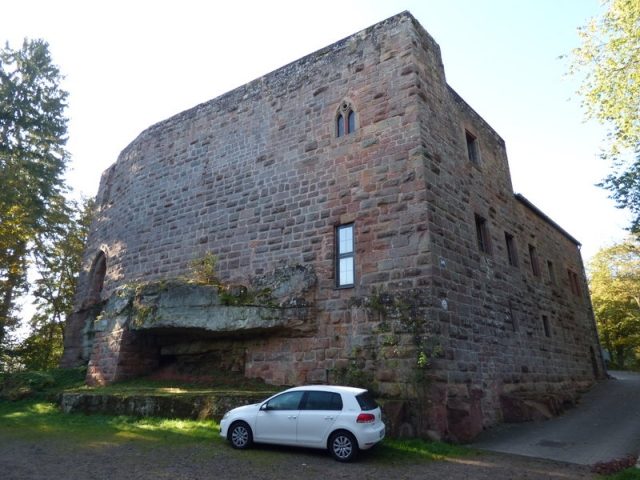
Wilenstein Castle, sometimes also called Willenstein, is the partially restored ruin of a 12th-century hilltop castle in the district of Kaiserslautern (Rhineland-Palatinate). It is located in the northwestern Palatinate Forest, on the right above the Karlstal of the Moosalb, at an altitude of 400 m, and belongs to the municipality of Trippstadt.
Wilenstein Castle later formed a double castle complex together with Flörsheim Castle. The latter was built in 1347 by the Lords of Flörsheim. It was destroyed in the Thirty Years' War (1618–1648). Only remnants of the former castle complex remain.
The older Wilenstein Castle was probably built in 1152 by Emperor Frederick Barbarossa to protect the imperial territory around Kaiserslautern and to secure the Staufer family estate. In 1169, a Merbodo von Wartenberg was documented as a nobleman of Wilenstein, serving as a ministerialis. In 1247, the castle was a fief of the Counts of Leiningen. In 1273, Knight Johannes von Wilenstein seized a stone cross seven kilometers southeast of his castle, which the Lords of Hohenecken had erected as a symbol of sovereignty, and had his own coat of arms carved into it. "Herr Johanns Creutz" (Lord Johann's Cross) was first mentioned in a document in 1551 and still exists today, both physically and in the place name of the hamlet Johanniskreuz that developed there.
In 1300, the Wilenstein line of the Wartenbergs died out. During inheritance disputes between Raugraf Konrad and Wildgraf Gottfried in 1334, the castle was destroyed, but subsequently rebuilt. The knightly family of Flersheim and the Countess Dowager of Falkenstein each received half of the castle as a fief in 1347. The complex was divided into two, creating the eastern, high-noble Falkenstein part, called Oberburg (Upper Castle), and the western, lower-noble Flersheim part, which was called Unterburg (Lower Castle). Initially, there were repeated disputes between the neighbors, until a castle peace was concluded after a year. In 1481, as a result of the Leiningen inheritance dispute, the entire castle fell to the Electoral Palatinate.
During the Thirty Years' War, the castle was destroyed in 1633/34 and was probably uninhabited thereafter. Baron Ludwig Anton von Hacke, descended from ancient Thuringian nobility, acquired the ruin and the surrounding forest district in 1719, but resided in his palace in Trippstadt. During the French Revolution, ownership of the castle fell to France in 1792. In 1803, it came into the possession of Alsace, and in 1865, through purchase, to the Kingdom of Bavaria. In the early 1960s, a part of the Oberburg was restored.
Complex+
The ruin of the Oberburg shows remnants of the shield wall, gate, palas, pentagonal keep, and bailey. Parts of the directly adjacent ruin of the Unterburg are freely accessible.
The restored part of the Oberburg has been converted into a school country home, which has been under the private sponsorship of a support association since 1962. The home is run as a self-catering house with 40 beds and can accommodate school classes, youth, and leisure groups.
Take Mobile History with you
You are reading this text for free. Premium adds what matters on the road: descriptions read aloud, sites found through your camera, whole regions taken offline.
- Every description, including the ~17,700 Premium sites
- Audio guide: have descriptions read to you on location
- AR finder: see sites through your camera, with distance and bearing
- Unlimited saved sites
14 days free, then from €2.99 a month. Cancel anytime.
Location: 49.3541, 7.7532