The remains of the castle can be visited
CastleOberhofen
Wildeneck Castle
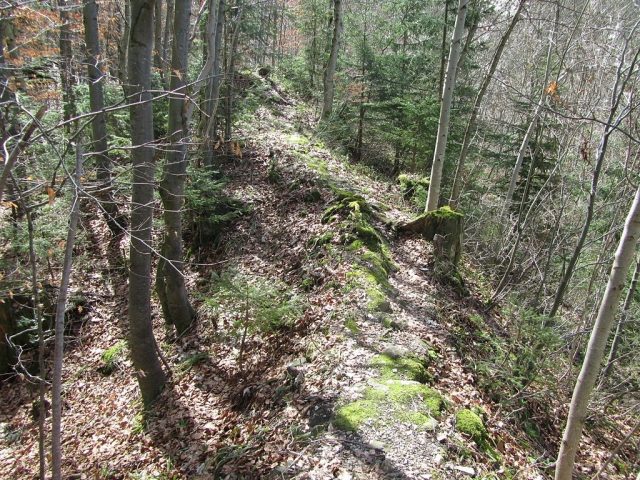
The ruin of the spur castle Wildeneck is located on the western shore of Lake Irrsee in the Upper Austrian municipality of Oberhofen, on the eastern slope of the Kolomansberg. The castle was built in the 12th century. From 1611, or possibly as early as 1572, the castle was no longer inhabited and was left to decay.
Wildeneck Castle (also called Wildenegg, Wildenekke, Wildenek or castrum Wildenekk) was built by Rapoto I of Ortenburg around 1140. His descendant Count Rapoto IV sold the castle in 1286 to the Dukes Stephan and Otto of Lower Bavaria. Their rule extended over Mondsee Abbey, the Mondsee region, and over the third of the Mondsee estates, known as the Salzburg Urbaramt zu Mondsee, which was sold by the Diocese of Regensburg to the Archdiocese of Salzburg in 1278. In 1321, the Bavarian dukes agreed that Count Heinrich III of Ortenburg should regain possession of the Wildeneck lordship.
Around 1370, the Mondsee region was separated from the Bavarian regional court of Weilhart, and a separate Bavarian regional court of Wildeneck was established. It was subordinate to the Rentamt Burghausen. The castle was administered by caretakers who also held the office of regional judge. In 1390, the Archdiocese of Salzburg bought the lordship of Mattsee with Straßwalchen. This made the Mondsee region an enclave separated from Lower Bavaria. The lordship of Wildeneck was pledged several times by the Bavarian dukes. After 1462, Mondsee Abbey was able to acquire the property as a pledged lordship. In 1506, the Mondsee region was bought by King Maximilian I and sold on to the Archbishop of Salzburg in the same year. However, Maximilian I reserved a right of repurchase. In 1565, the estates in Upper Austria were able to buy back the Mondsee region. Due to the relocation of the regional court to Mondsee, the castle was abandoned as early as 1572, according to other sources not until 1611.
In 1678, Mondsee Abbey bought the Vogtship and the regional court lordship, thereby exercising high jurisdiction, also known as blood court or neck court; the abbey also collected taxes. In 1759, the Salzburg Urbanamt was repurchased from Regensburg. Until this year, the subjects of the Mondsee region were obliged to serve two masters: the princely caretaker of the Vogtship of the Wildeneck regional court and the manorial court judge of Mondsee, or the Salzburg officials. Already at the beginning of the 17th century, dual rule and constantly increasing tax burdens due to the poverty of the farmers had led to a tax boycott and peasant uprisings (1611–1662), which were suppressed by the authorities with brutal coercive measures (imprisonment of rebellious farmers in the water tower, tying them to the stake, starvation). In 1662, farmers were also executed, banished from the country, or sentenced to lifelong forced labor, a procedure not known from neighboring Vogtships (e.g., Hochfeld).
Due to the multiple judicial rights, disputes continued for a long time. Only after the Peace of Teschen (on May 13, 1779), which ended the Bavarian War of Succession with Prussia, did the Innviertel finally become part of Austria. This ended the disputes over judicial and tax rights.
Wildeneck Today+
A steep ascent leads to the ruin. The castle stood on a steep spur; on the access side, it was protected by a deep neck ditch. Only sparse remains of the former castle exist, such as some wall sections of a tower in the curtain wall. A drawbridge over the neck ditch can be assumed. Several depressions are found at the castle site, indicating collapsed vaults.
The approximately 45-minute hike to the ruin is advertised as an adventure hiking trail (starting point Gasthof Fischhof on the western shore of Lake Irrsee) for families.
The ruin is associated with the legend "The Golden Carriage of the Countess of Wildeneck," which also expresses the disproportion between the wealth of the former rulers and the subjugated subjects.
Take Mobile History with you
You are reading this text for free. Premium adds what matters on the road: descriptions read aloud, sites found through your camera, whole regions taken offline.
- Every description, including the ~17,700 Premium sites
- Audio guide: have descriptions read to you on location
- AR finder: see sites through your camera, with distance and bearing
- Unlimited saved sites
14 days free, then from €2.99 a month. Cancel anytime.
Source: Wikipedia · Licence: CC BY-SA 4.0 · Image: http://commons.wikimedia.org/wiki/File:Ruine_Wildenegg.JPG
This description draws on the facts documented in the linked Wikipedia article; Wikipedia content is licensed under CC BY-SA 4.0. Wording and editing: Mobile History.
Location: 47.9140, 13.2903