The remains of the Castle can be visited
CastleWertheim
Wertheim Castle
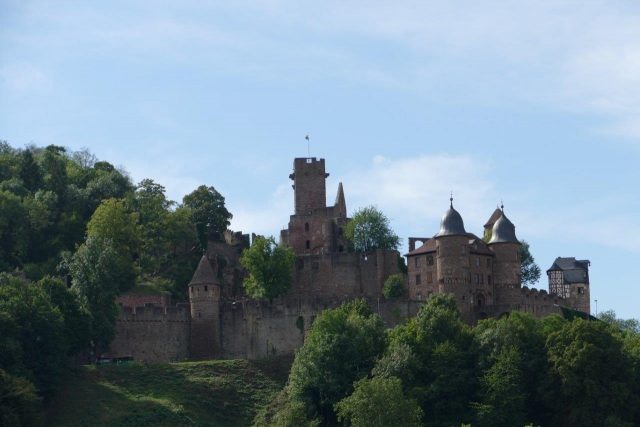
Wertheim Castle is the ruin of a hilltop castle on a high, narrow mountain spur between the two valleys of the Main and Tauber rivers above the city of Wertheim. It is one of the oldest castle ruins in Baden-Württemberg.
The Counts of Wertheim, members of the Franconian noble family of the Reginbodonen, first named themselves after Wertheim in 1132. In this century, construction of the castle began, which also developed into a cultural center. The poet Wolfram von Eschenbach was closely connected with the Counts of Wertheim. His presence at the castle can be assumed with certainty. Until the 17th century, the count's seat was continuously expanded with defensive fortifications and large residential palaces.
In 1556, the comital line of Wertheim died out. They were succeeded by Ludwig, Count of Stolberg-Königstein, who was replaced in 1598 by one of his sons-in-law, Count Ludwig von Löwenstein.
In 1619, parts of the castle were destroyed by a powder explosion. During the Thirty Years' War, the castle was occupied by the Swedes, and further destruction followed in 1634 due to bombardment by imperial troops. Since then, it has been in ruins.
From 1982, the castle ruin was renovated with considerable support from the state of Baden-Württemberg. Since 1995, it has been owned by the city of Wertheim, which bought it from the previous owners, the former noble families of Löwenstein-Wertheim-Freudenberg and Löwenstein-Wertheim-Rosenberg.
On July 21, 2008, the majority of the Wertheim city council approved a proposal from the city administration to make the castle more accessible by installing an inclined elevator. A citizens' initiative, however, fears for the cityscape of Wertheim and collected signatures until September 1, 2008, to enforce a citizens' petition that aims to overturn the city council's decision.
Layout+
Behind a deep neck ditch, the buildings stand on terraced rocky terrain. Additionally, the castle was secured by strong outer works from the period after 1400, and wing walls connected it with the city, which developed under its protection. Enclosed on the eastern side by a high curtain wall, the slender keep stands in the middle of the upper castle. The palas building, formerly with a castle chapel, completes the construction program of the oldest castle complex, from which three-part window groups from the Staufer period are still preserved. An octagonal stair tower with a beautiful portal from 1562 connects the palas and the residential building. On a significantly lower mountain level stands the bailey, which was continuously expanded into a residential castle. Today an imposing ruin, the "new" Löwenstein building, erected around 1600, surpasses the stately Johannesbau. Towards the Tauber valley, a late Gothic oriel with an openwork tracery balustrade protrudes. The archive building above the gatehouse dates back to the Baroque period.
Take Mobile History with you
You are reading this text for free. Premium adds what matters on the road: descriptions read aloud, sites found through your camera, whole regions taken offline.
- Every description, including the ~17,700 Premium sites
- Audio guide: have descriptions read to you on location
- AR finder: see sites through your camera, with distance and bearing
- Unlimited saved sites
14 days free, then from €2.99 a month. Cancel anytime.
Source: Wikipedia · Licence: CC BY-SA 4.0 · Image: Mobile Geschichte
This description draws on the facts documented in the linked Wikipedia article; Wikipedia content is licensed under CC BY-SA 4.0. Wording and editing: Mobile History.
Location: 49.7590, 9.5200