The remains of the Castle can be visited
CastleLind
Wensburg Castle
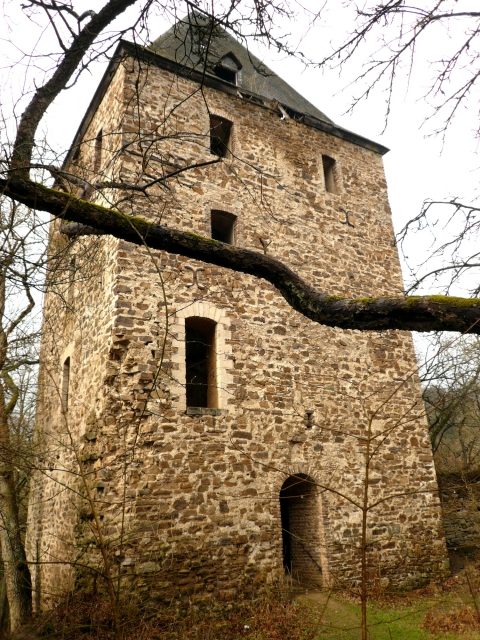
The ruin of Wensburg, also known as Wensberg Castle, is a castle ruin located in the Lierstal valley. The spur castle is hidden in the forest on a hilltop southwest of Lind in the Ahrweiler district of Rhineland-Palatinate and was once the center of the lordship of the same name.
Presumably built at the end of the 13th or beginning of the 14th century, the complex changed hands from the von Gymnich family to the von Helfenstein and then to the von Orsbeck. After a large part of the building fabric was demolished in 1832, the owner Louise Scheib undertook restoration and conversion work at the beginning of the 20th century, the result of which still characterizes the preserved castle remains of the freely accessible ruin today.
Description+
The approximately 20 by 40 meter complex is divided into two parts: the rectangular core castle area with its residential tower and the outer bailey area, which surrounds the main castle like a Zwinger and is enclosed by a curtain wall made of quarry stone. Its current building fabric largely dates from modern times. The approximately breast-high, almost oval outer curtain wall has two pointed-arch entrances, of which the northwestern one is the current main entrance. Towards the mountain side, it is secured by a neck ditch.
The current core castle area is dominated in the west by the approximately 20-meter-high residential tower, which was altered in the 20th century. Its 2.5-meter-thick outer walls rise on a 9.5 by 10.7 meter footprint and formerly had a staircase within their wall thickness leading to the upper floors. Only on the not quite as stable east side are there window openings, whose brick jambs were only installed during a renovation about 100 years ago. The tent roof of the tower also dates from this period.
Directly next to the residential tower, to its south, was formerly the original access to the core castle area. Its profiled trachyte stones are now scattered across the castle grounds. As late as the 1930s, the main castle was surrounded by a seven-meter-high ring wall, whose height today, however, is barely more than three meters. The wall, whose older parts consist of alternating layers of basalt ashlar and quarry stone, once had a battlement as its upper finish, which was accessible via a staircase within the wall thickness of the southern long wall.
The complex also formerly included a castle chapel, dedicated to Saint George, which was demolished in 1833.
The castle was first mentioned in a document in 1401 as "Haus zu Wentzbergh", when its then owner Dietrich von Gymnich enfeoffed it "with all its walls, gates, ditches, outer bailey and timberwork and with all its appurtenances" to Archbishop Friedrich of Cologne and at the same time granted him the right of opening. However, it is probable that the castle was founded at the end of the 13th century or the beginning of the 14th century. Evidence for the dating is provided by the architectural features still present today, such as the arrangement of the buildings and architectural details like the use of pointed-arch gates.
Through Dietrich's granddaughter Katharina von Gymnich, the property came to the family of her husband Johann von Helfenstein, whose family sold the complex to Engelbert von Orsbeck with the reservation of a right of repurchase. His relative Dietrich von Orsbeck redeemed the family's right of repurchase in 1506 for 200 guilders and definitively brought the castle to his family, in whose possession it remained until the 17th century.
After the buildings were allegedly destroyed by Spanish troops in 1633 during the Thirty Years' War, they came into the possession of the Barons von Bourscheid. Eva Katharina von Bourscheid brought the castle through marriage to her husband Franz Friedrich von Lütze(n)rode, whose family sold it in 1818, along with the lordship, to Johann Franz and Franz de Sales Biolley from Verviers.
After several changes of ownership in the first quarter of the 19th century, the wine merchant and iron manufacturer Carl Theodor Risch from Reifferscheid bought the castle. He had it demolished in 1832, except for the remains still preserved today.
Through inheritance, the castle came to the Scheib siblings. Louise Scheib had the ruin restored at the beginning of the 20th century, thus bringing it to its approximate current state. This included the expansion of the residential tower and the raising of the outer curtain wall to its current height. Subsequently, the property was sold to the Cramer family from Düsseldorf. As late as the 1930s, a coat of arms stone existed above the entrance of the residential tower, showing the alliance coat of arms of the von Orsbeck and von Frenz families, including the year 1614.
Take Mobile History with you
You are reading this text for free. Premium adds what matters on the road: descriptions read aloud, sites found through your camera, whole regions taken offline.
- Every description, including the ~17,700 Premium sites
- Audio guide: have descriptions read to you on location
- AR finder: see sites through your camera, with distance and bearing
- Unlimited saved sites
14 days free, then from €2.99 a month. Cancel anytime.
Source: Wikipedia · Licence: CC BY-SA 4.0 · Image: http://de.wikipedia.org/wiki/Datei:Wensburg1.jpg
This description draws on the facts documented in the linked Wikipedia article; Wikipedia content is licensed under CC BY-SA 4.0. Wording and editing: Mobile History.
Location: 50.4763, 6.9117