The remains of the Castle can be visited
CastleAnger
Waxenegg Castle
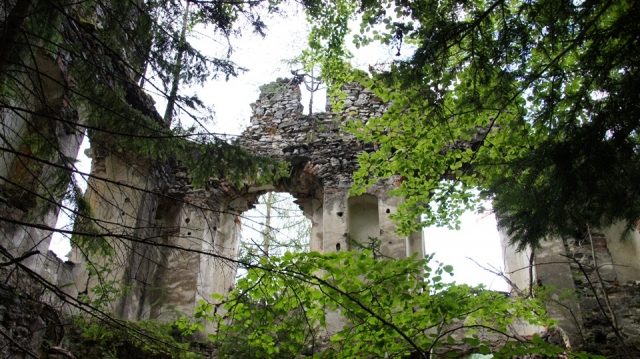
The once quite stately castle was probably built in the second half of the 13th century. At that time, it belonged to the Archdiocese of Salzburg. The bishops enfeoffed the Styrian Landmarshal Hartnit von Orth with Waxenegg. He appointed burgraves who named themselves after the fortress. In 1219, Perchtold von Waxenegg appears as such.
Hartnit von Orth probably felt overlooked in the distribution of the Murecker inheritance, whereupon he soon after began a fight against the Archbishop of Salzburg, his liege lord. The latter then withdrew his fiefdom over Waxenegg and handed it over to Duke Frederick II the Quarrelsome, who passed it on as a sub-fief to the Bishop of Seckau.
After the death of King Ottokar II, the Archbishop of Salzburg confiscated both fiefs and handed Waxenegg over to Duke Albrecht I of Habsburg. However, in 1277, he allowed the Bishop of Seckau to build a new castle just below the fortress. In 1286, a dispute over Waxenegg began between Albrecht and the Archbishop of Salzburg, which led to the castle being captured and partially destroyed by the Duke in 1289. The following year, however, it was again in the possession of Archbishop Konrad IV, who immediately began rebuilding it. Duke Albrecht was able to recapture Waxenegg in 1291 and now kept it permanently. Albrecht pledged the castle to Ulrich von Walsee in 1299.
During the Walsee feud, Hans von Stubenberg captured the castle in 1412 on behalf of Duke Ernst the Iron. In 1418, Reinprecht von Walsee received Waxenegg back as a pledged possession. After the debt was paid, King Frederick III took over the castle in 1450. Waxenegg subsequently served repeatedly as a pledged object; it was immediately pledged to Christof Mörsperger. This was followed by the Counts Christof von St. Georgen and Pösing (1504), Count Jörg von Rottal (1514) who transferred his claims to Siegmund von Dietrichstein in 1524. In 1556, Georg Kleindienst, who was the guardian of the minor Adam von Dietrichstein, acquired the lordship as a free property. He began to expand the old castle into a habitable residence. His son Siegmund continued the work from 1571. The lower castle Neu-Waxenegg was now left to decay.
In 1663, Hans Christof Kleindienst sold Waxenegg to Georg Hans von Webersberg. When the administration was moved to the Freihaus in Anger in 1723, the upper castle was also hardly inhabited anymore. In 1761, Waxenegg was publicly auctioned. It came into the possession of Johann Franz Graf Khevenhüller-Metsch, who lived in his castle Thannhausen and had the roofs of Waxenegg Castle removed, which sealed its fate. In 1799, Karl August Fürst Bretzenheim bought the lordship. It was sold in 1807 to Ferdinand von Gudenus, whose family still owns it today.
Take Mobile History with you
You are reading this text for free. Premium adds what matters on the road: descriptions read aloud, sites found through your camera, whole regions taken offline.
- Every description, including the ~17,700 Premium sites
- Audio guide: have descriptions read to you on location
- AR finder: see sites through your camera, with distance and bearing
- Unlimited saved sites
14 days free, then from €2.99 a month. Cancel anytime.
Source: Wikipedia · Licence: CC BY-SA 4.0 · Image: http://www.wehrbauten.at
This description draws on the facts documented in the linked Wikipedia article; Wikipedia content is licensed under CC BY-SA 4.0. Wording and editing: Mobile History.
Location: 47.2712, 15.6787