The remains of the Castle can be visited
CastleBrotterode-Trusetal-Auwallenburg
Wallenburg Castle
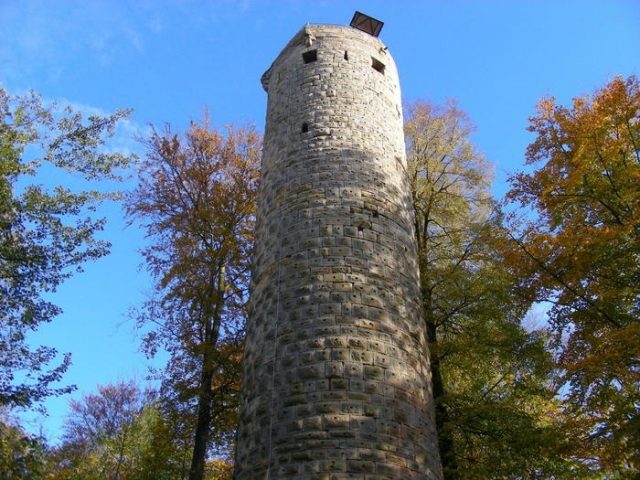
The Wallenburg refers to the ruin of a summit castle on the 523.8 m above sea level high summit of the Heinberg (also Hühnberg) above the district Auwallenburg of the municipality Brotterode-Trusetal in the district Schmalkalden-Meiningen in Thuringia.
The castle, built around 1200, initially served to control the old road ascending from Herrenbreitungen to the Rennsteigpass near Brotterode (Grenzwiese/Kleiner Inselsberg), which branched from there via Cabarz to Waltershausen and Gotha in the territory of the Thuringian Landgraves. The castle was built in the outer area of the Herrenbreitungen monastery. The Wallenburg court and castle district included Hessles with the Nüssleshof and the part of Bairoda located east of the Farnbach. The castellan of Wallenburg belonged to the service nobility of the Frankensteins.
- 1247 At the outbreak of the Thuringian-Hessian War of Succession (1247–1263), the complex gained military significance and was expanded by the Lords of Frankenstein (also referred to as "Counts of Frankenstein").
- 1249 The first mention as "Waldenburch" occurred in a settlement between Ludwig III of Frankenstein and the Herrenbreitungen monastery. Ludwig had to acknowledge the monastery's feudal sovereignty and pay damages.
- 1295 The Lords of Frankenstein were severely affected by the invasion of royal troops in 1295; their ancestral castle Frankenstein near Bad Salzungen was captured and destroyed after a short siege, and the defeated Counts of Frankenstein had to pay tribute.
- 1317 The first parts of the territory in the Trusetal had been sold; in the document sealed on August 29, 1317, the Frankenstein share of the castle (ihr halbes hus tzu Waldinburg) was asserted. The Fulda monastery, represented by Abbot Heinrich VI von Hohenberg (1315–1353), was now a co-owner of the castle. The Wallenburg had thus been divided into (initially) two equal shares of a joint inheritance, and both co-heirs had to appoint the servants mentioned in the contract (gatekeepers, tower guards, other servants as guards) and maintain the castle peace.
- 1330 – With the second Frankenstein sale, completed in 1330, Count Berthold VII (1272–1340) from the Schleusingen line of the Counts of Henneberg became a co-owner of the castle. At the same time, the brothers Siegbodo and Ludwig von Frankenstein released all their servants from their oath of loyalty. Despite extensive territorial sales in 1330, they were ruined and disappeared as a political power in the mid-14th century.
- around 1340 The Hennebergers were still in opposition to the Bishops of Würzburg. The Wallenburg also came into partial possession of the Würzburgers as a result of pledge and exchange agreements between the Würzburg and Fulda monasteries. The two co-heirs had to conclude a castle peace, which was broken at every opportunity. The dispute was carried out by the castle men and feudal lords from the lower nobility stationed at the castle.
- 1374 The Würzburg Bishop Gerhard von Schwarzburg (1372–1400) asked his cousins, Counts Heinrich and Ernst von Schwarzburg, for military assistance to protect the Wallenburg; as payment, he wanted to pay 400 guilders. The Würzburg share of the castle then passed
- 1384 as a pledge (for a debt that had already grown to 7400 guilders) to Counts Günther and Johannes von Schwarzburg. At the same time, the bishop had to pay annual costs of 740 guilders for the maintenance of the fortifications and armament, as well as food and 200 pounds of Heller for the castle's servants in Schwarzburg service.
- 1388 A feud with the knights Wetzel von Buchenau and Hermann von Völkershausen, who resided in the Rhön, resulted in the expulsion of the garrison of the Schwarzburg Counts Günther and Johannes from the Wallenburg. Archbishop Adolf of Mainz was appointed arbitrator of the feud. On April 24, 1388, he ruled in favor of the two knights and demanded that the Schwarzburgers pay a fine of 3000 guilders by the end of 1388 or hand over Wallenburg Castle to the knights as a fief with an annual expense reimbursement of 300 guilders; the Schwarzburg counts agreed. As a result of this "hostile takeover," the Schwarzburg part of the joint inheritance was halved, and the two knights each received a quarter of the castle as their share.
- 1408 The quarter belonging to Knight Otto von Buchenau (the Elder) was sold to Knight Hermann von Reckrodt, and the other quarter was to be amicably divided and handed over to the knights Wetzel vom Stein, as well as his cousins Hans, Heinrich, and Wetzel vom Stein; the lot was to decide the division of the castle. The Reckrodt family, also wealthy in the Werra valley near Gerstungen, sold their share as early as 1421 to the Würzburg Bishop Johann II von Brunn. In this context, the Wallenburg formed a base for military operations and at the same time enabled the monitoring and blocking of the roads leading north.
- 1459 The Henneberg half of the Wallenburg was handed over to Hans von Wangenheim zu Winterstein, who, with his sons, was made responsible as bailiff for the safety of the mines. The importance of the castle had increased due to the strong expansion of iron mining in the Trusetal; the iron goods and weapons produced in the hammer mills and forges had a high material value and thus provided an incentive for targeted raids.
- 1470 Philipp von Farnrode, in the service of the Counts of Gleichen, had received a quarter of the Wallenburg joint inheritance, presumably the Reckrodt part. He was obliged to provide armed servants in the castle. In 1471, Philipp von Farnroda unsuccessfully asked Count Wilhelm von Henneberg for money and wood for the repair of the castle.
- 1477 Wolfgang von Stolpenrode, a bailiff of Sonneberg in Würzburg service, appeared as a co-heir of the Wallenburg.
- 1479 Andreas von Liechtenstein took over this part of the joint inheritance.
- 1483 The dilapidated state of the castle required an inspection of the damage and the agreement on construction and repair measures. Wilhelm von Rossdorf was appointed as the Henneberg bailiff and compensated with a life-long fief.
- from 1501 The Hennebergers tried in negotiations with the Counts of Gleichen, as pledge holders of the Würzburg joint inheritance, to gain possession of the entire Wallenburg. The knightly family of the Füchse von Arnschwanz had been appointed as castle men by the Hennebergers. The most famous representative was Hans Christoph Fuchs; he had set a literary monument for himself with his verse epic "Der Ameisen- und Mückenkrieg" (The Ant and Mosquito War), printed in Schmalkalden.
- 1516 Götz von Berlichingen hid in the castle for a few days for his own safety; he was in a feud with Count Philipp II von Waldeck.
- Only in 1520 did Count Wilhelm IV von Henneberg-Schleusingen (1478–1559) of Henneberg gain full possession of the castle and entrusted the Füchse with the administration of the office.
- 1525 The castle was besieged by the rebels during the Peasants' War and set on fire after an assault. The outbuildings and part of the core castle burned down.
- 1580 Knight Hans Christoph Fuchs auf Arnschwang sold the ruinous Wallenburg to Knight Eitel von Boyneburg zu Lengsfeld.
- 1583 The castle ruin, still used as an official residence, was taken over by the Wettins as part of the Henneberg inheritance. The military value of the castle ruin was now insignificant.
- 1588 The Wettins prematurely sold it to the Hersfeld monastery in the Treaty of Friedewald, which existed until 1606 but was already under the influence of the Landgraves of Hesse, who also ruled as sovereigns in the southern adjacent Schmalkalden.
- 1589 The Landgrave of Hesse acquired the castle with its associated settlements, which he immediately incorporated into the Oberamt Schmalkalden. Landgrave Wilhelm IV of Hesse-Kassel needed building material for the construction of his secondary residence, Wilhelmsburg Castle in Schmalkalden, and for practical reasons approved the demolition of the Wallenburg ruin. Only the tower was to be preserved, as it could still be used as a watchtower.
- 1634-48, during the Thirty Years' War, the villages in the vicinity of the castle ruin were severely affected, and the castle's outwork was also plundered and destroyed.
The last noble owner of the castle ruin became the ducal house of Saxe-Coburg and Gotha in 1866 with Duke Ernst II. The ruin was merely part of an 8800-hectare former Hessian state forest, as well as Prussian areas without sovereign rights between Oberschönau and Schmalkalden, which the Duke received from the Prussian state as war compensation for his costly participation in the Battle of Langensalza (June 27, 1866). The forest area, which was private property of the Gotha dukes, was expropriated in 1945.
Description+
The castle consisted of the core castle built on the summit and the outer bailey located directly below on the west side with residential, economic, and ancillary buildings. East of the castle was a farmstead called a Vorwerk, which was devastated in 1643 and inhabited until the 19th century. The main attack side was secured by a trench about 300 m long on the east side of the mountain. Of the castle, only the four-story, 27.5 m high keep – a slender tower towering high above the forest – and a few wall remains have been preserved. The tower wall, made of ashlar blocks, also shows clamp holes as construction features. In addition to a well, the core castle included the representative Romanesque palas, of which only foundation walls remain. This part of the castle was surrounded by its own curtain wall and had a gate with a drawbridge. In front of it was the lower part of the castle with buildings also protected by a separate wall. Today, the Turmbaude is located there. Three trenches protected this outer part of the castle. The main access was probably on the south side of the mountain. A sketchy depiction of the Wallenburg office made in 1589 still shows the castle with two towers. During a systematic investigation of the castle ruin in 1979, a previously unknown underground passage was discovered; the collapsed and buried masonry could only be followed for a few meters. On an isolated rock formation west of the keep, a wall remnant was assumed to be the location of the second tower. The excavators presumed that a drawbridge must have been used for access.
Status and Use+
The castle is a protected architectural and archaeological monument. Already in the 19th century, interested people from the surrounding villages began researching the castle ruin. The current ground-level entrance to the interior of the tower was created by miners. Perhaps they hoped to recover interesting finds from the rubble at the bottom of the tower dungeon. Since 1963, the tower could be climbed again. Below the castle, a small kiosk was built during the GDR era, as the ruin was popular with tourists and school classes. Currently (2012), however, the tower is closed due to dilapidation, and the kiosk, which has been converted into a castle tavern, is threatened in its existence by technical problems.
Take Mobile History with you
You are reading this text for free. Premium adds what matters on the road: descriptions read aloud, sites found through your camera, whole regions taken offline.
- Every description, including the ~17,700 Premium sites
- Audio guide: have descriptions read to you on location
- AR finder: see sites through your camera, with distance and bearing
- Unlimited saved sites
14 days free, then from €2.99 a month. Cancel anytime.
Source: Wikipedia · Licence: CC BY-SA 4.0 · Image: http://www.wehrbauten.de/thread.php?threadid=654
This description draws on the facts documented in the linked Wikipedia article; Wikipedia content is licensed under CC BY-SA 4.0. Wording and editing: Mobile History.
Location: 50.7814, 10.4298