The remains of the Castle can be visited
CastleCalw-Kohlerstal
Waldeck Castle
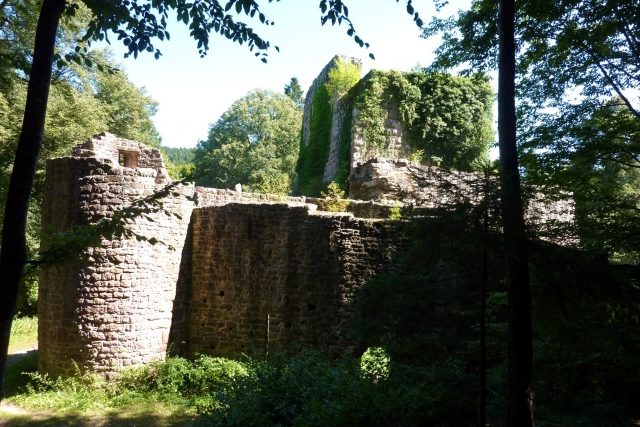
The Waldeck Castle Ruin is a castle ruin on a rock spur above the Nagold Valley and the small village of Kohlerstal near the town of Calw in the district of Calw in Baden-Württemberg.
When this spur castle was built is unclear. An Ortwin von Waldeck is first mentioned in 1140. The oldest preserved building remains do not date before 1200. The Lords of Waldeck were of "count-like" status and had acquired a more extensive territory over the course of the 13th century. Several grants of estates to monasteries testify to their prosperity. This was probably favored not least by the exploitation of the nearby silver mines of Neubulach. However, the influence of the Waldeckers in the region seems to have become too strong, so that their liege lords, the Counts of Hohenberg, felt compelled to besiege several Waldeck castles twice, in 1279 and 1284. The second siege took place with the support of the Habsburg King Rudolf of Habsburg and ended with the destruction of the castles. Several sources consistently report "quinque castra in uno monte" (five castles on one mountain). This statement was long doubted. However, investigations in the area surrounding the Waldeck ruin have shown that three other castles existed on the mountain spur west of it. Remains of ashlar masonry indicate that all three were 13th-century structures. Thus, the historical accounts of several castles on one mountain are correct. The missing fifth castle could be seen in a tower that stood separately on a rock block, which was located in front of the western castle. After the destruction, several castles must have been rebuilt. However, these were abandoned again at the latest in the 15th century, and only the well-preserved Waldeck ruin known today was further expanded and inhabited until the 17th century. The complex was probably finally destroyed in 1688 during the War of the Palatine Succession by French troops.
Of the castles on the spur west of the Waldeck ruin, only foundation remains, partly in ashlar masonry, are preserved. The ruin itself shows on the central rock remains of a compact building, consisting of a residential building and the keep. They are likely to have been built after the destruction of 1284. Extensive outer works can be attributed to several construction phases of the late Middle Ages and early modern period.
Take Mobile History with you
You are reading this text for free. Premium adds what matters on the road: descriptions read aloud, sites found through your camera, whole regions taken offline.
- Every description, including the ~17,700 Premium sites
- Audio guide: have descriptions read to you on location
- AR finder: see sites through your camera, with distance and bearing
- Unlimited saved sites
14 days free, then from €2.99 a month. Cancel anytime.
Source: Wikipedia · Licence: CC BY-SA 4.0 · Image: Joachim Schneeleopard
This description draws on the facts documented in the linked Wikipedia article; Wikipedia content is licensed under CC BY-SA 4.0. Wording and editing: Mobile History.
Location: 48.6723, 8.7375