The remains of the Castle can be visited
CastleWetter - Volmarstein
Volmarstein Castle
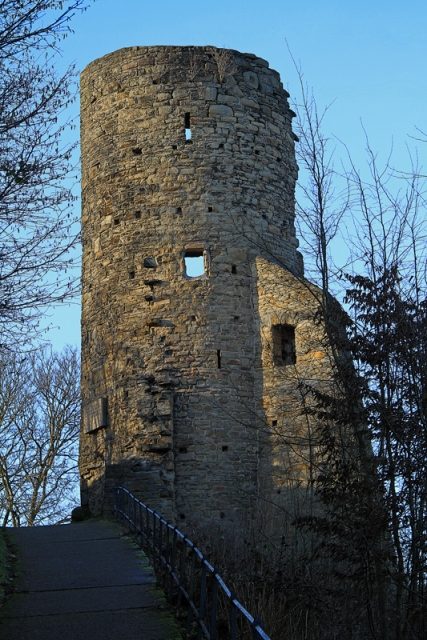
The castle ruin Volmarstein is located in the district of Volmarstein in the city of Wetter (Ruhr) in the Ennepe-Ruhr-Kreis in North Rhine-Westphalia.
It was built in 1100 by the Archbishop of Cologne, Friedrich I von Schwarzenburg, who wanted to underpin his claims to power in Westphalia, and was transferred as a fief to the noble lords of Volmestein (Volmudestede).
The castle protected the "Archiepiscopal Escort Road" from Ennepetal to Soest. It is situated on a ridge above the Ruhr. Until the 14th century, the castle was the administrative center for the lordship of Volmarstein, which also included Hagen. In 1134, Heinrich I is first mentioned as a representative of the "Lords of Volmestein". They were ministeriales of the Archbishops of Cologne.
Around the Electoral Cologne castle of Volmarstein, a rural settlement initially developed, which was already designated with the term "city" from 1307.
After the Battle of Worringen 1288
Following the Battle of Worringen in 1288, the castle was besieged and partially destroyed by Count Eberhard I of the Mark. After a reconciliation, it was restored in 1289.
In 1289, Eberhard I was granted full fortification rights by the Archbishop of Cologne Siegfried von Westerburg and recognized as an Imperial Prince, which had also been granted to his father, marking a decisive turning point in the relationship between the two powers. He thus benefited the most of all Westphalian princes, gaining, among other things, Gummersbach, Lünen with all episcopal rights, Westhofen, Brackel, Werl, Menden, Isenberg, Volmarstein and Raffenberg, as well as the Vogtland of Essen.
At the beginning of the 14th century, long-standing power struggles with Münster over some Märkisch county rights occurred. In 1314, Gottfried von Sayn became the lord of Volmarstein Castle. Since the fief "Volmarstein" (Volmestein) lay on the border of the bishopric and the County of Mark, the possessions changed back to Electoral Cologne due to political power struggles.
Due to a feud between the two contenders, Volmarstein Castle, along with the free county of the same name, was taken from the Archbishopric of Cologne and destroyed in 1324. The bishop was captured near Methler by Engelbert II of the Mark. After the reconciliation, however, the castle was rebuilt.
Beginning of the Decay
In the 14th and 15th centuries, the Counts of the Mark - later also Counts of Kleve and from 1417 Dukes of Kleve - seem to have used Volmarstein Castle intermittently, most recently around 1525 by Duke Johann of Kleve-Mark, before it slowly fell into disrepair in the 15th century.
Fire and Destruction
A large fire destroyed the village of Volmarstein and the castle in 1754. Only ruins remained of the castle. The residents used the stones of the castle to rebuild their houses.
In 1819, the ruin became the property of Count Philipp von der Recke-Volmarstein, who had significant renovation work carried out at his own expense between 1822 and 1854. This is how the wall support on the split tower, the symbol of today's Schlossberg, came into being. On June 24, 1830, half of the east tower was destroyed by a violent hurricane.
The Lords von der Recke-Volmarstein claimed and retained their property in Volmarstein and the associated fief chamber, which was one of the richest in Westphalia, until the 19th century and only sold their Volmarstein property in the 20th century. The castle ruin Volmarstein is still owned by the Counts v. der Recke v. Volmerstein.
Present+
The castle ruin is now easily accessible. All paths are developed and secured accordingly. From the castle, you have a wonderful panoramic view of the city of Wetter and the village of Volmarstein.
Below the castle is the Burghotel Volmarstein, whose parking lot is reserved only for hotel guests. It is therefore advisable to look for a parking space in the village below; the walk up to the castle is not very far. The "Nettmanscher Hof" parking lot is opposite the church.
A stone plaque on the only half-preserved tower of the ruin points to two important dates in the castle's history. It bears the inscription: This castle, built in 1100 by the Archbishop of Cologne and inhabited by the Lords of Volmarstein, was conquered and destroyed in 1324 by the Count of the Mark.
A second plaque commemorates a descendant of the Volmarstein family who fell in the Franco-Prussian War of 1870. The inscription reads: Of the descendants of the once flourishing family on this castle, Count Siegfried von der Recke-Volmarstein fell gloriously on August 18, 1870, near St. Privat. Pr. Lieutenant in the 3rd Guard Grenadier Regiment Queen Elisabeth.
The castle ruin is the landmark of the formerly independent municipality of Volmarstein.
Annually in summer, several events such as "Irish Folk Festival" and "Rock auf der Burg" take place.
Image source: www.wehrbauten.de
Take Mobile History with you
You are reading this text for free. Premium adds what matters on the road: descriptions read aloud, sites found through your camera, whole regions taken offline.
- Every description, including the ~17,700 Premium sites
- Audio guide: have descriptions read to you on location
- AR finder: see sites through your camera, with distance and bearing
- Unlimited saved sites
14 days free, then from €2.99 a month. Cancel anytime.
Source: Wikipedia · Licence: CC BY-SA 4.0 · Image: http://www.zeche.org/
This description draws on the facts documented in the linked Wikipedia article; Wikipedia content is licensed under CC BY-SA 4.0. Wording and editing: Mobile History.
Location: 51.3743, 7.3826