The remains of the castle can be visited
CastleZwingenberg
Unterburg Castle
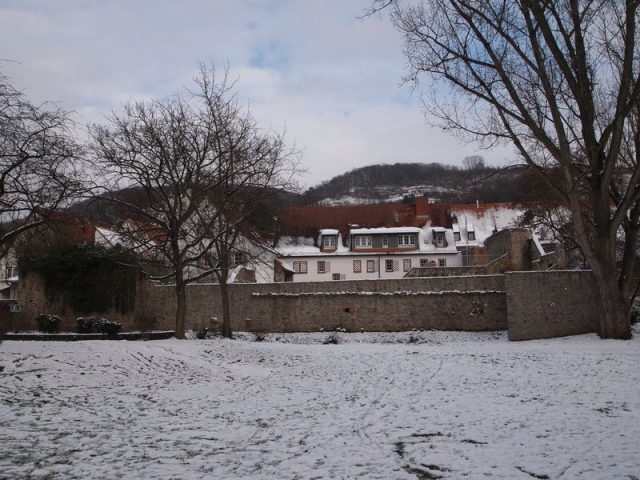
Zwingenberg Water Castle, also called Unterburg or Lower Castle, is a vanished water castle whose former site is now located in a small park southwest of the market square at a corner of the old city wall of Zwingenberg in the Bergstraße district in Hesse, visible from the B3.
The foundation remains of the water castle are among the oldest, if not the oldest, structure in the city of Zwingenberg and originally belonged to the former city fortifications.
The castle was located at the southwestern end of Zwingenberg's city wall and probably had a protective and control function for the trade routes passing along the Bergstraße, and was simultaneously the residence castle of the Katzenelnbogen counts in their upper county.
The castle, presumably built by the Counts of Katzenelnbogen (Count Diether III of Katzenelnbogen (old line)), was expanded around 1250 and probably destroyed in 1301.
In the disputes over customs duties around 1301 between the Rhenish electors and King Albrecht I, the castle was probably destroyed by the King's troops due to the Counts of Katzenelnbogen siding with the electors. According to written documents, it cannot be precisely proven whether the destroyed fortification was the older hilltop castle located in the southeast of the city or the water castle. According to Möller, the destruction of the water castle is to be assumed. Should the older complex still have existed at that time, the destruction of both fortifications cannot be ruled out. Subsequently, Count Wilhelm of Katzenelnbogen waged a feud against the Archdiocese of Mainz, as the Archbishop provided only limited funds for the reconstruction of the castle. In 1312, a settlement was finally mediated, as documented. Count Wilhelm of Katzenelnbogen ceded the allodial castle to the Archdiocese of Mainz. In return, Archbishop Gerhard II of Eppstein enfeoffed the Katzenelnbogen family with the castle and provided him with 200 marks of Cologne Heller, possibly as financing for the reconstruction.
In 1402 or 1403, with the extinction of the old Katzenelnbogen line, the castle was inherited by the younger line. The water castle was temporarily pledged in the 15th century. With the extinction of the Katzenelnbogen family through the death of Philipp I of Katzenelnbogen, the inheritance passed to Heinrich III of Hesse, and with the extinction of the then Hesse-Marburg in 1500, to the Hesse-Kassel line in the person of Landgrave Wilhelm II of Hesse, who was thus able to rule over the entire Landgraviate of Hesse.
In September 1518, the Imperial Knight and mercenary leader Franz von Sickingen had Zwingenberg occupied for a few days during his feud against the Landgraviate of Hesse. After that, the castle visibly decayed.
After the division of Hesse in 1567, Zwingenberg came to Landgrave Georg I of Hesse-Darmstadt.
On July 12, 1603, the castle passed into the possession of the city of Zwingenberg through a donation from Landgrave Ludwig V of Hesse-Darmstadt. After that, the castle visibly decayed, and after 1850, in which year the last repairs were carried out according to the cellar expenses, the last remains were demolished. The present castle site shows only minor wall remains. The shape of the castle can still be guessed from the existing castle mound. It is not clear whether the windows and wall decorations located south of the wall belonged to the castle.
Take Mobile History with you
You are reading this text for free. Premium adds what matters on the road: descriptions read aloud, sites found through your camera, whole regions taken offline.
- Every description, including the ~17,700 Premium sites
- Audio guide: have descriptions read to you on location
- AR finder: see sites through your camera, with distance and bearing
- Unlimited saved sites
14 days free, then from €2.99 a month. Cancel anytime.
Source: Wikipedia · Licence: CC BY-SA 4.0 · Image: http://www.wehrbauten.de/thread.php?threadid=984
This description draws on the facts documented in the linked Wikipedia article; Wikipedia content is licensed under CC BY-SA 4.0. Wording and editing: Mobile History.
Location: 49.7218, 8.6131