The remains of the Castle can be visited
CastleWierschem
Trutzeltz Castle
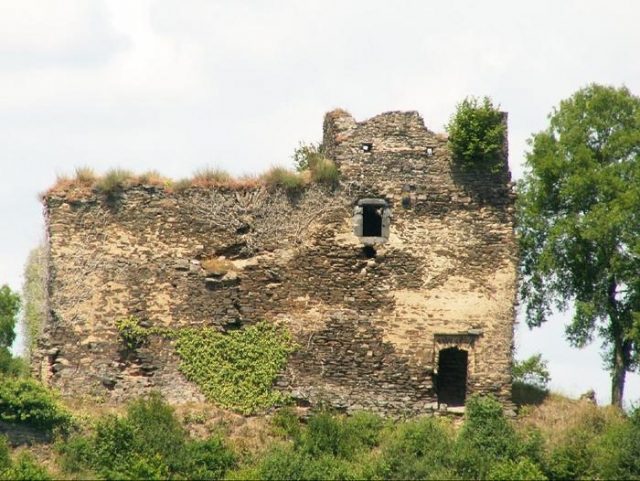
The ruin of Trutzeltz Castle, also known as Balduineltz, Baldeneltz, or Neueltz, is the ruin of a hilltop castle in the Elz valley, which separates the Maifeld from the Vordereifel, in the municipality of Wierschem near the town of Münstermaifeld.
Trutzeltz is located only about 230 meters as the crow flies north of Eltz Castle and 40 meters higher at 360 m above sea level on the rising mountain slope. The very small castle complex has a size of only about 30 x 25 meters. In the castle ruin, mainly the remains of the residential tower, still towering 10 meters high, as well as other foundation walls, are preserved.
The castle was built by the Archbishop Balduin of Trier as a siege castle against Eltz Castle during the Eltz Feud (1331–1336/1337). The Eltz Feud is to be seen in connection with Balduin's territorial policy. During his reign, he tried to expand the Trier sphere of influence along the Moselle. In doing so, he repeatedly encountered resistance, so a total of 21 knights, in the person of the Lords of Eltz, Waldeck, Schöneck, and Ehrenberg, formed a formal protective alliance. Balduin attempted a direct attack on Eltz, but it failed. In response, Balduin therefore presumably had the siege castle Trutzeltz, or Baldeneltz named after its builder, erected in 1331. The following year, he also had Rauschenburg built against the three castles allied with Eltz. That Baldeneltz was probably built in the shortest possible time to put pressure on the Lords of Eltz can be seen, among other things, from the building material used, predominantly small-sized rubble stone material from the vicinity of the siege castle itself. It was held together with a highly clayey mortar, which cannot permanently withstand the climate in Central Europe. This is not relevant for its use as a siege castle, but in this context, it is strange that the continued existence of the structure was contractually secured at the conclusion of peace.
Eltz Castle was bombarded by the siege castle with stone catapults (trebuchets), but ultimately could not be captured. In the course of the fighting, Balduin also used an early form of firearms (arrow guns), which finds at Eltz Castle suggest.
The Lords of Eltz and the other knights involved finally had to ask for peace in 1333. However, the feud was only settled in 1336 by a treaty (atonement). Only Johann von Eltz continued the dispute. He had already been in conflict with Balduin once before the Eltz Feud (Kempenich Feud) and was therefore probably not willing to make peace. But now Balduin showed his skill in bringing the opponent to his side: After Trutzeltz was virtually "legalized" by the peace treaty with the other knights and its continued existence secured, he enfeoffed it to Johann von Eltz in 1337 and made him hereditary burgrave.
On January 9, 1354, King Charles IV enfeoffed Archbishop Balduin of Trier with Eltz Castle for his loyal services against Emperor Henry VII. Quote: "Until now, the Lords of Eltz had been vassals of the Empire. On January 9, 1354, King Charles IV, out of goodwill towards Archbishop Balduin of Trier for his loyal services against Emperor Henry VII, enfeoffed him and his successors with the fortress of Eltz near Münstermaifeld, including all appurtenances, especially all goods that the commoners of Eltz held from him and the Empire as fiefs, so that the commoners of Eltz should henceforth receive and hold all these goods from Trier. At the same time, he released them from their oaths to the Empire after receiving these fiefs from Trier. Thus, the feudal relationship of the Eltz family to Trier was established."
Trutzeltz Castle soon lost its importance, was no longer maintained, and was already considered dilapidated in 1453. In a document dated to 1453, Trutzeltz Castle is described as "hitherto uninhabited and thereby devastated and perishable".
Take Mobile History with you
You are reading this text for free. Premium adds what matters on the road: descriptions read aloud, sites found through your camera, whole regions taken offline.
- Every description, including the ~17,700 Premium sites
- Audio guide: have descriptions read to you on location
- AR finder: see sites through your camera, with distance and bearing
- Unlimited saved sites
14 days free, then from €2.99 a month. Cancel anytime.
Source: Wikipedia · Licence: CC BY-SA 4.0 · Image: http://www.wehrbauten.de/thread.php?threadid=613
This description draws on the facts documented in the linked Wikipedia article; Wikipedia content is licensed under CC BY-SA 4.0. Wording and editing: Mobile History.
Location: 50.2071, 7.3363