The remains of the Castle can be visited
CastleThaur
Thaur Castle
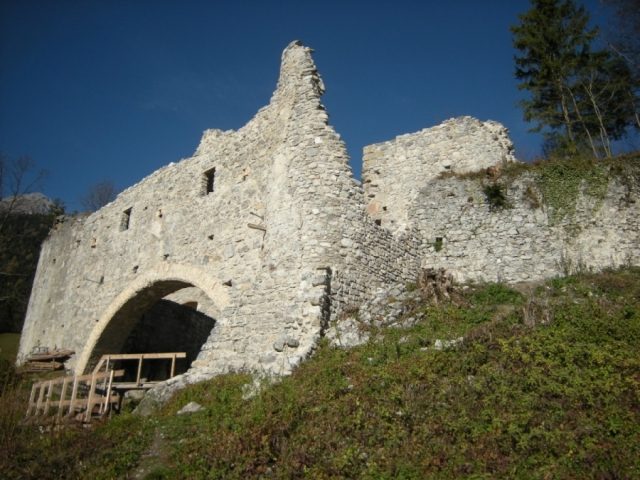
The exact time of the castle's construction is not known, but it is likely to have been around the end of the 12th century. The builders were probably the Counts of Andechs. The castle and saltworks of Thaur appear for the first time in documents in 1232. At that time, they were in the possession of Count Albert III of Tyrol.
After Albert's death, his son-in-law, Count Gebhard of Hirschberg, inherited the Inn Valley. In 1284, Count Meinhard II of Görz took over the Tyrolean possessions of the Hirschbergs. However, Thaur had probably come under his influence some years earlier. Heinrich von Thaur, who resided here, was married to an illegitimate daughter of Meinhard. Thaur remained princely until its decay and served as a court seat.
In 1305, the residential wing of the castle was renovated. From 1314, the Kämmerer of Thaur appear as an independent family. They served as burgraves of Thaur but no longer exercised the office of Kämmerer. From 1340, Thaur was frequently pledged by the territorial princes. Since the pledge lord Hans von Ems joined the noble alliance against Duke Frederick IV in 1423, the latter redeemed the pledge. Both Sigmund and Emperor Maximilian I used the castle as a hunting lodge. Both invested relatively high sums in its expansion, with great emphasis already placed on its comfort. Custodians were now usually appointed in Thaur, but they usually held their office for only a few years.
In 1511, the lordship was pledged to the city of Hall. Four years later, Margarete von Edelsheim, an illegitimate daughter of Emperor Maximilian, was the lady of the castle. Her second husband, Count Ludwig Helfrich zu Helfenstein, returned the pledge for nine years to the city of Hall. In 1525, a fire caused by rebellious peasants broke out in the castle, causing great damage. In 1537, the gun chamber burned out and had to be re-equipped by 1542. After the castle bridge had already collapsed in 1550, the kitchen vault collapsed in 1578. The entire curtain wall was also already dilapidated. Anna Katharina Gonzaga of Mantua was the last princely person who resided here, at least briefly, in 1592 and had some repairs carried out. Soon after, the castle was finally left to decay.
From 1616, the custodians no longer lived here. However, the prison remained in use until 1684. A series of earthquakes in the summer of 1670 largely reduced the castle to ruins. The lordship of Thaur was granted to frequently changing pledge lords in the 17th century. The last of them, Franz Andre Wenzel von Sternbach, received the lordship as a fief in 1744. In 1967, Dr. Bernhard von Liphart acquired the property with the ruin. It still belongs to him today. In the last quarter of the 20th century, the Thaurer Schützenkompanie initiated the securing of the remaining wall remnants. Since then, these have been maintained.
Take Mobile History with you
You are reading this text for free. Premium adds what matters on the road: descriptions read aloud, sites found through your camera, whole regions taken offline.
- Every description, including the ~17,700 Premium sites
- Audio guide: have descriptions read to you on location
- AR finder: see sites through your camera, with distance and bearing
- Unlimited saved sites
14 days free, then from €2.99 a month. Cancel anytime.
Source: Wikipedia · Licence: CC BY-SA 4.0 · Image: http://schloesserrundschau.de/tirol/schloesser/thaur.html
This description draws on the facts documented in the linked Wikipedia article; Wikipedia content is licensed under CC BY-SA 4.0. Wording and editing: Mobile History.
Location: 47.3012, 11.4659