To be privately owned
CastleHörbich-Tannberg
Tannberg Castle
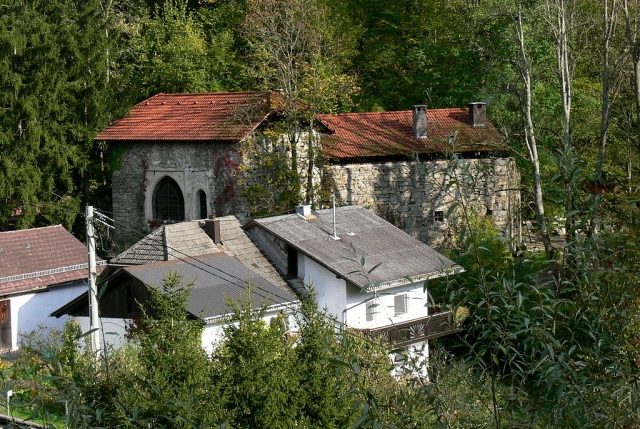
The Tannberg castle ruin is the ruin of a hilltop castle at 446 m above sea level in the eponymous district of the municipality of Hörbich in the Rohrbach district of Upper Austria on the right bank of the Kleine Mühl (Tannberg No. 6).
The ancestor of the family that gave the castle its name was probably Sigibot Tannberg, who was already a seneschal of the Prince-Bishopric of Passau at the end of the 11th century. The builder of the castle was probably the Passau ministerialis Walter I von Tannberg in 1188. When the Passau ministeriales rebelled against the bishop in 1240, Walter and Pilgrim von Tannberg were on the bishop's side. Pilgrim's wife Kunigunde was pledged Partenstein Castle from Passau. Berthold and Chunrad I († 1278, buried in the Marienkirche in Sarleinsbach) are also mentioned. The Tannberg coat of arms (a three-peaked mountain, with the middle peak rising as a point) goes back to Berthold. A Konrad von Tannberg was accused of wilfully instigating feuds together with his brother-in-law Kalhoch von Falkenstein and that both made the roads from their castles unsafe; therefore, in 1281, both were sentenced by the Dukes of Bavaria and their liege lord, Bishop Wichard von Pohlheim of Passau, to compensate for the damages they had caused, otherwise they would be declared dishonorable and lose their lives. In his feud against Duke Heinrich of Bavaria, Duke Albrecht I of Austria conquered Falkenstein and Tannberg castles in 1289. However, the Tannbergs remained at their feudal seat.
In 1327, Kunrad von Tannberg pledged to Duke Friedrich III of Austria to serve him with his castle. This last Tannberg living here († 1356) appointed his liege lord, the Bishop of Passau, as heir to the castle and the Tannberg lordship in 1354. His brother Gundacker von Tannberg had already come into feudal possession of Pürnstein in 1338. The Bishops of Passau then had Tannberg administered by caretakers (Alber von Jagenreuter, 1390; Heinrich der Mühlwanger, 1401) or pledged the castle when they were in financial difficulties, for example to Chunrad von Tannberg (1366–1374) or to Dankwart Herleinsperger (1430 and 1443). After redemption, Passau again appointed caretakers, such as Achaz Premser. The last caretaker at the castle was Wolf Herleinsperger in 1529.
In 1529, the administration of Tannberg, as well as that of the other possessions of the Passau diocese in the Mühlviertel, was moved to Marsbach. The castle, now functionless, was left to decay. In Georg Matthäus Vischer's engraving from 1674, Tannberg is already a ruin, with the two deep moats still visible, which protected the castle from the land side.
Tannberg Castle Ruin Today+
The former outbuildings of the castle, the so-called Pflegerstöckl (with Gothic window frames and high buttresses) and the lower tower, have been converted into a farmhouse. The side of the tower facing the Kleine Mühl is still assembled from ashlar stones. The buildings on the upper castle have, with the exception of the curtain wall, fallen into disrepair or been demolished. On the castle grounds, heaps of rubble next to a few wall sections still hint at the former upper castle. The once deep moats have been partially filled in.
The lower castle, including the Gothic gatehouse, has been converted into a residential building.
Take Mobile History with you
You are reading this text for free. Premium adds what matters on the road: descriptions read aloud, sites found through your camera, whole regions taken offline.
- Every description, including the ~17,700 Premium sites
- Audio guide: have descriptions read to you on location
- AR finder: see sites through your camera, with distance and bearing
- Unlimited saved sites
14 days free, then from €2.99 a month. Cancel anytime.
Source: Wikipedia · Licence: CC BY-SA 4.0 · Image: http://commons.wikimedia.org/wiki/File:Burg_Tannberg_1_Gesamt.jpg
This description draws on the facts documented in the linked Wikipedia article; Wikipedia content is licensed under CC BY-SA 4.0. Wording and editing: Mobile History.
Location: 48.5018, 13.9389