To be privately owned
Restaurant
CastleSankt Georgen am Längsee-Taggenbrunn
Taggenbrunn Castle
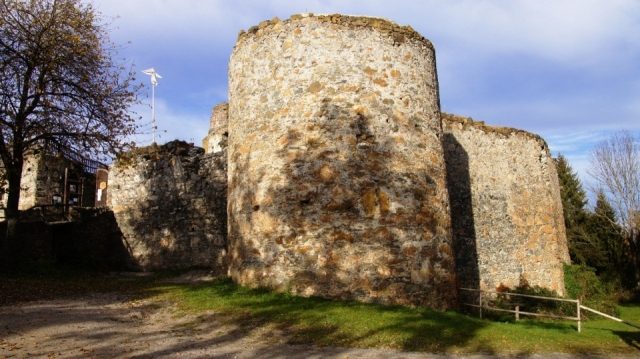
Taggenbrunn Castle is located in the municipality of Sankt Georgen am Längsee near Sankt Veit an der Glan in Carinthia, Austria.
Through a donation by Louis the German in 860, Salzburg came into possession of the area. Taggenbrunn was built on the remains of a Celtic-Roman ring fort settlement (6th century BC) in the first third of the 12th century by Tagenus von Pongau on behalf of the Archdiocese of Salzburg.
Taggenbrunn was first mentioned in a document in 1142 (Rahuinus de Takkenbrunnen), and explicitly named as a castle (Castrum Takenbrunne) in 1157. In the feud between Elector Philipp von Spanheim and Bishop Ulrich von Seckau over the Archdiocese of Salzburg, in which Duke Ulrich III of Carinthia also intervened in favor of his brother Philipp, the castle was destroyed in 1258 and rebuilt in 1268. In Ulrich von Heunburg's uprising against Duke Albrecht I and Duke Meinhard of Carinthia in 1292, the Carinthian ducal son Ludwig was captured and briefly imprisoned by Salzburg Archbishop Konrad IV in Taggenbrunn. In 1308, Otto von Liechtenstein-Murau was appointed governor of Carinthia, and Salzburg granted him Taggenbrunn as a residence: Carinthia was governed from Taggenbrunn.
In 1479, Archbishop Leonhard von Keutschach opened the fortress of Taggenbrunn to the Hungarians, with whom he was allied against Emperor Frederick III, after which it was destroyed by the imperial troops. Taggenbrunn remained in imperial possession until 1494. At this time, Frederick's son, Maximilian I, returned Taggenbrunn to the Archdiocese of Salzburg. The castle complex was expanded from 1497 to 1503 into a modern fortification under Archbishop Leonhard von Keutschach, who was also responsible as the most important builder for the final expansion of Hohensalzburg Fortress to its current size. In the immediate vicinity, a granary, the Pfleg- and Marhaus were also built, which are still preserved in their original form today. The granary, in particular, is architecturally interesting because it is one of the last of its size in the near and wider surroundings that is well preserved. The heavy roof slates still rest on the original roof truss.
Salzburg housekeepers and officials resided at Taggenbrunn until 1692. In 1796, Taggenbrunn was first referred to as a ruin. When Salzburg ceased to exist as a sovereign principality due to the Reichsdeputationshauptschluss in 1803, Taggenbrunn fell to Austria and became a state domain. In 1858, Antonie von Reyer bought Taggenbrunn, in 1883 Taggenbrunn came into the possession of the Paulitsch family and in the same year to the Kleinszig family. In 2011, the entrepreneur Alfred Riedl (Jacques Lemans watches) bought Taggenbrunn.
Gastronomy+
Since the mid-1980s, a catering establishment has been largely continuously operating in the still largely existing and well-preserved or restored part of the castle ruin with its associated castle courtyard. Among other things, medieval knight's dinners are also organized.
Take Mobile History with you
You are reading this text for free. Premium adds what matters on the road: descriptions read aloud, sites found through your camera, whole regions taken offline.
- Every description, including the ~17,700 Premium sites
- Audio guide: have descriptions read to you on location
- AR finder: see sites through your camera, with distance and bearing
- Unlimited saved sites
14 days free, then from €2.99 a month. Cancel anytime.
Source: Wikipedia · Licence: CC BY-SA 4.0 · Image: http://www.wehrbauten.at/ktn/kaernten.html
This description draws on the facts documented in the linked Wikipedia article; Wikipedia content is licensed under CC BY-SA 4.0. Wording and editing: Mobile History.
Location: 46.7716, 14.3902