The remains of the Castle can be visited
CastleLangenstein
Spielberg Castle
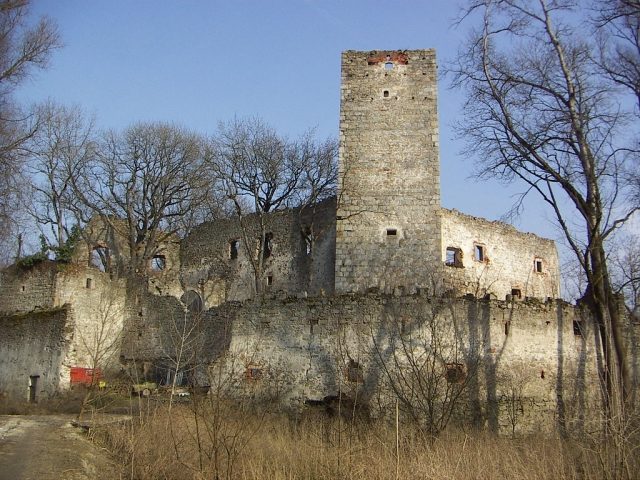
The castle ruin of Spielberg is located about one kilometer southwest of Langenstein in the Perg district in the Mühlviertel region of Upper Austria.
The ruin, now located in the municipality of Langenstein, was once an important moated castle on an island in the Danube. Today it lies in a floodplain landscape, the Schlossau, about 600 meters from the Danube bank.
Description+
The main castle has a 35-meter-high Romanesque crenellated tower and is surrounded by a 16-meter-high rampart wall. The castle complex covers an area of about 7500 m2. The former moated castle of Spielberg is still surrounded by the Danube during floods.
Antiquity
A Roman watchtower, part of the Danubian Limes, is said to have stood on the site of the castle in antiquity. Numerous Roman tombstones recovered from the castle ruins by a prisoner commando from Gusen I concentration camp in 1941/42 underscore the close historical connection to the Roman era. The Danube port of the former Roman Danube fleet (classis Lauriacensis) of the legionary camp Lauriacum was probably only about 1 kilometer from the castle rock. The strategic importance of the site is evident from its historical border location (northern border of the Roman Empire, eastern border of the Carolingian Empire) and its proximity to an ancient Danube crossing opposite the Enns estuary, which could be secured from here.
Middle Ages
The actual Spielberg Castle is said to have been built by the Lords of Perg and Machland and, after the death of Otto von Machland in 1148, passed to Otto III von Lengenbach (1130–1192), who from 1188 was the cathedral provost over the possessions of the Prince-Bishopric of Regensburg in the Duchy of Austria. In 1159, Spielberg was a fief of the Prince-Bishopric of Passau. The discovery of coins from the Archdiocese of Cologne from 1156 and 1167 underscores the early importance of the fortress, then located on the border between the Duchy of Bavaria and the newly founded Babenberg Duchy of Austria.
In the princely urbars of the Otakars (1197–1230), possessions of the Spielberg lordship between Abwinden (municipality of Luftenberg) and Stein (today Langenstein) are mentioned. As late as 1230, Otto V von Lengenbach (1195–1236), as cathedral provost of Regensburg, held Spielberg Castle as a Passau fief. In 1236, Spielberg passed to Frederick II of Babenberg, the Warlike, and thus to Austria, after Otto V von Lengenbach died in a dispute with the duke over the unlawful appropriation of possessions of Garsten Abbey in the Riedmark. In 1259, a Dietrich von Spielberg was mentioned in a document. Eberhard von Spielberg then sold the castle and town of Enns to King Rudolf I of Habsburg between 1273 and 1291.
Spielberg was subsequently frequently granted as a princely fief or as a pledged lordship. From 1314 to 1324, the princely castellan Hagen was named. In 1329, Spielberg came as a life annuity to Eberhard von Wallsee and again as a pledged lordship to the castellans Hagen. In 1348, they confirmed an exchange between the castle priest Ott and St. Florian Abbey.
Around 1353, Duke Albrecht II (the Lame) pledged Spielberg to Erhart Hagen for a loan of 600 pounds and allowed him an annual subsidy of 50 pounds from the toll at Stein (today Langenstein) for the maintenance of the fortifications.
On April 29, 1365, Spielberg was handed over by Duke Rudolf IV, the Founder, to St. Florian Abbey as an eternal castellan for wartime, in exchange for the relinquishment of old rights in the city of Enns, with the condition that the fortress be kept open at all times to the captain above the Enns. Duke Albrecht III and Duke Leopold III also confirmed St. Florian's rights to Spielberg, but reserved the right to redeem the castle.
Through St. Florian Abbey, Spielberg passed around 1390 for a few years as a pledge to Hans (Johann I) von Liechtenstein. In 1397, Duke Albrecht IV granted half of Spielberg to his captain above the Enns, Reinprecht von Wallsee, as a life annuity. In 1455, King Ladislaus Postumus enfeoffed the Ruckendorfers with Spielberg, who already resold Spielberg in 1475. From the time of the Ruckendorfers, a Spielberg Banntaiding is also preserved, which primarily regulated the rights and duties of the subjects in Langenstein and Au an der Donau. In 1484, Emperor Frederick III enfeoffed the then governor of Upper Austria, Bernhard von Scherffenberg, with the fortress of Spielberg as free property, in gratitude for his services in the fight against King Matthias Corvinus of Hungary.
Modern Era
The castle, somewhat dilapidated at the time due to frequent changes of ownership, was reinforced and expanded by the Scherffenbergers, and the Spielberg lordship was extended by the purchase of the Lorch office in 1597. As late as 1594, Spielberg was counted among the places of refuge and main defensive castles of Upper Austria in times of war.
From around 1600, a Spielberg Banntaiding of the Scherffenbergers is handed down, which was extended in 1650. Also handed down are a fishing regulation for the Au an der Donau estate from 1608 and a separate urbar from 1610.
In 1619, a toll station was established on the Danube at Spielberg Castle. The Spielberg lordship also asserted the right of Grund-Ur and declared ships forfeited that were shipwrecked by the rapids north of the castle and could not buy themselves free.
In the turmoil of the Upper Austrian Peasant Wars, a peasant army of 700 men under Christoph Zeller reached Spielberg on May 29, 1626, demanding the surrender of weapons and provisions. Spielberg Castle was last used as an important military base in the 17th century in the wars against the Swedes and against the Bavarians.
The later governor of Upper Austria, David Ungnad von Weissenwolf, acquired the castle in 1671. The execution of a Spielberg subject from Langenstein by fire and sword in 1692 by Helmhart Christoph von Weissenwolff led to considerable disputes between the holders of the respective regional courts at the beginning of the 18th century due to the border location of the Spielberg lordship between Traunviertel and Machlandviertel. Spielberg Castle was left to decay in the 18th century.
Up to the Present
On September 6, 1936, the Spielberg ruin was the scene of a regional knight's festival with a Riedmark celebration organized by illegal National Socialists. Spielberg Castle also occupies a prominent place in the Blood and Soil novel "Die Beichte des Ambros Hannsen" by Eduard Munninger, published in Germany in 1937, about the peasant uprising under Martin Aichinger.
In 1941 and 1942, extensive archaeological excavations were carried out by prisoners from the nearby Gusen I concentration camp.
The Spielberg ruin was inherited in 1952, along with Luftenberg, by Henriette von Thurn und Taxis (from the House of Weissenwolff) to Maria Immaculata Mensdorff-Pouilly (from the Thurn und Taxis family) and has been owned by her daughter Marie Antoinette Krassay, along with Luftenberg, since 1980.
Since the regulation of the Danube in the mid-19th century, the Spielberg ruin, which traditionally belonged to the Enns locality of Enghagen, lies north of the Danube. On January 1, 1997, the Spielberg ruin and its surrounding area, now north of the Danube, were detached from the municipality of Enns and assigned to the municipality of Langenstein and thus to the Mühlviertel.
In the spring of 2013, the "Friends of Spielberg Castle Ruin" association was founded, which has made it its mission to stop the decay of the object.
Take Mobile History with you
You are reading this text for free. Premium adds what matters on the road: descriptions read aloud, sites found through your camera, whole regions taken offline.
- Every description, including the ~17,700 Premium sites
- Audio guide: have descriptions read to you on location
- AR finder: see sites through your camera, with distance and bearing
- Unlimited saved sites
14 days free, then from €2.99 a month. Cancel anytime.
Source: Wikipedia · Licence: CC BY-SA 4.0 · Image: http://commons.wikimedia.org/wiki/File:Ruins_of_Spielberg_Castle_at_Langenstein_West.JPG
This description draws on the facts documented in the linked Wikipedia article; Wikipedia content is licensed under CC BY-SA 4.0. Wording and editing: Mobile History.
Location: 48.2444, 14.4703