The remains of the Castle can be visited
CastleSchwanberg
Spangstein Castle
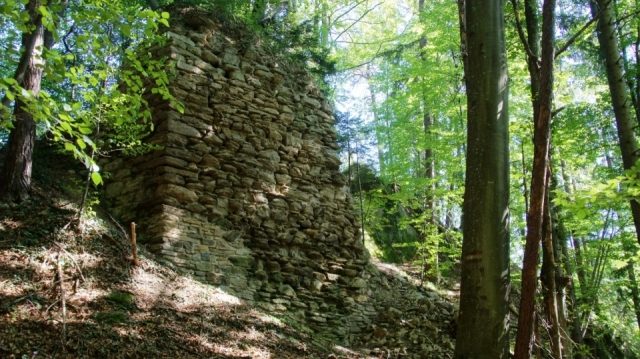
The castle ruin Spangstein, also known as Ahnherrnschloss, is located in the Stullneggraben, about 4.8 kilometers northwest of Schwanberg in the district of Deutschlandsberg in Austria.
Of the once mighty castle, only a wall remnant remains, which is interpreted as a gate tower, but also as a keep; the remaining buildings fell into disrepair or were destroyed by treasure hunters. In 2009, the "Komitee Altburg" from Schwanberg, which deals with the excavation of the remains of the old Schwanberg castle on the Tanzboden, carried out a first emergency renovation of the still existing remains of the complex.
Spangstein Castle above the Stullneggraben was probably built around the middle of the 13th century by one of the Pettauer's ministeriales, Erchenger von Spangstein, who is first mentioned in 1255. The Spangstein family also took over Schwanberg Castle and lordship in 1501. The religious disputes of the 16th century led to the Habsburgs under Archduke Karl of Inner Austria reclaiming the lordship of Schwanberg and selling it to the Galler family in 1576. However, they also proved to be representatives of the Protestant side, which led to repeated conflicts with the Catholic ruling house and to destruction (1600: the Protestant school, cemetery, and chapel). In 1602, an earthquake caused severe damage in the area. The reason why Spangstein ultimately became a ruin is not verifiable. The last Spangsteiner, Georg von Spangstein, died in Nuremberg in 1651. After several changes of ownership and border feuds between the lordships of Schwanberg and Deutschlandsberg, the castle ruin with the remaining Spangstein estates in Styria came to the related Counts of Trautmannsdorf in 1685. After that, it was no longer used and fell into ruin.
The castle is associated by the population with a cruel legend in which a daughter of the lord of the castle, who refused to be married against her will, was killed by her father. The complex belonged to a series of castles and fortified places in the Schwanberg area, which had to guard the passes over the Koralm located there.
Location+
The castle was located on a rock ridge that juts into the valley of the Stullneggbach from the west and is surrounded by rockfalls and steep slopes on all sides except the western one. To the west, it is delimited from the terrain by a ditch. The stone wall still visible east of this ditch is approx. 1.5 m thick and is dated to the 13th century due to its building style. This also corresponds to documents and finds. This wall is considered part of a gate tower, not the keep.
Wall remains south of the gate tower are interpreted as remnants of a curtain wall. According to descriptions from the early 20th century, a round tower might have risen just above the eastern end of the rock spur.
Take Mobile History with you
You are reading this text for free. Premium adds what matters on the road: descriptions read aloud, sites found through your camera, whole regions taken offline.
- Every description, including the ~17,700 Premium sites
- Audio guide: have descriptions read to you on location
- AR finder: see sites through your camera, with distance and bearing
- Unlimited saved sites
14 days free, then from €2.99 a month. Cancel anytime.
Source: Wikipedia · Licence: CC BY-SA 4.0 · Image: http://www.wehrbauten.at
This description draws on the facts documented in the linked Wikipedia article; Wikipedia content is licensed under CC BY-SA 4.0. Wording and editing: Mobile History.
Location: 46.7943, 15.1705