The remains of the Castle can be visited
CastleHüttenberg-Sankt Martin am Silberberg
Silberberg Castle
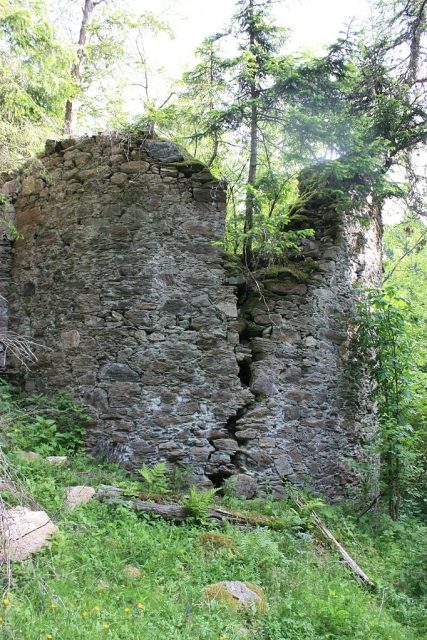
The castle ruin Silberberg stands on a rocky, wooded hilltop three kilometers north of St. Martin am Silberberg, a village in the municipality of Hüttenberg (Carinthia).
The castle stood in an area where prehistoric and Roman finds were made, and where silver and iron ore had been mined early on. It originated from a valley barrier facing north. In 1214, the brothers Leonhard, Hermann, and Heinrich von Silberberg were mentioned in a document. The family, which derived from the Karlsbergers, owned the complex until its extinction in 1756. In 1280, Heinrich von Silberberg, Vogt of the Göss monastery in Styria, was involved in a feud with the monastery. He was accused of robbery by the Göss abbess before the Duke of Carinthia and sentenced to compensate for the damage and relinquish his Vogt rights. Shortly thereafter, a second feud occurred between Heinrich, who was in the service of the Duke of Carinthia, and the Salzburg church, concerning a dispute over Salzburg properties in Lungau. In 1309, Duke Otto of Carinthia enfeoffed Ulrich von Silberberg with Reinegg Castle near Brückl. Later, the Silberbergers also served Salzburg. Jörg der Silberberger was a Salzburg administrator in Althofen and Reinprecht der Silberberger was a Salzburg captain in Friesach. In the mid-16th century, the Silberbergers became Protestant and desecrated the castle chapel dedicated to Saint Pancras. When the family died out in 1756, the castle, which had by then been expanded into a palace, was taken over by the iron industrialist Pfeilheim, but soon fell into disrepair. In 1928, the complex came into the possession of Johann Nepomuk Dickmann, and later belonged to the Knappitsch family.
Architectural Description+
The ruin is located north of Hüttenberg, not far from the Styrian border, halfway up the slope at an altitude of about 1138 m above sea level. The extensive, multi-part complex was built in the 16th century over the remains of the medieval castle. Valvasor depicted an intact castle in 1688 with a Romanesque keep, two residential buildings arranged diagonally to each other, and a separate gate system. Of the standing masonry of the complex, which has been in decay since the mid-18th century, only a few remains from Romanesque and Gothic times are preserved and show heavy vegetation.
Take Mobile History with you
You are reading this text for free. Premium adds what matters on the road: descriptions read aloud, sites found through your camera, whole regions taken offline.
- Every description, including the ~17,700 Premium sites
- Audio guide: have descriptions read to you on location
- AR finder: see sites through your camera, with distance and bearing
- Unlimited saved sites
14 days free, then from €2.99 a month. Cancel anytime.
Source: Wikipedia · Licence: CC BY-SA 4.0 · Image: http://commons.wikimedia.org/wiki/File:H%C3%BCttenberg_-_Ruine_Silberberg1.jpg
This description draws on the facts documented in the linked Wikipedia article; Wikipedia content is licensed under CC BY-SA 4.0. Wording and editing: Mobile History.
Location: 47.0057, 14.5310