The remains of the Castle can be visited
CastleHardheim-Schweinberg
Schweinberg Castle
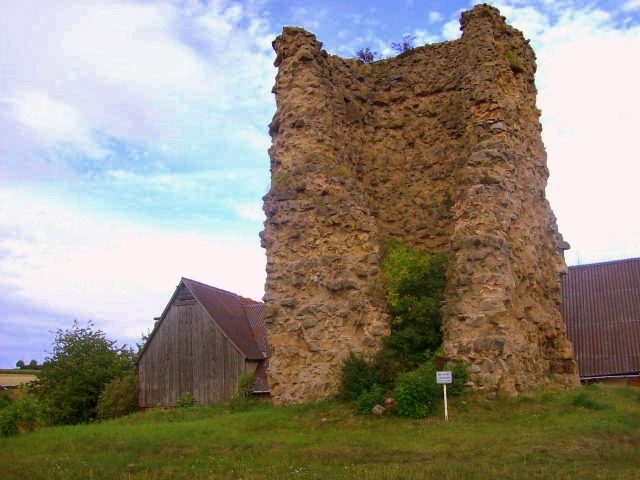
Schweinberg Castle is the ruin of a medieval spur castle in the Schweinberg district of the municipality of Hardheim in the Neckar-Odenwald district in Baden-Württemberg. The castle is located on the eastern edge of the Odenwald at an altitude of 345 meters on a relatively low mountain spur, built of Muschelkalk, just under 30 meters east above the village of the same name. In the Middle Ages, it controlled a road running from Würzburg via Tauberbischofsheim to the Lower Main.
The first documentary mention of a noble family "de Swenenburg" dates back to 1098. The castle was probably built in the late 11th or early 12th century, but the actual date of construction is disputed. In 1127, a Wolfram de Sueneburc is mentioned as a witness in a Mainz document, and in 1157 the name Suinenburch appears. The last Schweinberger, Kraft II, was in the retinue of the Staufer Emperor Frederick Barbarossa during his Italian campaign in 1167; he died after his return the following year, probably from the consequences of a malaria epidemic. The castle, which was probably expanded during this period, fell to Kraft's brother-in-law, Konrad von Boxberg. The Boxbergers subsequently ceded Schweinberg to the Knights Hospitaller in Wölchingen. Other parts of the Schweinberg lordship went to the noblemen of Dürn and the Counts of Wertheim.
In 1287, the Bishop of Würzburg, Berthold II von Sternberg, exchanged Schweinberg Castle with the Knights Hospitaller for Boxberg Castle, which had previously been a fief of the prince-bishopric. Konrad Rupert von Boxberg received Schweinberg Castle and lordship from the bishop, which was thereafter associated with the office and dignity of the ducal hereditary chamberlain. In 1299, Boxberger transferred the castle and its associated possessions to the Counts of Wertheim, who were related to him by marriage, and who also acquired the office of hereditary chamberlain in 1313. The counts tried to assert their claim to territorial and judicial rule in their dominion by establishing offices as administrative units. The new Schweinberg office included, in addition to Schweinberg Castle and village, several other villages and hamlets. The prince-bishops, however, continued to regard Schweinberg as a Würzburg fief.
In the course of inheritance disputes with Michael I of Wertheim, the castle was conquered and plundered by the Prince-Bishopric of Würzburg in 1437. However, the castle was rebuilt in 1473 and remained the official seat of a Wertheim ministerialis. After the extinction of the Counts of Wertheim, the hereditary chamberlain's office and the castle fell to the father of Michael III's widow in 1556, and after his death in 1574 to Baron von Crichingen. Prince-Bishop Julius Echter, after a long feud with the Wertheim heirs, enforced the reversion of the Schweinberg fief in 1612 - in court and by force of arms. However, the dispute could only be settled de facto; de jure it lasted until the end of the Old Empire in 1803. During the Thirty Years' War, the castle was damaged, soon described as dilapidated due to neglected maintenance work, and served as a quarry until the second half of the 19th century. The keep was restored in 1974.
Layout+
Of the formerly stately castle complex, the approximately 15-meter-high stump of the square keep, which rises on the eastern edge of the core castle above the largely filled neck ditch, is particularly noteworthy. The tower is largely stripped of its outer facing of ashlar blocks, exposing the infill masonry built in herringbone bond. Furthermore, the substructure of an artillery rondel from the late 15th century expansion and minor remains of the curtain wall are preserved.
The Baden State Museum houses an elaborately ornamented round-arched double window, which probably comes from the completely vanished palas of the original complex. It was found walled up in 1894 in the pigsty of the neighboring farm (site of the former outer bailey) and brought to Karlsruhe together with a capital. Further Romanesque architectural elements (wall columns, capitals, friezes) are located in the Grafschaftsmuseum in Wertheim and the Erfatal-Museum in Hardheim.
Take Mobile History with you
You are reading this text for free. Premium adds what matters on the road: descriptions read aloud, sites found through your camera, whole regions taken offline.
- Every description, including the ~17,700 Premium sites
- Audio guide: have descriptions read to you on location
- AR finder: see sites through your camera, with distance and bearing
- Unlimited saved sites
14 days free, then from €2.99 a month. Cancel anytime.
Source: Wikipedia · Licence: CC BY-SA 4.0 · Image: http://www.wehrbauten.de/thread.php?threadid=1629
This description draws on the facts documented in the linked Wikipedia article; Wikipedia content is licensed under CC BY-SA 4.0. Wording and editing: Mobile History.
Location: 49.6208, 9.5207