The remains of the Castle can be visited
CastleSchraplau
Schraplau Castle
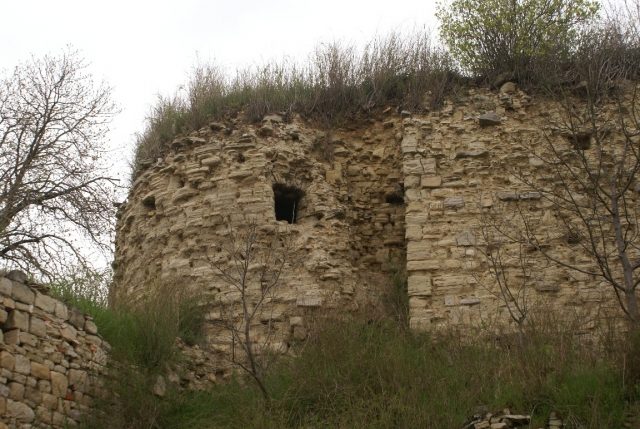
Schraplau Castle is the ruin of a hilltop castle in Schraplau in the Saalekreis district of Saxony-Anhalt. The ruin is barely accessible and little known. Only a few visible remains of the castle complex have been preserved.
Schraplau was already mentioned as "Scrabenlebaburg" in the Hersfeld Tithe Register (880–899). In 979, it appears as a fortified settlement under the name "Scroppenlevaburch". During this time, the Altenburg, a spacious castle complex, must have already existed. A high earthen rampart with a dry-stone wall and a moat are preserved from this complex. Further moats indicate an even older complex. Excavations revealed that the Altenburg was built as a large folk castle in the 9th to 10th centuries by the Slavs, when the Slavs settled west of the Saale in the fight against the Frankish Empire or as its allies. The remains of two temporally offset dry-stone walls were discovered, indicating destruction and reconstruction during its use.
In the 10th/11th century, the castle was owned by the imperial immediate Lords of Schraplau. The noble lords were in all probability related to the noble lords of Querfurt. In written traditions, a Thimo von Schraplau, as the ancestor, and an Egeloff von Schraplau appear. With Egeloff's death in 1196, the lineage died out. The castle of these Lords of Schraplau would no longer have encompassed the entire territory of the folk castle, but would have been a relatively small ministerial castle at the site of the later castle of the archbishops.
Around 1200, the Archdiocese of Magdeburg was the feudal lord. It built the Romanesque castle in the western part of the Altenburg, which still exists as a ruin today. The Archdiocese granted the fief to the Burgraves of Magdeburg from the Querfurt noble family. These appointed bailiffs to administer the lordship. In 1242, a knight Rudolf von Schrapelo is documented as a vassal of the Burgrave. Since 1267, Burchard I von Schraplau from a collateral line of the noble Lords of Querfurt resided in the castle. Burchard II von Schraplau "the Lapp" also called himself "burchgravius in scraplowe".
The close connection of the Schraplau counts to the Querfurt noble lords and to the archbishopric led to a significant expansion of the family's dominion in the 13th century. They were able to acquire the lordship of Nebra, estates near Röblingen am See, valley estates in Halle, and partial ownership in the lordship of Querfurt. Burchard III von Schraplau even became Archbishop of Magdeburg in 1307. As a contentious church leader, he tried to expand the power base of the archbishopric and regain lost rights. In a feud against the cities of Halle and Magdeburg, which had united against him, he was captured and slain in 1325.
Burchard III von Schraplau had become heavily indebted due to his feuds. His heirs therefore had to sell the lordship of Schraplau to the Counts of Mansfeld in 1335. The Lords of Schraplau retreated to their fief in Wettin.
In the 14th and 15th centuries, the castle was owned by various lines of the Counts of Mansfeld. In 1484, Ernst and Albrecht von Mansfeld repaired the medieval castle. In a division of inheritance in 1501, the lordship of Schraplau was divided into two administrative districts. Count Gebhard von Mansfeld-Mittelort received the upper district with the castle.
In the Schmalkaldic War, imperial soldiers occupied and devastated the castle in 1547. Under Count Christoph I von Mansfeld-Mittelort (1520–91), a castle-like new building was erected in the residence between 1574 and 1591. As late as 1571, the castle had been described as "now quite desolate in itself".
After the extinction of the Schraplau line of Mansfeld, the lordship passed to the Counts of Mansfeld-Hinterort. In 1637, Count Johann Georg von Mansfeld-Vorderort moved his residence to the castle. In 1683, Countess Barbara Magdalene sold the upper district of Schraplau to the Lords of Hake. She was the last Mansfeld resident to move out of the castle.
In 1713, the cap was removed from the keep by the bailiff Sylvester Brachvogel. Although a Prussian occupation of 22 men is still recorded for 1730, the structural condition of the complex seems to have been poor. Use as an archive and court chamber is last documented for 1732. After that, the castle fell into disrepair more and more. In 1736, it was already being used as a quarry.
Today, the castle is located on the grounds of several private properties. Therefore, only a few outer walls of the former complex can be seen.
Take Mobile History with you
You are reading this text for free. Premium adds what matters on the road: descriptions read aloud, sites found through your camera, whole regions taken offline.
- Every description, including the ~17,700 Premium sites
- Audio guide: have descriptions read to you on location
- AR finder: see sites through your camera, with distance and bearing
- Unlimited saved sites
14 days free, then from €2.99 a month. Cancel anytime.
Source: Wikipedia · Licence: CC BY-SA 4.0 · Image: Roland Neubert, Halle (Saale)
This description draws on the facts documented in the linked Wikipedia article; Wikipedia content is licensed under CC BY-SA 4.0. Wording and editing: Mobile History.
Location: 51.4381, 11.6690