The remains of the Castle can be visited
CastleSchönburg
Schönburg Castle
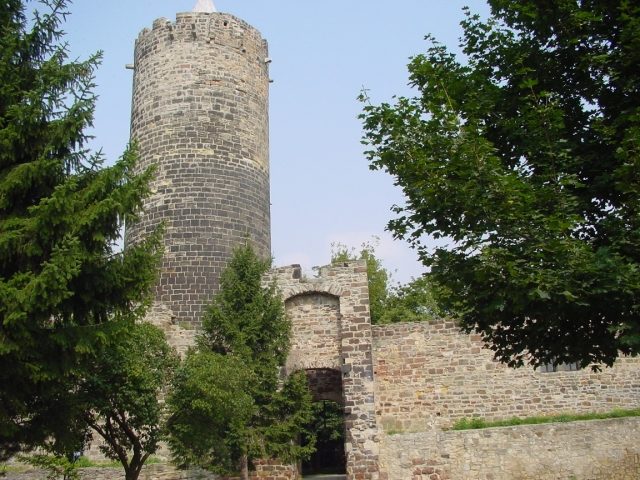
The Schönburg is a castle complex above the village of Schönburg near Naumburg (Saale) in the Burgenlandkreis in Saxony-Anhalt.
The hilltop castle rises on a sandstone rock about 40 meters above the Saale. The complex consists of the outer bailey and the core castle, each with a nearly rectangular floor plan. Between the two lies a zwinger, through which a chamber gate with Romanesque edge columns in the gate reveal leads. Particularly worth seeing is the 32-meter-high, climbable keep (3.60 m wall thickness, original entrance at 8 meters height) with its beautiful fireplace in the tower chamber and the guardroom at the top of the tower. The tower dates from around 1230. The last building still preserved in the core castle was called the courthouse - today it is known as the Knights' Hall, where weddings also take place. Large parts of the defensive walls around the outer and core castle are still present.
The older buildings and building parts of the Schönburg still found today were mainly erected in the 12th and 13th centuries. Since the complex was not adapted to military requirements after the spread of firearms or converted into a palace, a significant part from this construction period has been preserved. The building next to the gate to the outer bailey is the former forester's house and was built in 1539/40 in the Renaissance style. It is now used as a restaurant.
In 1137, the Schönburg is first mentioned in a document. According to legend, it was already founded by Louis the Springer. In the 12th century, the owners of the castle were the noble families of Schönburg and Schönberg. Since 1174, episcopal-Naumburg ministeriales with the name Schönburg have also been mentioned.
From about the 13th century until the Reformation, the castle was in the direct and allodial possession of the Bishops of Naumburg/Zeitz and also served them as a summer residence. In the Saxon Fratricidal War, Apel von Vitzthum, in the service of Landgrave Wilhelm III, conquered the castle, during which it burned down.
With the Reformation, the bishopric was dissolved and the castle became the property of the Electors. An official administered it. In 1570, the castle was leased by the Electors - initially again to the Cathedral Chapter of Naumburg. Around 1650, the forester's house was established in the Renaissance building of the outer bailey, where it remained for several centuries. The unused buildings began to decay. In 1668, the official estates belonging to the castle were sold to the farmers of Schönburg and Possenhain. These then repeatedly took the well-hewn stones from the buildings for their farms. From the 16th/17th century, several inventories and building accounts have been preserved, documenting the partly poor condition of the building fabric, but also repair work.
In 1815, the castle became the property of the Prussian state. The Romantic era brought more attention back to the Schönburg. Already around 1800, restorations were carried out on the castle, aimed at preserving the charming view of the castle in the Saale valley. Likewise, the keep was repaired in 1825 to be used as a viewpoint.
On July 25, 1860, the young Friedrich Nietzsche, with his friends Wilhelm Pinder and Gustav Krug, founded the artistic-literary association "Germania" in the castle ruins, where literature, philosophy, music, and language were discussed quarterly. The association existed until 1863.
Throughout the entire 19th century, repair work was carried out on the ring walls to secure their existence. After major restoration work in 1884, a restaurant was opened in the core castle, which was moved to the outer bailey after 1927. In 1924, the city of Naumburg, together with the Naumburg Delegates' Convention, took over the castle from the Prussian state. The Convention now held its annual meetings here.
After the Second World War, the traditional cultural life in the village of Schönburg was resumed. The "Dorfensemble Schönburg" with choir, dance group, and brass band included the castle. In 1952, the first large singers' meeting took place at the Schönburg. This was followed by regular so-called Schönburg festivals to this day.
In 1991, an extensive reconstruction of the castle complex began, so that the castle was closed to visitors until 1994.
Take Mobile History with you
You are reading this text for free. Premium adds what matters on the road: descriptions read aloud, sites found through your camera, whole regions taken offline.
- Every description, including the ~17,700 Premium sites
- Audio guide: have descriptions read to you on location
- AR finder: see sites through your camera, with distance and bearing
- Unlimited saved sites
14 days free, then from €2.99 a month. Cancel anytime.
Source: Wikipedia · Licence: CC BY-SA 4.0 · Image: Roland Neubert, Halle (Saale)
This description draws on the facts documented in the linked Wikipedia article; Wikipedia content is licensed under CC BY-SA 4.0. Wording and editing: Mobile History.
Location: 51.1606, 11.8685