The remains of the Castle can be visited
CastleSchenkenzell
Schenkenburg Castle
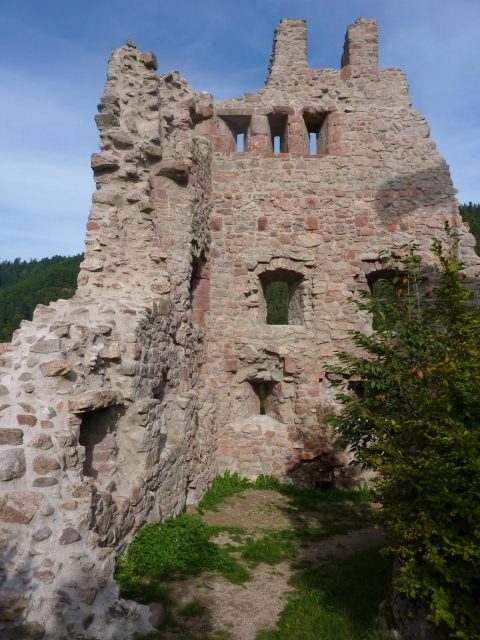
The Schenkenburg is the ruin of a hilltop castle at 391 m above sea level on an Umlaufberg (meander spur) in the upper Kinzig valley near Schenkenzell in the Rottweil district in Baden-Württemberg (Germany).
The Schenkenburg was built between 1220 and 1250, probably by the Schenken von Zell family, who also gave their name to the village. They were ministeriales of the Counts of Freiburg and managed their mining interests in the Wittichen area. Other castles owned by the Schenken, which also served to protect the mining district, were Wittichenstein Castle and the Schenkenzell Castle site.
The castle passed into the dominion of the Geroldsecker at the beginning of the 14th century; the reasons for this are unknown. It is possible that disputes arose between Counts Egen and Konrad II of Freiburg and Schenk Burkhard, with Burkhard also being captured, as documents report. Burkhard resided at Wittichenstein Castle until 1304, and the other Schenken von Schenkenzell are only documented at Schenkenzell Castle until 1299. From 1301, the castle was then in the possession of the Geroldsecker, and in 1309 it was listed among the Geroldsecker castles. In 1312, Wittichenstein Castle was also in Geroldsecker possession, as they also appear there as feudal lords. Thus, the entire dominion of the Schenken von Schenkenzell probably passed into the hands of the Geroldsecker.
In 1433, during the Geroldseck War of Succession, the castle was severely damaged; as late as 1436, construction was still underway at Schenkenzell and Romberg castles, as well as at Wittichen Monastery.
Gangolf, Lord of Geroldseck and Schenkenzell, fell into increasing economic difficulties and had to sell all his possessions in the Kinzig valley in 1498. The Counts of Fürstenberg appeared as buyers; they acquired a large part of the dominion for 1400 guilders, and two years later they also acquired Wittichenstein Castle for another 920 guilders. In 1513, the castle passed as an hereditary male fief to Junker Hans von Weitingen. However, his successors were guilty of disloyalty, so Count Wilhelm von Fürstenberg had to storm his own castle in 1534, destroying it in the process. It was not rebuilt, but has remained an impressive ruin to this day.
Description+
Parts of the palas, which has been preserved in part up to the 3rd floor, as well as the stump of the keep, are still standing.
Approaching from the north, one encounters the deep neck ditch via a narrow path. Parts of the outer bailey are still present, although some are very overgrown.
Take Mobile History with you
You are reading this text for free. Premium adds what matters on the road: descriptions read aloud, sites found through your camera, whole regions taken offline.
- Every description, including the ~17,700 Premium sites
- Audio guide: have descriptions read to you on location
- AR finder: see sites through your camera, with distance and bearing
- Unlimited saved sites
14 days free, then from €2.99 a month. Cancel anytime.
Source: Wikipedia · Licence: CC BY-SA 4.0 · Image: Joachim Schneeleopard
This description draws on the facts documented in the linked Wikipedia article; Wikipedia content is licensed under CC BY-SA 4.0. Wording and editing: Mobile History.
Location: 48.3017, 8.3658