The remains of the Castle can be visited
CastleSchärding
Schärding Castle
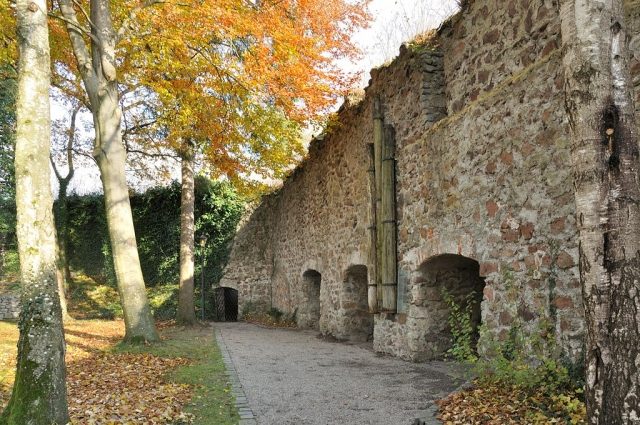
Schärding Castle presumably dates back to the 12th century and is located in what is now the city park of Schärding, above the Inn River.
The Counts of Formbach are believed to be the builders of the castle. The castle was first mentioned in 1150. Subsequently, through inheritance, the castle passed to the Andechs family in 1160 and to the Babenbergs in 1230. The Babenberg Duke Leopold VI the Glorious had the first stone castle erected on the granite rock above the Inn, replacing the wooden fortifications. The Dukes of Bavaria were the lords of the castle and city of Schärding from 1248 to 1357. In 1356, Duke Albrecht I of Bavaria-Straubing needed funds to raise an army against invasions from Bohemia. He therefore pledged the city of Schärding, including its territory and toll, to the Dukes of Austria for 20,000 gold guilders in 1357. In the Peace of Schärding concluded here on September 29, 1369, Tyrol went to Austria and Schärding to Bavaria, of which the castle and city were to remain a part until 1705. In the course of the expansion of the fortifications, from 1429 to 1436, among other things, the city moat, the outer castle gate, and the important gates of Schärding were built by Duke Ludwig the Bearded.
In early 1705, the city and castle of Schärding were captured and occupied by Austrian troops during the War of the Spanish Succession. After the Peace of Rastatt, Bavarian regiments re-entered the castle in early 1715. On June 18, 1724, a city fire was triggered in Schärding by cannon shots during the Corpus Christi procession. 32 houses and the castle burned down. Only the administrative buildings of the castle were repaired, the stately residences (the palas of the castle) remained a ruin. On November 9, 1775, a fire broke out in the castle due to arson, further damaging the already affected parts of the building. In the Peace of Teschen, Schärding returned to Austria in 1779. In 1809, during the Napoleonic Wars, the castle was finally destroyed and never rebuilt. The castle moats were filled with the rubble from the fire.
Present Day+
Of the once mighty castle, some sections of walls, the moat with the curtain wall, and the outer gate tower (now a local history museum) remain. The castle gate, built in 1430 and 1570, formerly served as the residence of the ducal castle warden and was only accessible via a bridge over the moat until 1809; it formed the outermost castle tower and once had four stories. The buildings located in the castle courtyard also partly belonged to the former castle (e.g., the music school is located in the former granary). The 26-meter-deep castle well was rediscovered and reconstructed in 2003. The castle grounds have been designed as a park since 1895. The city of Schärding is the owner of the grounds.
Take Mobile History with you
You are reading this text for free. Premium adds what matters on the road: descriptions read aloud, sites found through your camera, whole regions taken offline.
- Every description, including the ~17,700 Premium sites
- Audio guide: have descriptions read to you on location
- AR finder: see sites through your camera, with distance and bearing
- Unlimited saved sites
14 days free, then from €2.99 a month. Cancel anytime.
Source: Wikipedia · Licence: CC BY-SA 4.0 · Image: http://commons.wikimedia.org/wiki/File:Sch%C3%A4rding_Burgmauer_GstNr_83_3_Brunnenrohre.JPG?uselang=de
This description draws on the facts documented in the linked Wikipedia article; Wikipedia content is licensed under CC BY-SA 4.0. Wording and editing: Mobile History.
Location: 48.4567, 13.4290