The remains of the Castle can be visited
CastleNeckarsteinach
Schadeck Castle
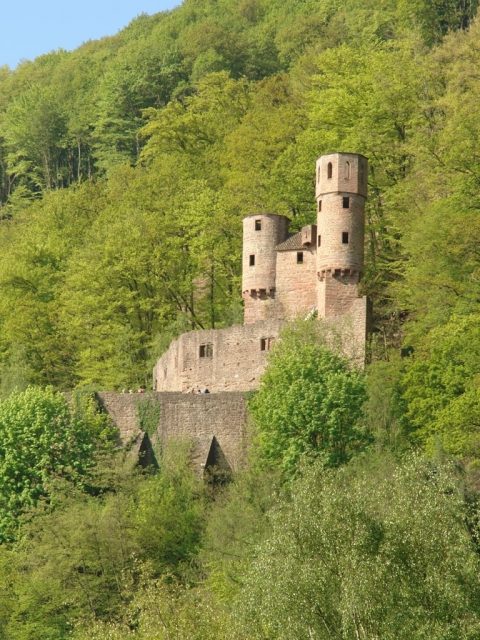
The castle ruin Schwalbennest, actually Schadeck, is the medieval ruin of a rock castle at 190 m above sea level near Neckarsteinach in the Bergstraße district. It is the youngest of the four Neckarsteinach castles Vorderburg, Mittelburg, Hinterburg, and Schwalbennest. Unlike the other three castles, the castle ruin Schwalbennest (Schadeck) is not located on the mountain spur, but downstream on a steeply sloping mountain massif.
The castle was probably built by the youngest son of Ulrich I von Steinach, Ulrich II, as the fourth and youngest of the four castles near Steinach. The builder had to have a large piece broken out of the rock face to obtain enough building space for the castle. The name of the castle, "Schadeck" (formerly: "Schadheck") means swallow's nest, and from this name derives the name of the noble line Landschad von Steinach, to distinguish it from the other lines of the Lords of Steinach that still existed at that time. After the extinction of the older line, the Landschad also came into possession of the Vorderburg, so that the small Schadeck was sold in 1335 by Bligger X and Dieter I Landschad von Steinach, half each, to the foundations in Worms and Mainz. In 1350, the Worms part seems to have violently passed to Mainz. In 1395, the castle was pledged in fragmented shares to the descendants of the sons of Eberhard von Rosenberg, the Mainz Vogt zu Walldürn, who in turn partially ceded these shares to other minor nobles. In 1428, the entire castle was in the possession of the Archbishop of Mainz, Konrad, who pledged it to Dieter II Landschad von Steinach. The castle remained in the possession of the Landschad von Steinach and, since the episcopal pledge was no longer redeemed, passed into the allodial possession of the family, where the castle remained until the extinction of the Hanseatic main line of the Landschad with the death of Dieter VIII in 1625. Dieter VIII's daughter Eva Elisabeth, widow of Wolf Conrad Greck von Kochendorf, sold Schadeck with the remaining allodial possessions of the Landschad on May 6, 1657, to Wolf Heinrich Metternich zu Burscheid, who owned the fiefs over the village, Vorderburg and Mittelburg, and half of Hinterburg, which had been seized by Speyer and Worms after the extinction of the Landschad. After the extinction of the Burscheid line of the Metternich in 1753, not only the former feudal possessions, but also allodial possessions and thus the Schadeck, passed to the foundations of Speyer and Worms. After 1803, the territorial possessions of the foundations passed to the state of Hesse, in whose possession the castle remains to this day.
Layout+
The ascent to the castle was originally possible via a serpentine path and later via a neck ditch cut into the rock.
Instead of a keep, the castle has a two-winged shield wall, which points with its tip towards the rock massif. A battlement runs along the shield wall. During reconstruction work in the 15th century, the palas was moved into the protected but damp corner of the shield wall, and the battlement received a tower at each of its two ends. The octagonal top on the northern tower dates from the period of romanticization in the 19th century, similar to the Mittelburg.
One of the earlier palas buildings was located in the current courtyard, where the still visible window openings offer a magnificent view of Neckarsteinach, and inside the core castle, remains of residential buildings can still be seen.
Reception+
There are a multitude of romantically transfigured legends and reports about Neckarsteinach, the Landschad von Steinach, and the Schwalbennest. For example, the French poet Victor Hugo also conceived an event set at the Schwalbennest in 1838:
- "One of the four keeps has been turned into a farmhouse, the second into a summer house. The other two, completely dilapidated, destroyed or abandoned, particularly interested me and prompted me to return several times. One was called, and still is called today, Schwalbennest (Swallow's Nest) in the 12th century, because it rises as if it had been built by a giant swallow on a rock base against the wall of a large sandstone mountain. In the time of Rudolf of Habsburg, this was the seat of a terrible nobleman and robber knight, who was called Bligger the Scourge. The entire valley from Heilbronn to Heidelberg was the prey of this human-faced hawk. Like all of his kind, he was summoned before the Imperial Diet. Bligger did not go. The Emperor placed him under the imperial ban. Bligger merely laughed about it. The Rhenish League sent its best troops and its best commanders to besiege the Schwalbennest. After three sallies, the Scourge had slaughtered the besiegers. This Bligger was a warrior of enormous stature, who struck with the arm of a blacksmith. Finally, the Pope excommunicated him and all his followers. When Bligger heard one of the heralds of the Holy Roman Empire reading the bull of excommunication at the foot of his castle wall, he merely shrugged. When he awoke the next morning, he found his castle deserted, the gate and the sally port walled up. All his men-at-arms had left the cursed citadel under the cover of night and walled up the exits. One of them, who had hidden on a mountain rock from which he could observe the interior of the castle, saw Bligger the Scourge lower his head and slowly pace up and down his courtyard. He did not enter the keep for a moment, but walked alone back and forth until evening, letting the tiles resound under his iron heels. As the sun set behind the hills of Neckargemünd, the feared castellan fell lengthwise onto the pavement. He was dead. His son could only free the family from excommunication by taking the cross and bringing back the head of the Sultan from the Holy Land, which still adorns the coat of arms of a stone knight named Ulrich Landschad, who was Bligger's son and now lies on a tomb in the church of Steinach. This noble family is now extinct."
Mark Twain also describes in his book "A Tramp Abroad" a raft trip on the Neckar from Heilbronn to Heidelberg, during which he also passed Neckarsteinach:
- "The graceful towers and battlements of the two medieval castles »The Swallow's Nest« and »The Brothers« enhanced the romantic impression of the landscape around the river bend to our right."
Take Mobile History with you
You are reading this text for free. Premium adds what matters on the road: descriptions read aloud, sites found through your camera, whole regions taken offline.
- Every description, including the ~17,700 Premium sites
- Audio guide: have descriptions read to you on location
- AR finder: see sites through your camera, with distance and bearing
- Unlimited saved sites
14 days free, then from €2.99 a month. Cancel anytime.
Source: Wikipedia · Licence: CC BY-SA 4.0 · Image: Dr. Gebhard Gaukler
This description draws on the facts documented in the linked Wikipedia article; Wikipedia content is licensed under CC BY-SA 4.0. Wording and editing: Mobile History.
Location: 49.4070, 8.8245