The remains of the Castle can be visited
CastleSteinthaleben
Rothenburg Castle
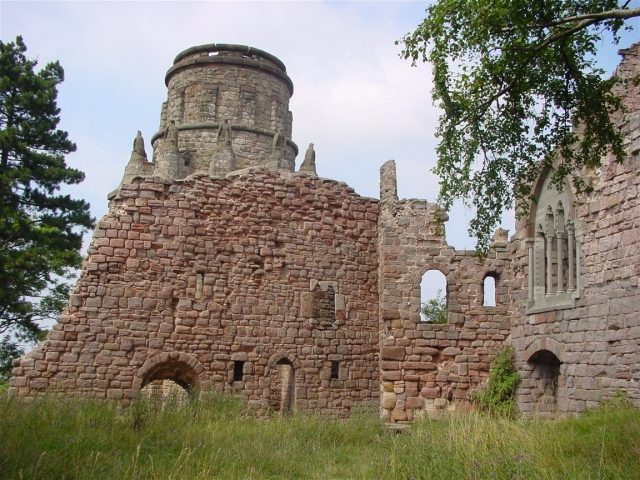
The Rothenburg is the ruin of a hilltop castle in the municipality of Steinthaleben in the Kyffhäuser district, Thuringia. It is located on a steep mountain spur on the northwestern edge of the Kyffhäuser mountains. The castle complex served to control the passing salt road, which led from Bad Frankenhausen over the Kyffhäuser to Kelbra. Parts of the palas, the castle chapel, and the keep have been preserved.
The building material for the castle complex was predominantly red sandstone. The Rothenburg probably owes its name to this. However, the name could also be derived from forest clearing.
The Rothenburg was first mentioned in a document in 1103 with the nobleman Christian von Rothenburg, one of the two murderers of Count Kuno von Beichlingen. From 1128 onwards, this Christian is increasingly found as a partisan of Emperor Lothar III, which must have been to his advantage. A son of Christian became the founder of the small county of Kirchberg in the Hainleite in 1155, while the main line of the Rothenburg counts died out as early as 1209.
The Counts of Beichlingen became the new lords of the castle. Under their rule, around 1300, the famous medieval minnesinger Christian von Luppin also resided at Rothenburg. Emperor Otto IV undertook a campaign to Thuringia in the summer of 1212, during the Staufer-Welf throne dispute, during which he conquered Dryburg near Langensalza and Rothenburg. The emperor used heavy siege equipment. He was only unable to conquer the nearby Runneburg.
The partially destroyed castle was rebuilt and modernized after the emperor's withdrawal; the palas and chapel probably date from this construction period. Until the end of the 16th century, the castle changed owners several times until it went to the Counts of Schwarzburg as a male fief.
In the 15th century, the castle was last restored and expanded. During this time, the enigmatic figure of the Püstrich von Sondershausen was discovered in the dilapidated castle chapel. The find came into the princely cabinet of curiosities and natural history of the Schwarzburgs in Sondershausen. After the death of the last count in 1576, the Rothenburg began to decay. Most recently, the robber Loth von Frankenhausen used the ruin as a hideout.
During the Romantic period, interest in the castle awoke, partly due to Heinrich Heine, who drew attention to the Kyffhäuser with his biting satire Deutschland ein Wintermärchen. After the erection of the Kyffhäuser Monument, a large excursion restaurant was built next to the Rothenburg at the end of the 19th century from the building material remaining from this monumental structure, replacing a restaurant that had existed since 1839. In 1906, the prominent Bismarck Tower was erected in the northern part of the castle by the Association of German Student Societies - Kyffhäuserverband, an umbrella organization of German student fraternities.
During the Third Reich, construction measures were carried out on the Rothenburg by the NS-Reichskriegerbund (1937-39), during which some archaeological and architectural-historical observations were made and a few finds could be recovered. The castle grounds and the guesthouse were later used by the SS as a recreation home, as was the NVA during the GDR era. After reunification, the area was used by the Bundeswehr for several more years. The guesthouse housed the officer and sergeant quarters for the Kyffhäuser barracks.
In the 1990s, further securing and renovation work was carried out, including the clearing of the completely overgrown viewing terrace below the Bismarck Tower. After the withdrawal of the Bundeswehr, the Rothenburg castle ruin has been in private ownership since 2010 and the area is increasingly decaying. It cannot be visited. A fence also interrupts the hiking trail that previously ran over the castle grounds.
Construction+
The castle complex consisted of the core castle and a section, now built over, with the completely demolished outer bailey located to the south. The core castle, oval in plan, was separated from the mountain by a rampart and ditch and covered by the round keep on the attack side of the castle. This tower, with almost 3 m thick walls, has a diameter of about 12 m and a remaining height of 12 m. East of the tower, the gate path led over a drawbridge to the former gate. It was integrated into the main building and led through the ground floor into the spacious castle courtyard. At 20 x 9.5 m, this house, known as the Count's House, was the main building of the castle. On the upper floor, which was also accessible from the courtyard via an external staircase, the delicate, richly decorated four-part windows indicate the castle's representative rooms. To the north follows the ruin of the former chapel. Excavations on the west side uncovered the largely demolished curtain wall and adjacent utility buildings and residential buildings. The northern part of the castle is overlaid by the Bismarck Monument, and there was also space for residential and utility buildings here.
Inn at the Castle+
In 1836, Karl Friedrich Wilhelm Beyer received a concession from the Schwarzburg government for an inn at Rothenburg. On August 1, 1836, it was opened in a small wooden shack. The excursion restaurant, considered original and inexpensive, soon became successful. Donkeys brought the necessary supplies from Kelbra up the mountain. Water was fetched from the Wasserkunst, a small mountain spring. However, Beyer only used the castle in summer. Transport on the Frankenhausen road was subject to tolls at that time, which were collected at the Rothenburg forester's house (now a residential building). At that time, Kelbra was in the Kingdom of Prussia, Rothenburg in the Principality of Schwarzburg-Rudolstadt. When the beer ran out, new orders were allegedly placed with the brewery in Kelbra using a three-meter-long speaking tube. Many of the associations of the time celebrated their festivals and held meetings here. For example, a singing festival with about 200 participants took place here.
In 1849, "revolutionaries" met at the inn at Rothenburg. Afterwards, attempts were made to denounce the innkeeper Friedrich Beyer to the prince as a participant. However, the prince stood by Beyer and did not withdraw his coveted concession. But when the prince died in 1867, the inn was awarded to Hermann Prinz from Bad Frankenhausen. However, he did not succeed in running the business successfully.
Take Mobile History with you
You are reading this text for free. Premium adds what matters on the road: descriptions read aloud, sites found through your camera, whole regions taken offline.
- Every description, including the ~17,700 Premium sites
- Audio guide: have descriptions read to you on location
- AR finder: see sites through your camera, with distance and bearing
- Unlimited saved sites
14 days free, then from €2.99 a month. Cancel anytime.
Source: Wikipedia · Licence: CC BY-SA 4.0 · Image: Roland Neubert, Halle (Saale)
This description draws on the facts documented in the linked Wikipedia article; Wikipedia content is licensed under CC BY-SA 4.0. Wording and editing: Mobile History.
Location: 51.4242, 11.0650