To be privately owned
CastleRosegg
Rosegg Castle
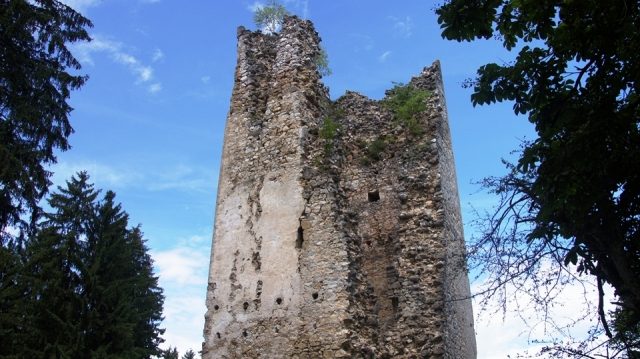
The castle ruin Rosegg, also called Altrosegg, is a high castle presumably built in the second half of the 12th or early 13th century and expanded until the early 19th century, after which it fell into ruin, located in the Rosental valley of Carinthia.
The Rosegg castle hill was probably the third location of the seat of the Lords of Ras, an influential Carinthian noble family in this region. They were vassals of the Styrians and sympathizers of the Carinthian dukes, and first resided in a castle at Gratschitzen on the northern slope of the Karawanken, of which only a few remains are preserved today, later at Ras Castle near Sankt Jakob im Rosental, which was first mentioned in a document in 1171 and abandoned between 1309 and 1317. At this time (1171), they already called themselves Lords of Rosegg (or Rasek); the castle in Rosegg itself was first mentioned in a document in 1239.
In the 12th and 13th centuries, the Ras family acquired important feudal estates, thereby establishing a significant dominion and regional court district. After the noble family died out in the male line in 1318, the castle came into the possession of foreign noble families, each of whom appointed local administrators. Until their extinction in 1363, the Rosegg dominion belonged to the Walsee-Graz family, then it passed to the Pettauers, who also owned the second large Rosental property around Hollenburg. After this noble family died out in the male line in 1438, the property was inherited through their female descendants. Hollenburg went to the Styrian Stubenbergers, Rosegg to the Counts of Schaunberg, who originated from Upper Austria.
For the year 1468, an intact state of the castle is documented. Repairs were carried out in 1632 and – after a fire – before 1688. In 1605, the brother of the Archbishop of Salzburg, Wolf Dietrich von Raitenau, owned the castle; in 1686, the Counts Orsini-Rosenberg acquired the property and maintained the castle. Even after the construction of Rosegg Castle in the valley north of the castle hill by Count Franz Xaver Wolfgang von Orsini-Rosenberg from 1772, which was intended to replace the castle as the seat of power, the castle was not allowed to fall into disrepair.
During the French Wars in 1801, a wall was built around the base of the hill using stones from the castle. When building material was needed for a new construction of the tower of the Rosegg parish church in 1806/07, Prince Orsini-Rosenberg allowed the villagers to use stones from the old castle, and after the village was damaged by the French in 1813, the castle's structure was further dismantled. Only the keep remained largely spared. In 1829, Peter Ritter von Bohr received Rosegg and had a wildlife park laid out starting in 1830. Already in 1833, the Rosegg dominion passed to Prince Johann von Liechtenstein. The ruin, the castle, and the wildlife park are still owned by his descendants today.
Of the formerly extensive castle complex, remnants of the Romanesque keep, which was unsuccessfully attempted to be blown up at the end of the 19th century due to its alleged dilapidation, as well as parts of the outer curtain wall, are still preserved on the north side.
Take Mobile History with you
You are reading this text for free. Premium adds what matters on the road: descriptions read aloud, sites found through your camera, whole regions taken offline.
- Every description, including the ~17,700 Premium sites
- Audio guide: have descriptions read to you on location
- AR finder: see sites through your camera, with distance and bearing
- Unlimited saved sites
14 days free, then from €2.99 a month. Cancel anytime.
Source: Wikipedia · Licence: CC BY-SA 4.0 · Image: http://www.wehrbauten.at/ktn/kaernten.html
This description draws on the facts documented in the linked Wikipedia article; Wikipedia content is licensed under CC BY-SA 4.0. Wording and editing: Mobile History.
Location: 46.5847, 14.0247