The remains of the Castle can be visited
CastleFränkisch-Crumbach
Rodenstein Castle
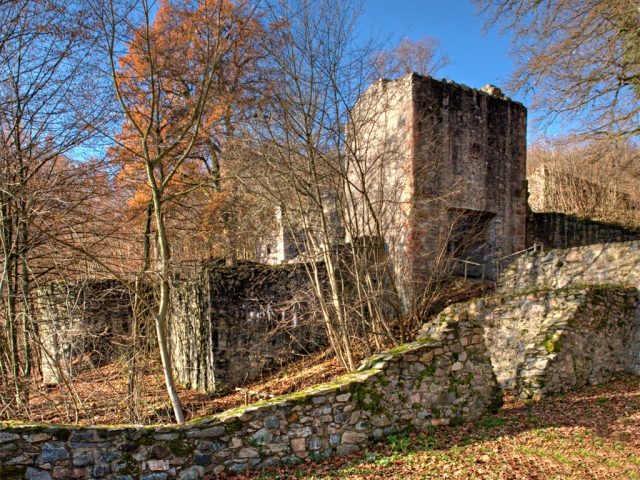
Rodenstein Castle is the ruin of a hillside castle in the Odenwald and belongs to the municipality of Fränkisch-Crumbach in the Odenwald district (South Hesse); it can be reached from there and the neighboring municipality of Reichelsheim.
The ruin is located at 322 m above sea level in a side valley of the Gersprenz valley, away from larger settlements, about 3.5 km west-southwest of Fränkisch-Crumbach and 2.7 km northwest of Reichelsheim. Its location as a hillside castle is rather unfavorable terrain. In addition to its name, its location also indicates a castle that was pushed into the cleared forest. Typical for such clearing castles is the farm below the castle, which had the few fields and meadows in the valley as usable land.
The castle is a fortified complex of the Lords of Crumbach and Rodenstein, whose ancestral seat was in Fränkisch-Crumbach. It was built around 1240 as a defiant castle against Reichenberg Castle, with the Lords of Crumbach and Rodenstein enjoying the full support of the Counts of Katzenelnbogen. In 1346, Erkenger, Lord of Rodenstein, sold half of his share in the house of Rodenstein to Count Wilhelm II of Katzenelnbogen. In 1433, Philipp I of Katzenelnbogen acquired further shares from Hermann and Konrad of Rodenstein. In 1436, Count Johann IV of Katzenelnbogen enfeoffed the noble Hans, Lord of Rodenstein and Lißberg, with half of Rodenstein Castle.
In 1479, with the extinction of the Katzenelnbogen, their possessions fell to the Landgraviate of Hesse under Heinrich III. The castle did not become a ruin due to warlike events. A sketch by Valentin Wagner from 1634 still shows it as a castle-like complex with intact buildings. After Adam von Rodenstein died of the plague with his entire family in 1635, the castle was no longer inhabited. From this time on, parts of the castle began to be demolished and the building material reused. In 1640 and 1646, when the last Rodensteiner, Georg Friedrich, embarked on a journey to France, it was still intact. A legal dispute developed between Georg Friedrich and his guardian over the demolition that had begun, during which Rodensteiner even appealed to Emperor Leopold. Attempts at restoration thereafter remained unsuccessful. After Georg Friedrich's death in 1671 and the extinction of the Rodensteiner male line, the castle was used as a quarry until the mid-19th century. In Fränkisch-Crumbach, the noble court of the Barons of Pretlack (today's town hall) was built from the stones.
Today, Rodenstein has belonged to the Barons of Gemmingen-Hornberg (Rohrbach & Höhr-Grenzhausen) for several generations.
Condition and Description 1634+
Wagner's drawing from 1634 gives a good impression of a densely built late medieval ganerbenburg (jointly inherited castle). The artist's position was probably on the current road to Laudenau. At the now wooded spot, there is an information board with Wagner's view of the castle. On the right side of the picture, the well-preserved mill tower can be seen. It has a half-timbered upper floor with a steeply hipped roof. The chimney on it suggests that the upper room inside may have served as the tower watchman's dwelling.
The newer gate in the northwest of the castle, which replaced the mill tower as a gate system, can be seen to the left of the mill tower. The access was via a covered wooden bridge in front of it. Behind the gate rises a massive residential building compared to the overall complex. This is the younger palas from the 14th century (stone floor), in whose upper floor the lord's dwelling was located. At the height of this floor, there is a half-timbered oriel on two supporting timbers. Numerous dormer windows, a chimney, and a weather vane can be seen on the roof. A faintly indicated wavy line below the windows on the upper floor could suggest a round arch frieze. The building adjoining the residential building on the left with its eaves side is likely to be identified as the kitchen building, which in turn adjoins the older palas on the left. Two oriels projecting far into the Zwinger (outer bailey) area could have been used as latrine oriels.
A smaller building, visible in front of the large residential complex of the main castle and projecting into the Zwinger, cannot be identified. On the left side of the picture, part of the Zwinger wall can be seen, and on the far left, the northeastern flanking tower of the Zwinger fortification. The castle is additionally surrounded by a palisade fence, possibly an indication of agriculture practiced here. A division deed from 1624 also mentions vineyards at the castle. In front of the castle, a large roof of an outbuilding is still visible, possibly a barn.
Current Castle Ruin+
The castle is a typical hillside castle. The core complex was a rectangular building with rounded corners, with the southwest side reinforced like a shield wall towards the hillside. In the northern corner of the main castle is the former first palas. A second was added in the 14th century. The complex had no keep.
The inner castle complex was surrounded by a ring wall with several towers. A bricked-up gate can be seen on the outside of the mill tower. Apparently, the entrance was only later moved from the mountain side to the valley side, where the current gate with access is located. In the 16th century, further parts of the ring wall and a Zwinger (outer bailey) were added in the south of the complex.
In the 20th century, the ruin was restoratively secured and brought to its current state.
Below the castle is the Rodenstein manor, an older half-timbered building that was rebuilt after a fire in 1910. The stone with the year 1593 above the portal originally came from the castle. The manor houses a restaurant.
Legends+
The legend of the Rodensteiner, also known as the Schnellertsgeist, is associated with Rodenstein Castle and the noble family, as well as the neighboring Schnellerts Castle. He was cursed to rise from his grave and warn people when war threatened to break out. The poets Joseph Victor von Scheffel and Werner Bergengruen immortalized the ruin in literary works.
About 750 m southwest of Rodenstein Castle is the Wildweibchenstein, a rock formation to which several legends are also attached.
Take Mobile History with you
You are reading this text for free. Premium adds what matters on the road: descriptions read aloud, sites found through your camera, whole regions taken offline.
- Every description, including the ~17,700 Premium sites
- Audio guide: have descriptions read to you on location
- AR finder: see sites through your camera, with distance and bearing
- Unlimited saved sites
14 days free, then from €2.99 a month. Cancel anytime.
Source: Wikipedia · Licence: CC BY-SA 4.0 · Image: Dr. Gebhard Gaukler
This description draws on the facts documented in the linked Wikipedia article; Wikipedia content is licensed under CC BY-SA 4.0. Wording and editing: Mobile History.
Location: 49.7314, 8.8131