The remains of the Castle can be visited
CastleReinsberg
Reinsberg Castle
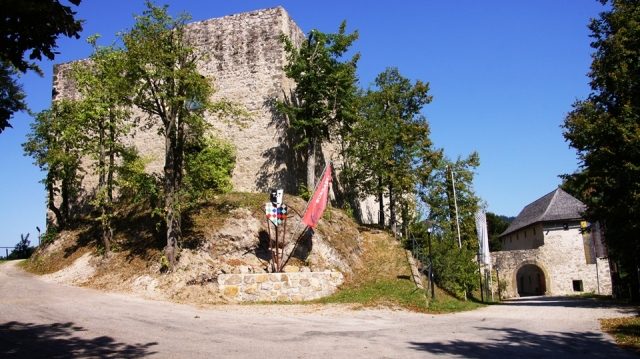
Reinsberg Castle is located in the municipality of Reinsberg in the district of Scheibbs in Lower Austria.
The castle, then still called Reinsperg, was built around the year 1000 as protection against the Slavs. From here, the Lower Austrian Iron Road was also protected. The castle had its heyday in the 13th and 14th centuries. When the castle was plundered in 1597, its decay began. The roof tax under Joseph II meant the end of the castle.
With the founding of the parish of Steinakirchen in 976, an important historical epoch also began for Reinsberg. Here in this narrow valley, amidst Slavic settlers, the southernmost baptismal site of this large parish was installed. The Christianization up to the Ötscher was directed from Reinsberg. To secure this baptismal church, which was dedicated to St. John the Baptist, but also to secure the Iron Road over the Buchberg and the Dreimärktesstraße, Reinsberg Castle was built at the beginning of the second millennium.
Reinsberg experienced its greatest social and economic importance in the 13th century under the rule of Adelhaid von Reinsberg. Adelhaid founded the parish of Reinsberg in 1291, the parish of Randegg in 1294, and a convent in Randegg in 1296. The founding of the parish of Gaming is also quite likely attributable to Adelhaid or her ancestors.
In April 1597, the peasant leader Markgraber "with some loose boys" plundered Reinsberg Castle. This was probably the beginning of its decay.
The Castle since the 20th Century+
A popular excursion destination during the post-war summer retreat, the castle ruin sank into a deep Sleeping Beauty slumber with the absence of holiday guests. Shrubs and trees overgrown it, and the proud castle on the hill above the village fell into oblivion.
In 1990, an initiative renovated and revitalized the ruin, creating the Reinsberg Castle Arena, where various open-air events now take place.
Renovation of the Castle
In 1990, the first negotiations with the Austrian Federal Forests began. The municipality, the Dorfwerkstätte (village workshop), and the Heimatbühne (local stage) took on the ruin. Initially, a lease agreement was concluded. Since 1997, the castle complex has been owned by the municipality of Reinsberg.
Opera in Reinsberg
Since 2002, operas have been performed at the castle. The unique open-air ambiance of the Reinsberg Castle Arena has approximately 900 seats, most of which are covered.
Architecture+
General
The Reinsberg castle ruin has long served as a venue for theater performances, festivals, and exhibitions. Through the provision of funding from the state of Lower Austria, the municipality's own funds, and further extensive and voluntary cooperation from the village renewal association, it became possible to convert the castle ruin into a professional event venue.
Roofing
The project is characterized by a globally unique mobile roofing of the lower castle courtyard. A used mobile crane, permanently installed, supports a huge elliptical lightweight structure, which is anchored to the ground by steel cables. Due to the rotatability of the mobile crane, various positions of the roofing are possible. The structure is very easy to dismantle and can therefore be conveniently removed outside the playing season.
South Building
Immediately adjacent to the lower castle courtyard, an infrastructure building has been erected with a buffet, kitchen, office, and a large covered spectator terrace on the ground floor, as well as facilities for performance operations and storage rooms in two basements.
Palas
The main building, the historically oldest part of the castle complex, has been supplemented at the height of the upper castle courtyard with reinforced concrete columns and balcony-like steel structures. From these balconies, there is a fantastic view of the arena lying deep below.
Upper Castle Courtyard
The entire project is being created in cooperation with and with the approval of the Federal Monuments Office. It was agreed that the area of the upper castle courtyard, which is highly likely to be completely cellared, will not be altered in this construction phase. The possibility of a later excavation should remain here.
The conversion of the castle ruin into a cultural arena was planned by architect Johannes Zieser.
Take Mobile History with you
You are reading this text for free. Premium adds what matters on the road: descriptions read aloud, sites found through your camera, whole regions taken offline.
- Every description, including the ~17,700 Premium sites
- Audio guide: have descriptions read to you on location
- AR finder: see sites through your camera, with distance and bearing
- Unlimited saved sites
14 days free, then from €2.99 a month. Cancel anytime.
Source: Wikipedia · Licence: CC BY-SA 4.0 · Image: http://www.wehrbauten.at/noe/niederoesterreich.html
This description draws on the facts documented in the linked Wikipedia article; Wikipedia content is licensed under CC BY-SA 4.0. Wording and editing: Mobile History.
Location: 47.9823, 15.0711