The remains of the Castle can be visited
CastleHohenleuben
Reichenfels Castle
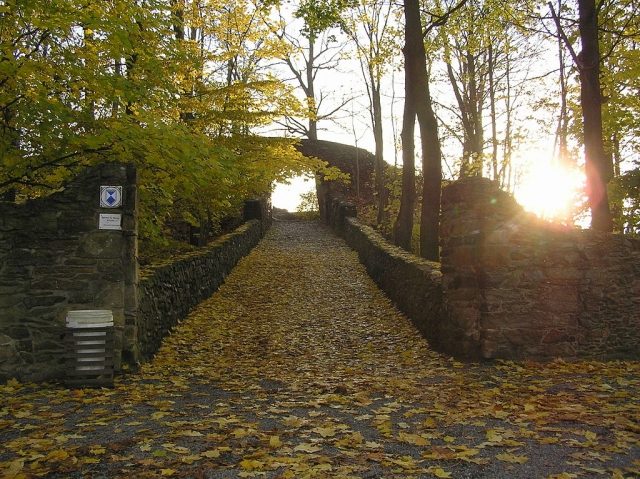
The castle ruin Reichenfels is a medieval fortification near Hohenleuben in the Greiz district in Thuringia. The ruin of this spur castle and the surrounding public and private buildings form the Hohenleuben district of Reichenfels.
The castle is located about one kilometer west of Hohenleuben city center at an altitude of about 350 m above sea level on the Schlossberg mountain spur and about 45 m above the Triebes valley. It lies on the Reussian Princely Road. Since 1770, a chestnut avenue has led from the edge of Hohenleuben's town center to Reichenfels.
The complex consists of the core castle, which is separated from the forecourt by a deep and wide moated ditch. Today, a continuous stone bridge leads over the moated ditch. However, traces of a drawbridge can be seen at the castle gate. The core castle was surrounded by a polygonal curtain wall (diameter about 30 meters, remains of the wall in the west preserved with a remaining height of 4 to 8 meters) and secured by a keep. Remains of further buildings are recognizable.
The castle was probably built as early as the 12th century by the Vögte of Weida and came into the possession of the Vögte of Gera in 1356. In 1550, the Burgraves of Meissen zu Plauen acquired the castle and staffed the castle garrison with families of the ancient nobility of Vogtland. In 1703, the castle with all its buildings was bought by Count Heinrich XXIV Reuss zu Köstritz. From the 18th century onwards, the castle fell into disrepair.
In 1804, Prince Heinrich XLIII Reuss zu Köstritz began to erect a Neo-Romanesque castle in the ruin and to design the surroundings in a park-like manner. The work was stopped in 1811 without significant success. In 1846, the Köstritz princes also dissolved the estate management. The castle tower collapsed in 1872, and from 1900 to 1903, the castle and palace were demolished down to their foundations.
In 1944 and 1955, the castle complex was placed under monument protection. To make it available to the public for cultural and tourist purposes, restoration work has been carried out on the complex since 1955. In the courtyard-like forecourt is the Hohenleuben-Reichenfels Local History Museum, created by the Vogtländischer Altertumsforschender Verein Hohenleuben (founded 1825), and the former farm building, now a castle tavern and hotel. The museum also presents the history of the castle, partly based on finds. Where there are no buildings, the courtyard is surrounded by a historic wall. A small part of the courtyard has a tent roof for rain-proof outdoor events.
Outside the courtyard is the Reichenfels Labyrinth (diameter 10 m, path length approx. 200 m). Lawn and stone labyrinths are considered pre-Christian cult sites and were used especially during solstice and spring celebrations for meditation, for ritual round dances and processional dances, running exercises, and games. In the Middle Ages, the Christian church adopted labyrinths as a symbol for the ideal pilgrimage to Jerusalem.
In the surroundings, one can also find remains of Prince Heinrich XLIII's attempted park design, such as a classical sandstone gate and a legendary stone cross brought here, called "Heilige Kreuz" (Holy Cross).
Take Mobile History with you
You are reading this text for free. Premium adds what matters on the road: descriptions read aloud, sites found through your camera, whole regions taken offline.
- Every description, including the ~17,700 Premium sites
- Audio guide: have descriptions read to you on location
- AR finder: see sites through your camera, with distance and bearing
- Unlimited saved sites
14 days free, then from €2.99 a month. Cancel anytime.
Source: Wikipedia · Licence: CC BY-SA 4.0 · Image: https://commons.wikimedia.org/wiki/File:Aufgang_zur_Burgruine_Reichenfels.JPG
This description draws on the facts documented in the linked Wikipedia article; Wikipedia content is licensed under CC BY-SA 4.0. Wording and editing: Mobile History.
Location: 50.7073, 12.0392