The remains of the Castle can be visited
Here is a Geocache
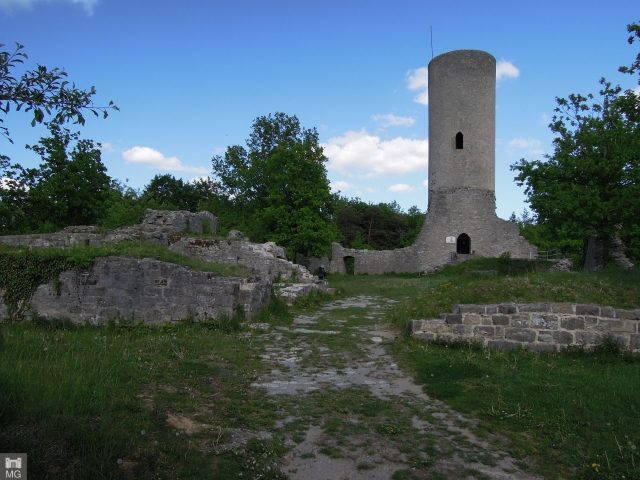
The remains of the Castle can be visited
Here is a Geocache
The Reichelsburg, also known as Reichelsberg Castle, is the ruin of a late medieval hilltop castle of the Prince-Bishopric of Würzburg. It is located near the village of Baldersheim, now part of the town of Aub, in the district of Würzburg in Bavaria.
The ruin of the spur castle is situated at 300 m above sea level, south of Baldersheim, above the Gollach river at the western end of a ridge extending in a west-easterly direction.
Reichelsberg Castle was first mentioned as "Reigirberc" around 1230 as property of the brothers Gottfried and Konrad von Hohenlohe-Brauneck, whose ancestral seat, Brauneck Castle, was located six kilometers south of Aub and is partly still preserved. The castle mentioned in 1230 was probably a predecessor building of the current castle ruin. The feudal lord of the Reichelsberg dominion, which included the fortress and the villages of Baldersheim, Burgerroth (both now part of Aub), Bieberehren, and Buch (now part of Bieberehren), was the Prince-Bishopric of Bamberg. In 1338, Gottfried III von Hohenlohe-Brauneck and his wife Margareta founded a chapel at Reygerberch. In 1390, the Hohenlohe-Brauneck line died out with the death of Konrad IV. The Prince-Bishopric of Bamberg seized the fief and exchanged it for other properties with the Prince-Bishopric of Würzburg.
In 1401, the Imperial Hereditary Chamberlain Konrad von Weinsberg received Reichelsberg as a fief from the Würzburg Bishop Johann von Egloffstein. Konrad had married Anna von Hohenlohe-Brauneck, the widow of Konrad IV, in 1396. In 1425, four cannons ("Klotzbüchsen") were located at Reichelsburg.
After Konrad von Weinsberg's death in 1448, he was succeeded by his sons Philipp the Elder (also Imperial Hereditary Chamberlain) and Philipp the Younger (a clergyman), both of whom lived together at Reichelsburg. Under the rule of Philipp the Elder, Reinhardt Truchsess von Baldersheim became bailiff at Reichelsburg in 1477.
After the extinction of the Lords of Weinsberg in the male line, the castle passed to Philipp the Elder's daughter, Countess Katharina von Königstein, who sold the Weinsberg share of Reichelsburg to Prince-Bishop Konrad von Thüngen for 49,000 guilders in 1521. From 1521, the castle thus belonged entirely to the Prince-Bishopric of Würzburg; it was initially no longer enfeoffed but inhabited by Georg von Rosenberg as bailiff of the Prince-Bishopric. On April 22, 1525 (Saturday after Easter), Reichelsburg, like Brauneck Castle, was plundered and destroyed by rebellious peasants during the Peasants' War, causing Georg von Rosenberg to move to Aub Castle. The castle was later partially restored and continued to be inhabited but had lost its significance. In 1669, the Reichelsberg office was dissolved, and in the early 18th century, it fell as a fief to the Barons von Schönborn.
From about 1750, Reichelsburg was no longer inhabited and fell into disrepair. In the first half of the 19th century, the still relatively well-preserved castle was gradually dismantled by the inhabitants of the surrounding villages, who used the stones to build their own buildings. Protests against this remained ineffective. Only in 1900 did the Aub Beautification Association, founded 15 years earlier, begin to secure and restore the ruin. At the expense of the Bavarian state, from 1905 to 1907, the keep, which was in danger of collapsing, was secured and fitted with a wooden internal staircase, the well was re-walled, a collapsed cellar was rebuilt, and large quantities of rubble were removed, some of which was used in the construction of the Gaubahn railway from Ochsenfurt to Röttingen. Minor work continued until 1910, after which the condition of the ruin remained almost unchanged for decades. Only in the 1960s were new contracts issued for the fortification of the walls. In 1986, the wooden staircase in the keep was replaced by a metal staircase. Finally, in 2000, a new access bridge, the "Truchsessbrücke" (named after the Truchsesses of Baldersheim, who were bailiffs at the castle), was built on the foundations of the former drawbridge.
In the 1950s, associations from Aub organized festivals at Reichelsburg. Building on these festivals, the first Reichelsburg Festival of the Baldersheim-Burgerroth Music Community took place in 1996 and has been held annually ever since. The Music Community, in cooperation with state authorities, is responsible for the restoration and preservation of the castle ruin and had the new bridge built in 2000.
The rectangular core castle is enclosed by an irregular curtain wall, which originally had eight flanking towers. One of the towers in the north of the wall has completely disappeared, and remnants of the others still exist. The curtain wall is surrounded by a 10 to 15 meter wide and eight meter deep moat, in front of which an earth rampart still lies to the east.
The access road to the castle led up the hill from the west and crossed the moat with a drawbridge. The core castle was a regular quadrangle measuring 42 by 33 meters, with walls two meters thick. On the east side was a ten-meter-high shield wall with a 23.50-meter-high keep, which is still preserved today and has walls 2.50 meters thick. The buildings around the inner courtyard were partly cellared, and some cellars are still accessible. On the northeast side of the inner courtyard was a stair tower, and a 15-meter-deep bricked well is preserved in the courtyard.
The repeatedly rebuilt castle dates back to the 14th century in its oldest parts, while the youngest building components date from the 15th or early 16th century. In front of the castle grounds to the west are still remnants of a predecessor complex, a simple motte-and-bailey castle (Motte), which was circularly enclosed by a rampart and moat.
Take Mobile History with you
You are reading this text for free. Premium adds what matters on the road: descriptions read aloud, sites found through your camera, whole regions taken offline.
14 days free, then from €2.99 a month. Cancel anytime.
Source: Wikipedia · Licence: CC BY-SA 4.0 · Image: Mobile Geschichte
This description draws on the facts documented in the linked Wikipedia article; Wikipedia content is licensed under CC BY-SA 4.0. Wording and editing: Mobile History.
Location: 49.5465, 10.0509