The remains of the castle can be visited
CastleOlfen
Rauschenburg Castle
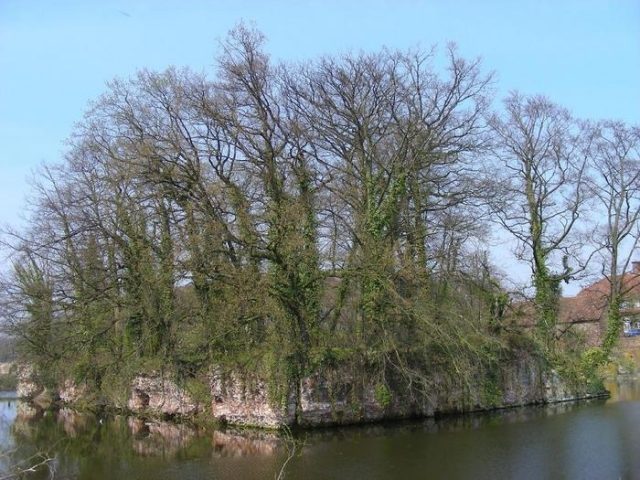
The Rauschenburg is a vanished moated castle in the Lippe meadows on the edge of the small town of Olfen (Lehmhegge) in the Coesfeld district in North Rhine-Westphalia.
The name Rauschenburg possibly refers to the eternal rushing of the former rapids at this point in the Lippe river.
The Rauschenburg manor was first mentioned in 1050, with the first owner appearing in 1317 as an official of Bishop Ludwig Landgrave of Hesse from Münster. In 1322, the Bishops of Cologne, Heinrich von Virneburg, and Münster concluded a treaty in which a bridge over the Lippe at Rauschenburg was decided, which was reconfirmed in 1444 and 1498 by the then territorial lords.
In 1326, however, the castle belonged to Sweder von Rechede and was sold by him to Reimbode von Landberge, but by 1397 it was already in the possession of the von Oer family, who used it as a base for the troops of the Münster diocese. In 1418, Horneburg and Rauschenburg castles were besieged and finally conquered by the Archbishop of Cologne, Dietrich von Moers; the von Oer family was initially expelled but was able to conclude a contract for the castle with the same in 1451.
Around 1470, the castle came into the possession of Johann von Hake zu Wulfsberg near Lüdinghausen, who subsequently called himself Johann zu Rauscheburg. He had two daughters, each inheriting half of the castle. At this time, 20 farmsteads north of the Lippe alone belonged to the castle's estate. However, the division of inheritance led to a dispute. Daughter Margarethe was married to Johann von Ascheberg, while daughter Ursel was married to Alard von Hörde. Ursel died childless on March 9, 1564, whereupon Johann von Ascheberg considered himself the sole and rightful owner of the manor. Bishop Bernhard von Raesfeld from Münster supported Alard von Hörde and marched with soldiers to Rauschenburg, which was shelled until Johann von Ascheberg's capture. Later, a settlement was reached, and both lived in the castle until Johann von Ascheberg's death in 1577. The property then passed to Johann's son and then to Johann's grandson Heinrich von Ascheberg, who died childless, thus ending the era of the von Aschebergs at Rauschenburg in 1638.
However, Heinrich von Ascheberg had a sister, Adolpha, who married Steffen von Neuenhoff in 1638. The castle remained in the possession of the von Neuhoff family until 1770, after which it passed into the possession of Rittmeister von Stockheim, who sold it to the Cathedral Chapter of Münster in 1783. In the same year, however, Baron Werner von Brabeck, who lived at Haus Vogelsang, was already named as the owner.
In an inheritance agreement between the von Brabeck and von Twickel zu Havixbeck families, it was stipulated that if one lineage should die out, the property would fall to the other family. This, however, led to several lawsuits, at the end of which the von Twickel zu Havixbeck were named as owners in 1850. However, the castle had already been taken into possession earlier, at the earliest in 1820.
After that, the castle increasingly fell into disrepair; in 1878, the upper floor was removed and used for a new bridge construction. The castle was inhabited until 1900; today, only remnants of the foundations and cellar vaults remain.
Structure+
The Rauschenburg was built at a ford, which could temporarily be crossed with horse and cart through the Lippe, on the otherwise impassable river to protect it. Today, a bridge carrying Federal Highway 235 stands at the site of the ford.
The castle had a three-story main house with a tower, which was very similar to that of Horneburg Castle. This was surrounded by a moat, and a drawbridge connected the outbuildings and stables, located outside the moat, with the main house.
Take Mobile History with you
You are reading this text for free. Premium adds what matters on the road: descriptions read aloud, sites found through your camera, whole regions taken offline.
- Every description, including the ~17,700 Premium sites
- Audio guide: have descriptions read to you on location
- AR finder: see sites through your camera, with distance and bearing
- Unlimited saved sites
14 days free, then from €2.99 a month. Cancel anytime.
Source: Wikipedia · Licence: CC BY-SA 4.0 · Image: http://www.wehrbauten.de/thread.php?threadid=563
This description draws on the facts documented in the linked Wikipedia article; Wikipedia content is licensed under CC BY-SA 4.0. Wording and editing: Mobile History.
Location: 51.6824, 7.3581