The remains of the Castle can be visited
RuinRauenstein
Rauenstein Castle
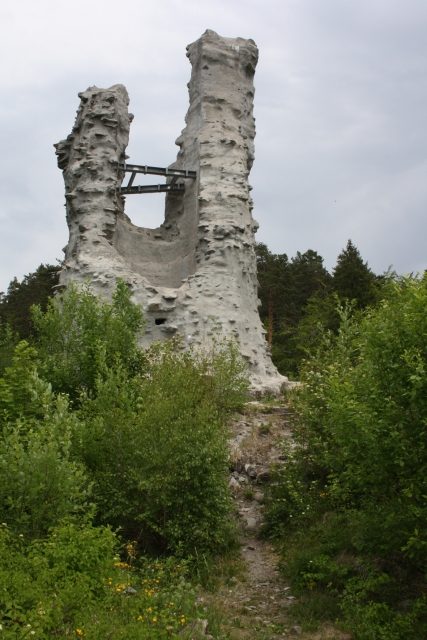
Rauenstein Castle is a castle ruin in Rauenstein, Thuringia. From the 14th century, it was the seat of the noble family of Schaumberg and thus the ancestral seat of the Schaumberg-Rauenstein line.
Around 1315, the high noble princely county of Henneberg was enfeoffed with the ancestral castle of the Lords of Schaumberg, Schaumberg Castle near Schalkau, after Count Hermann I of Henneberg had already acquired the rights to this castle in 1260. Even before 1350, the princely counts finally held the castle and half of the Schalkau Cent as an imperial fief. The Schaumbergers were forced to move to the Niederfüllbach manor, but acquired Rauenstein halfway between Schalkau and Sonneberg as their new seat of power. Possibly, a Schaumberg Kemenate (stone house) for the administration of the valuable property "vor dem Walde" in Rauenstein, which was equipped with extraordinary sovereign rights such as high justice, escort, customs, mining rights, high hunting rights, and church patronage, already existed at this location before 1340, and was expanded and fortified at that time. In 1349, Regent Jutta von Henneberg granted permission to fortify the castle, named Haus Ruhestein, on the condition that this house should be open to her as a Henneberg son's and daughter's fief. Margrave Friedrich the Strict of Meissen renewed this contract in 1351, whereby in addition to ownership and the imperial fief, a Saxon male fief was now added.
The Schaumbergers quickly established themselves at their new seat of power. By 1398, the territory of the Rauenstein court already comprised 25 forest mountains, 6 free villages, and the Hiftenberg houses. In 1455, the village of Rauenstein was mentioned for the first time, noting that it had existed before the castle and had been bought by the Schaumbergers, thus becoming their property.
In 1660, the Rauenstein property was still referred to as a family estate (fideicommissum), but as early as 1662, a part of it passed to the castellan Georg Dietrich zu Klein-Ziegenfeld and was at his free disposal as a co-heir. From 1669, he also lived in the castle, which had already been abandoned by the Schaumbergers in 1632 and partially destroyed by imperial troops in 1640. In 1670, castellan Georg Dietrich also left the castle and resided in a new castle house on the market square, also known as the rectory.
In 1687, the ducal-Coburg master of the horse, Hans Siegmund von Schaumberg, regained full rights to the castle and the Schaumberg lordship and attempted to sell them to Duke Albrecht of Saxe-Coburg, which failed due to the objection of the Ziegenfeld heirs. He built a New Castle at the foot of the castle, which later served as the town hall and today houses the Rauenstein Porcelain Cabinet. The castle was no longer used and fell into ruin. Finally, Duke Anton Ulrich of Saxe-Meiningen acquired the entire family estate from Hans Siegmund von Schaumberg in 1729, making him the last Schaumberger in Rauenstein. He died in the same year. In addition to the main creditor, the Sonneberg businessman Andreas Grosch zu Ehnes, the heirs of Klein-Ziegenfeld, and the heirs of Strössendorf, his daughter Sophie Magdalene, wife of a Colonel von Hanstein, benefited from the payments, and upon the final transfer of the purchase sum by Charlotte Amalie of Saxe-Meiningen in 1763 and the redemption of the last mortgaged properties in Grümpen and Theuern in 1786, finally her son, Lieutenant Colonel Johann Adam Wilhelm von Hanstein. The von Hanstein family had owned the Einberg estate in present-day Rödental since 1620.
Condition of Preservation+
Remains of walls are preserved, from which the distinctive keep rises. Only at the end of the 1990s were attempts at renovation made, but these were not completed. Since then, a dramatic decay of the building fabric of the keep, curtain wall remains, gatehouse, and shell towers has set in. In 2004, the Thuringian-Franconian Historical Society was founded with the aim of saving the Rauenstein castle ruin. Through the initiatives of the society in conjunction with other local associations, the municipality of Effelder-Rauenstein, and the monument protection authorities of Thuringia, the purchase agreement between the previous owner company LEG-Thüringen and the municipality of Effelder-Rauenstein was signed on August 24, 2006, and the renovation of the keep was carried out at the end of 2006. Since then, volunteer helpers have been working to preserve the ruin and make the castle area accessible.
Take Mobile History with you
You are reading this text for free. Premium adds what matters on the road: descriptions read aloud, sites found through your camera, whole regions taken offline.
- Every description, including the ~17,700 Premium sites
- Audio guide: have descriptions read to you on location
- AR finder: see sites through your camera, with distance and bearing
- Unlimited saved sites
14 days free, then from €2.99 a month. Cancel anytime.
Source: Wikipedia · Licence: CC BY-SA 4.0
This description draws on the facts documented in the linked Wikipedia article; Wikipedia content is licensed under CC BY-SA 4.0. Wording and editing: Mobile History.
Location: 50.4201, 11.0550