The remains of the Castle can be visited
CastleSchramberg
Ramstein Castle
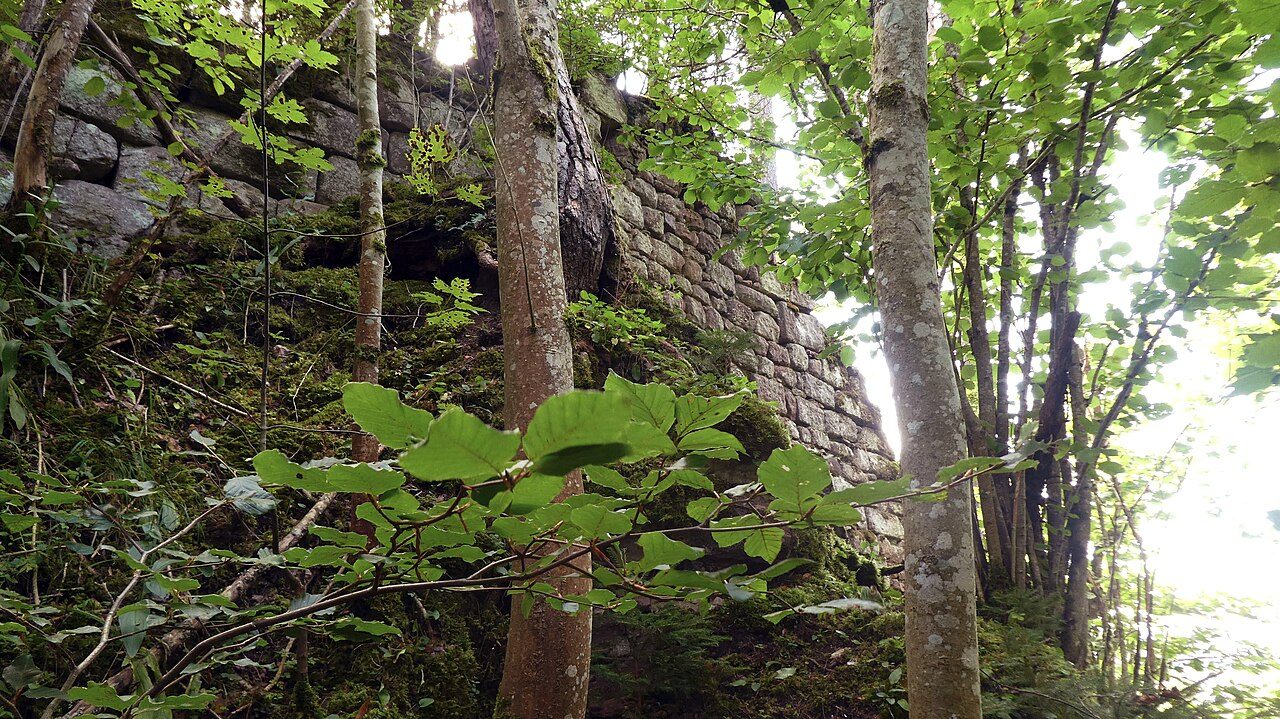
Ramstein Castle is the ruin of a hilltop castle on a wooded ridge about 688 meters above sea level in the valley of the upper Schiltach between Schramberg and Tennenbronn in the district of Rottweil in Baden-Württemberg.
Ramstein Castle, built before 1137, was the namesake political center of the Lords of Ramstein, who emerged from the Lords of Obereschach. This line died out around 1280, whereupon their rule passed to the Lords of Falkenstein-Ramstein. In 1411, the castle was besieged, conquered, and destroyed by troops of Konrad von Fürstenberg (1408-1418/19) and the city of Strasbourg, and rebuilt in 1428. In 1449, Ramstein was finally in the possession of Elisabeth von Rechberg, wife of Hans von Rechberg (†1464).
The castle itself is only mentioned in written historical sources at the beginning of the 15th century, while preserved sandstone ashlar blocks of the castle wall point to the period around 1250, and remains of the mountain-side wall with its natural stones indicate an even earlier period. The St. Georgen Landtafel of 1606 and the foundations reveal a small complex, only 400 square meters in size, with a moat, wall, gate, gate tower, inner courtyard, and palas.
Final Destruction of the Castle
In 1451, Hans von Rechberg and Heinrich von Eisenburg began a feud against the Swabian League of Cities by capturing merchants Jörg Ehinger from Ulm and Rudolf Muntprat from Ravensburg and bringing them to Ramstein. The cities paid them 5200 guilders in ransom for the prisoners, but after their release in July 1452, they marched with 1100 foot soldiers and 200 horsemen to the castle, which they then besieged for four days. On July 19, the castle was taken after massive use of fire arrows. Weapon finds from the fortification (small projectile balls, crossbow bolts, swords) prove that, after the attackers had entered through the burned-down castle gate, fierce fighting must have taken place within the castle. The Zimmerische Chronik reports in detail on the destruction of Ramstein: "then they marched forth with might, but lay before it for only six days, then they won it, albeit not by storm or force, but they shot and threw so much fire into the castle, thereupon they inflicted such an overwhelming barrage on those in the castle with shooting that they could not extinguish it. Much provisions and a great deal of goods burned within." In 1454, Emperor Frederick III ordered peace negotiations between Rechberg and the Imperial Cities, which surprisingly sided with Rechberg. He received 14000 guilders in compensation from the League of Cities for the destruction of Ramstein. However, he did not rebuild the castle with this money, but used it to erect the Hohenschramberg fortress.
Architectural Description+
The castle complex, built in ashlar construction, has an area of about 400 square meters. It is separated from the mountain side by a wide moat and was originally surrounded by a circular curtain wall. The castle had a gate tower, a round corner tower, and a palas and was additionally secured on the valley side by masonry. In the center of the complex was a small inner courtyard. Today, only a few wall remains are visible.
Take Mobile History with you
You are reading this text for free. Premium adds what matters on the road: descriptions read aloud, sites found through your camera, whole regions taken offline.
- Every description, including the ~17,700 Premium sites
- Audio guide: have descriptions read to you on location
- AR finder: see sites through your camera, with distance and bearing
- Unlimited saved sites
14 days free, then from €2.99 a month. Cancel anytime.
Location: 48.1899, 8.3847