The remains of the Castle can be visited
CastlePuchberg am Schneeberg
Puchberg Castle
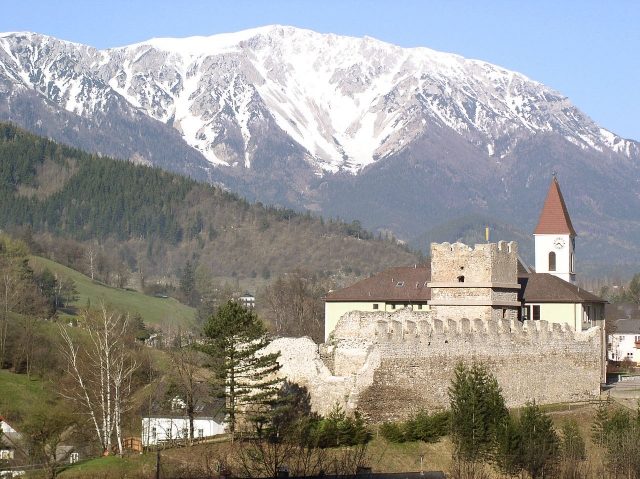
The castle ruin of Puchberg, still in private ownership today, is located above the Sierning at the southeastern end of a small plateau that slopes down on three sides. It was built at the beginning of the 13th century and is one of the landmarks of Puchberg am Schneeberg. In the early 20th century, it formed the center of the village together with the parish church of St. Vitus.
Historical data on the castle and the dominion of Puchberg are very scarce and provide little information about its owners, especially since there is often confusion with the dominion of Puchberg (Buchberg) am Kamp. Eberhard von Puchberg, who appears in written sources in the 1260s, is considered certain. A closer relationship to the Losenheimers can also be proven for him, as he is described as "descended from the paternal uncle". The following period cannot be determined, but the castle probably came into the possession of the Stüchse von Trautmannsdorf after 1357, became princely in 1381, then passed to Johann von Liechtenstein, and after his fall in 1395, reverted to the sovereign.
From 1500, the dominion of Puchberg appears in the manorial records of the dominion of Stixenstein. In 1547, Hans von Hoyos redeemed the pledged dominion over Stixenstein and took possession of the property with "all appurtenances" on October 15, 1549.
Until the middle of the 19th century, the castle, which was converted into a granary around 1674, still had a well-preserved roof and continued to be used, as evidenced by numerous scattered finds made during the renovation work. For example, schooling took place in the castle until 1837. Around 1850, the roof structure was removed, which initiated an accelerated process of decay, to which the Second World War later additionally contributed. Evidence of this was provided by remnants of a Russian tank grenade in the southern curtain wall and numerous damages to window openings – also attributable to grenade fire.
After the war, the ruin was used for various purposes – from fur animal breeding to a storage place – for all sorts of things. In the 1950s, the municipality of Puchberg am Schneeberg concluded a lease agreement with the Hoyos family and began to preserve the ruin from further decay using the renovation methods common at the time; the two concrete collars bear visible witness to this. Until the 1970s, the castle ruin was still occasionally used as an event venue, but was then closed to the public due to the renewed danger of falling stones.
Description+
The ruin consists of a curtain wall in the shape of an irregular quadrangle, the longest side of which measures around 38 meters, and a keep about 18 meters high, built in two stages. Due to an absolutely chronological date of a dendrochronologically examined scaffolding timber, whose felling date was determined to be the winter half-year of 1204/05, this keep is one of the oldest actually dated keeps in Lower Austria. A wall interlocking on the north side of the keep still suggests an older curtain wall. A further construction phase includes the raising of the keep and the construction of the current curtain wall. After the purchase of the lands by the Hoyos family in the 16th century, the keep was converted into a multi-story storage room by doubling the intermediate floors, the original high entrance on the south side was walled up, and a ground-level entrance was broken out on the north side. A total of eight secondary window openings on the south and east sides of the curtain wall, as well as a series of beam holes in the inner courtyard of the complex, are attributable to the construction of the granary around 1674.
Renovation+
The first safety works began in the 1950s when the municipality of Puchberg concluded a lease agreement with the Hoyos family. Due to the danger to the elementary school located directly next to the castle, the municipality of Puchberg had the castle tower secured by two concrete collars in the 1990s. However, there was hardly any money available for further renovation work.
In the spring of 2002, after extensive surveying and documentation work, the Puchberg am Schneeberg Castle Association, founded in 2001 with the aim of preserving and revitalizing the castle, began safety measures on the castle ruin.
With the participation of many volunteer helpers, it was possible within five years to structurally secure the severely damaged complex – professionally guided and financially supported by the Federal Monuments Office, the market and spa municipality of Puchberg am Schneeberg, and the Lower Austrian Village Renewal – and to make it accessible to the public again.
In addition to the restoration of wooden floors in the keep and a walkable battlement on the north side of the complex, a wooden building in the form of a post-and-beam construction with a lean-to roof was erected in the castle courtyard in 2007, as it might once have stood in the castle. The basis for this was archaeological findings from castle complexes that suggested parlor and kitchen functions. This combination allowed cooking on an open fireplace and at the same time feeding a tiled stove from the kitchen, thus keeping the parlor smoke-free.
Regular Events+
Experience the Middle Ages
Since 2003, a museum event in the form of an "International 13th Century Weekend" with participants from various European countries has taken place every two years on the first weekend in August. In addition to presenting old craft techniques, everyday objects, weapons, and armor, an attempt is made to provide information about the living conditions at the time, to give modern people a feeling of what it might have been like back then. The motto is: Living History - tangible history to touch.
Other
- Since 2006, the so-called "Contemplative Advent" has taken place every year in the castle ruin.
- The castle ruin is often used for receptions and agapes.
Take Mobile History with you
You are reading this text for free. Premium adds what matters on the road: descriptions read aloud, sites found through your camera, whole regions taken offline.
- Every description, including the ~17,700 Premium sites
- Audio guide: have descriptions read to you on location
- AR finder: see sites through your camera, with distance and bearing
- Unlimited saved sites
14 days free, then from €2.99 a month. Cancel anytime.
Source: Wikipedia · Licence: CC BY-SA 4.0 · Image: https://commons.wikimedia.org/wiki/File:Burgruine_Puchberg01.jpg
This description draws on the facts documented in the linked Wikipedia article; Wikipedia content is licensed under CC BY-SA 4.0. Wording and editing: Mobile History.
Location: 47.7861, 15.8986