The remains of the Castle can be visited
CastleOybin
Oybin Castle
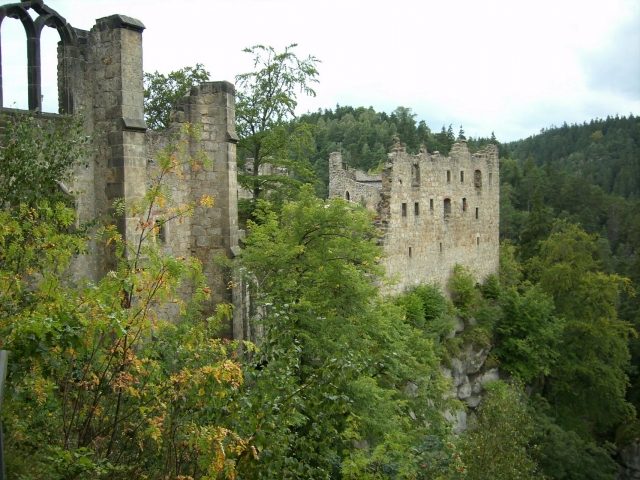
The Oybin is a 514-meter-high mountain in the Zittau Mountains above the town of the same name in southeastern Saxony. On it are the ruins of Oybin Castle, which Emperor Charles IV had expanded into his retirement residence, and a monastery of the Celestines, founded in 1369.
The castle complex of the hilltop castle occupies the entire summit area of Oybin mountain. In addition to the actual castle on the west side with the Imperial House, it also includes the monastery ruins, the mountain cemetery of the municipality of Oybin, and a castle restaurant. At the highest point of the mountain is a Camera Obscura. The mountain church of Oybin, located on the slope, has remarkable paintings inside.
Settlement and Castle History+
Prehistory to (1300)
The first archaeologically verifiable Bronze Age settlement on Oybin mountain dates from the 11th and 12th centuries BC. A settlement in the Slavic period was proven by a few individual pottery shards. The earliest traces of construction date from the 13th century. This century also saw the first documented destruction by the city of Zittau in 1291. The castle was used as a base for raids by robber knights. This is also the first documented mention of Oybin (Moybin). The castle was soon rebuilt.
Middle Ages and Golden Age (1300–1577)
Between 1311 and 1316, the complex was expanded into a fortified section castle to protect the nearby trade routes under Heinrich von Leipa, Marshal to King John of Luxembourg. As early as 1346, it fell directly back to the Bohemian Crown. In 1364, Emperor Charles IV built the Imperial House on Oybin, which he intended to use as his retirement residence. In 1366, he also began the construction of the Gothic church (with the participation of the famous Prague Cathedral workshop Parler), which was completed as early as 1384. In 1369, the Emperor endowed a monastery on Oybin to the Order of the Celestines. A significant member of this convent was the inquisitor and prior (from 1395) Petrus Zwicker.
During the Hussite Wars, Oybin was attacked twice. In 1420 under Zbynec Buchowec and Chwal Repicky von Machowitz (Czech: Chval Řepický z Machovic). It was mainly due to the strong walls and steep rocks that the besiegers had to withdraw without success. The manor farm at the foot of the mountain was burned down. However, this news is unfounded, as Richard Jecht (1911, p. 62f) already determined. The Hussites appeared before the castle monastery on September 28, 1429, and stormed the mountain fortress. These were troops of Prokop the Great, their attack is said to have lasted four hours. Again, the defensive system proved stronger than the stormy attacking will of the Hussites. They withdrew unsuccessfully and unsettled the Zittau surrounding area. Oybin was considered impregnable ever since.
Part of the Prague Cathedral treasure from St. Vitus Cathedral was stored on Oybin to protect it from the Hussites. A war wagon (upgraded covered wagon) was later found during excavations at the foot of Oybin. The castle continued to be expanded until the second half of the 16th century. In the course of the Reformation, the monastery was dissolved, and its slow decay began. In 1577, lightning struck the church, burning it down. Further destruction followed in 1681 due to a rockfall. At this time, the castle was already uninhabited and used as a quarry by the valley residents.
Modern Era (from 1800)
A "rediscovery" of the castle occurred during the Romantic period, when the Saxon court painter Johann Alexander Thiele discovered the romantic, nature-overgrown walls as a motif. Caspar David Friedrich, Carl Gustav Carus, and other Romantic painters then painted the ruin and made it famous. Subsequently, the castle was cleared of rubble from 1829, and in 1877, the Imperial House was renovated to preserve it from further decay. From the mid-19th century onwards, more and more hikers and spa guests came to the mountain. This was ultimately due to the establishment of an express stagecoach connection from Zittau in 1830 and the opening of the narrow-gauge railway from Zittau to Oybin in 1890. In 1883, a museum was first opened on the mountain by Alfred Moschkau. At the beginning of the 20th century, the castle was scientifically recorded and examined by Cornelius Gurlitt and Hugo Rathgens. In 1936, there was a setback: the rich museum collection was significantly decimated by sales by the heirs of Alfred Moschkau. Another setback followed at the end of World War II, when larger parts of the museum were plundered. Herrmann Knobloch saved the almost destroyed Zittau Lenten Veil of 1472 stored there. In the coming decades, a race against decay began. Further renovation work followed. For example, the monastery ruin, also because of its good acoustics, has been used as a concert venue (among other things for the traditional Monk's Procession) since 1972. Since 1991, the castle has been extensively renovated, and larger parts have been uncovered and reconstructed. Today, up to 100,000 guests visit the castle and monastery ruins on Oybin mountain each year. Special guided tours and an annual historical castle and monastery festival are held.
Take Mobile History with you
You are reading this text for free. Premium adds what matters on the road: descriptions read aloud, sites found through your camera, whole regions taken offline.
- Every description, including the ~17,700 Premium sites
- Audio guide: have descriptions read to you on location
- AR finder: see sites through your camera, with distance and bearing
- Unlimited saved sites
14 days free, then from €2.99 a month. Cancel anytime.
Source: Wikipedia · Licence: CC BY-SA 4.0 · Image: Uwe Klimpke
This description draws on the facts documented in the linked Wikipedia article; Wikipedia content is licensed under CC BY-SA 4.0. Wording and editing: Mobile History.
Location: 50.8440, 14.7413