The remains of the Castle can be visited
CastleSchnaittach-Osternohe
Osternohe Castle
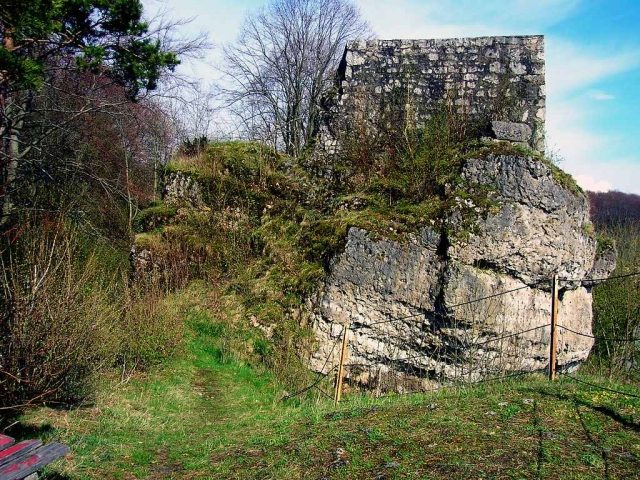
The age of Osternohe Castle on the Schlossberg, as the municipal district is also called, has not yet been determined with the help of scientific-archaeological research. However, at least the keep of the castle could have been built in the decades around 1200. This is supported by Georg Christoph Wilder's drawing and historical photographs, which show a ashlar construction that still exhibited clear features of Staufer castle building until the tower repair in 1968. The castle, whose high medieval remains were placed on a rock reef at the western edge of the village, is already documented as "castrum Osternach" for the year 1228.
It is to be assumed that the Lords of Osternohe, like other noble free men, were counted among the higher imperial ministerials before 1200. After all, Poppo II and his brother Konrad von Osternohe appeared as witnesses for King Philip in 1199. The most important representative of the family was Poppo IV, who on July 22, 1228, handed over his share of the castle to a relative, Bruno von Osternohe, participated in a crusade in 1229, and served as Grand Master of the Teutonic Order from 1253 to 1257. Konrad de Osternach, mentioned in 1219, was also later a member of the knightly order.
The family was related to the dynastic family of Hohenlohe, which also speaks for the noble free origin and high standing of the Osternohe family. Gottfried von Hohenlohe probably acquired the castle in 1254 from the last-mentioned Osternohe, "Engelhard de Osterna". After that, the sources are silent for seven decades. Only from a document issued at the end of 1326/beginning of 1327 does it emerge that Rienolt, the deceased father of Neidung von Winterstein and Hartmann von Diepoltsdorf from the Neidunge family [cf. Simmelsdorf I, Winterstein], called himself after Osternohe. Whether he administered the castle and on whose behalf is not known. The latter also applies to Wolfram, Vogt of Osternohe, mentioned in 1330. Although it was assumed that around 1323/26, when Gottfried von Hohenlohe-Brauneck and his wife Margaretha née von Gründlach sold part of their possessions to Burgrave Friedrich IV of Nuremberg [cf. Großgründlach II, Malmsbach], Osternohe also came into the possession of the burgraves, there is no evidence for this.
In 1340, Heinrich Rindsmaul resided in Osternohe. Only in 1354 is Berthold Haller [cf. Gräfenberg, Introduction] explicitly mentioned as the burgravial Vogt of Osternohe. He was probably a pledge owner, as were Dietrich III von Spies and Dietrich Türriegel in 1374. From then on, the castle remained closely linked to the history of the Hohenzollerns: from 1385/88, Osternohe temporarily appeared as the seat of a burgravial, then margravial office. Nevertheless, the castle was also frequently pledged by the sovereign in the 15th century. Before 1415, Heinrich Schenk von Leutershausen, in 1416 Georg Türriegel, and before 1435 Georg von Wildenstein acted as pledgees.
In the Cities' War of 1388, all places in the Osternohe office were allegedly destroyed; whether this also applies to the castle itself has not yet been proven. In the First Margrave War, however, Nuremberg troops burned down only the outer bailey on March 9, 1450, which was then rebuilt only after 1457. At that time, the castle had been pledged to Hans von Egloffstein since 1447, who, as margravial bailiff, still resided there in the 1470s and initiated the construction of the Osternohe church. In addition to the officials or administrators, so-called castle guards of ministerial origin were employed at the margravial castle. They had a number of castle guard estates, which can no longer be reconstructed, at their disposal as remuneration for their services [cf. Diepoltsdorf]. One such was in any case in the outer bailey, which was granted to the Hüttenbecken family from about 1349 to 1467 [cf. Hüttenbach].
In the Second Margrave War, the castle was plundered and set on fire by Nuremberg mercenaries stationed at Hohenstein on May 23, 1553. At the latest with the documented construction work around 1573, the castle was restored and used from 1577 to 1722 as the margravial administrative seat, elevated to an Oberamt since 1694. In 1692, the condition of the fortifications was still found to be good. In 1703, during the War of the Spanish Succession, Bavarian troops occupied the fortress and devastated rooms.
In the 18th century, the office declined. The last chief administrator moved out of the castle in 1718, and after his retirement from service, the office was no longer filled. In 1766, the Osternohe Oberamt was finally abolished as part of an administrative reform and assigned to the Brandenburg-Bayreuth Oberamt Pegnitz. At this time, the castle was no longer habitable. The ruin of the buildings had already been lamented in 1747. In 1764, the castle was only occupied by a guard. After the keep lost its upper floors due to a lightning strike after 1766, the remaining buildings were demolished in the late 18th century and used by the population as a quarry. The residential building, the so-called old Kemenate, and large parts of the keep are said to have been razed in 1773.
In the first years of the 19th century, parts of the ruin complex were privatized and left to themselves for a long time. A smaller round tower with a flattened tent roof was only demolished after 1843. In the 1930s, a noticeable loss of rising masonry was again observed. The local historians Dr. Hellmut Kunstmann and Gottfried Stammler did not miss an opportunity for decades to point out the urgent need for action.
In the post-war period, the demolition of the ruin could be prevented with difficulty, but no securing measures were taken. The restoration was delayed from year to year until finally, on April 26, 1968, the southwestern enclosure of the keep collapsed. Immediately after the disaster, an association for the preservation of the castle ruin was founded to promote the reconstruction of the tower and further restorations. With the help of state subsidies, including those from the State Office for Monument Preservation, the masonry of the keep was repaired in 1968, without, however, any documentation of the building-historical findings. The repair was carried out so brutally that even the old pentagonal ground plan of the tower was abandoned. Today, the former keep presents itself as an approximately rectangular tower stump.
In 1968, work on the tower remained limited, so Walter Heinz had to observe further losses of ruin parts during an inspection in 1992. Especially to the northeast, rising masonry is increasingly being lost. The masonry of the residential building situated immediately west of the keep, still rising with two full stories in 1773, has also almost completely disappeared today, except for a few remnants. The younger lower castle has been absorbed into a private property. Larger parts of the eastern defensive wall have been preserved, as well as a horseshoe-shaped bastion to the south. Immediately northeast of the vanished gate, now a private driveway, the remains of a massive economic building can be observed. The remarkably long eastern front, which, as Walter Heinz already noted, appears to be of little defensive use, was additionally protected by a ditch, which is still recognizable to the northeast.
Take Mobile History with you
You are reading this text for free. Premium adds what matters on the road: descriptions read aloud, sites found through your camera, whole regions taken offline.
- Every description, including the ~17,700 Premium sites
- Audio guide: have descriptions read to you on location
- AR finder: see sites through your camera, with distance and bearing
- Unlimited saved sites
14 days free, then from €2.99 a month. Cancel anytime.
Source: Wikipedia · Licence: CC BY-SA 4.0 · Image: http://de.wikipedia.org/wiki/Datei:Burgruine-Osternohe,Bergfried1.JPG
This description draws on the facts documented in the linked Wikipedia article; Wikipedia content is licensed under CC BY-SA 4.0. Wording and editing: Mobile History.
Location: 49.5877, 11.3766