The remains of the Castle can be visited
CastleOschatz
Osterland Castle
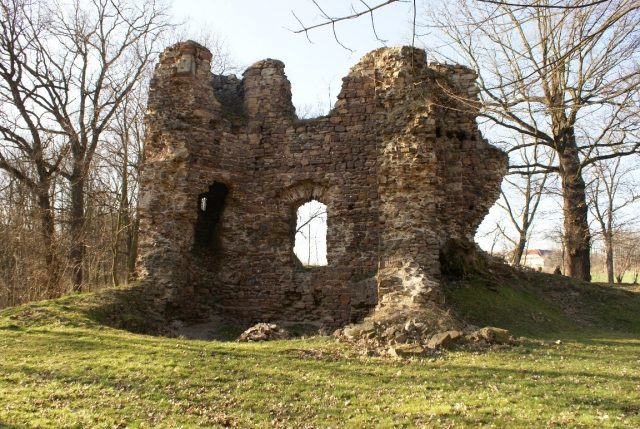
Osterland Castle near Oschatz was probably a late Romanesque-early Gothic hunting lodge, built between 1211 (dendro) and 1230 under Margrave Dietrich the Oppressed, and already fell into disrepair from 1300 onwards as it no longer had a clear purpose. The three-story, four-wing complex was built over a stream and had the form of a Roman porticus villa with corner risalits. The spring or water house in the inner courtyard, temporarily uncovered during excavations in 1901–08 and 1991–92, is one of the most beautiful examples of European Romanesque architecture. A connection of this complex as a residence for the Margraves of Meissen and the Ostmark with the most important medieval court in the Margraviate of Meissen, the Thingplatz at the 1000-year-old court linden tree in nearby Collm, where 15 court days, known as Landthing, were demonstrably held between 1185 and 1259, and which continued in Oschatz until the 14th century, is plausible. A feudal letter for Wolfgang von Schleinitz from 1501 documents meadows, ponds, dams, and woods in the immediate vicinity of the object then called "Altes Steinhaus" (Old Stone House), which in 1501 belonged to the feudal possession of the Vogtshaus Oschatz, built around 1200, opposite the Oschatz town church. Another enigmatic object like Osterland Castle is the origin of Grillenburg Castle in the Tharandt Forest.
The name "Osterland" in connection with the ruins outside the gates of the city of Oschatz dates back to written mentions from the early 18th century. When creating a geographical atlas commissioned by August the Strong, the pastor and geographer Adam Friedrich Zürner referred to the ruin as "wüstes Schloss Osterland" (desolate Osterland Castle). It is assumed that this designation was prevalent among the population at that time. A deed of gift from 1379 refers to the castle as "wüstes steynhuse" (desolate stone house). It should be noted that the word "wüstes" here can also mean abandoned. In all subsequent documents from 1388 to 1511, there is no longer talk of 'wüst', but of "alten Steynhuze" (old stone house) or "alden schlosse" (old castle).
Take Mobile History with you
You are reading this text for free. Premium adds what matters on the road: descriptions read aloud, sites found through your camera, whole regions taken offline.
- Every description, including the ~17,700 Premium sites
- Audio guide: have descriptions read to you on location
- AR finder: see sites through your camera, with distance and bearing
- Unlimited saved sites
14 days free, then from €2.99 a month. Cancel anytime.
Source: Wikipedia · Licence: CC BY-SA 4.0 · Image: Roland Neubert, Halle (Saale)
This description draws on the facts documented in the linked Wikipedia article; Wikipedia content is licensed under CC BY-SA 4.0. Wording and editing: Mobile History.
Location: 51.2905, 13.0704