The remains of the Castle can be visited
CastleNiederdürenbach
Olbrück Castle
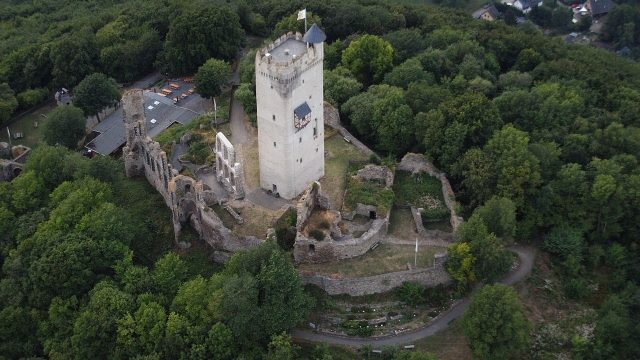
The ruin of Olbrück Castle, colloquially often referred to as "die Olbrück", stands on a phonolite cone about 460 meters high above the village of Niederdürenbach in the Ahrweiler district and is the widely visible landmark of the Brohl Valley. More than 15 families have owned the complex since the castle's foundation around 1100. It was destroyed several times and rebuilt again and again – at least partially.
The hilltop castle is one of the oldest and largest of its kind in the Eifel and has been a protected monument since June 24, 1980. The castle hill has been designated as a nature reserve since January 13, 1986.
Olbrück is a hilltop castle with a rhomboid floor plan. The castle is dominated by the 34.10-meter-high main tower in the center of the complex. It is dated to the mid-14th century, making it the oldest preserved part of the complex. Its uppermost floor consists of a battle platform, now used as a viewing platform, whose crenellated parapet is a 19th-century reconstruction. The residential tower, often referred to as a keep, has rounded corners and a floor plan measuring approximately 8x12.5 meters. Its plastered masonry is up to five meters thick. The rooms of the five tower floors have vaulted ceilings and are accessed by a spiral staircase in the northeast corner. Today they serve as museum rooms where visitors can learn about the building history and function of castles. The tower access is now on the ground floor, but in earlier times the high entrance was on the second floor and could only be reached via a drawbridge from an adjacent residential building. It can still be seen today as a narrow round-arched opening on the north side. The half-timbered bay window on the exterior of the third upper floor is a free reconstruction from 2001. From the roof of the tower, visitors have a good view of the Rhine to the east, the Ahr Mountains to the north, and the volcanic landscape to the south. In good weather, even Cologne Cathedral can be seen.
To the south are the remains of a rectangular residential building, whose long side was divided by windows into seven axes. Its two corners on the south side were marked by massive round towers. The building dated from the end of the 17th century and was erected using older foundations. To the northeast are the remains of a medieval residential building, including a room that still has vaulted beginnings and is therefore interpreted as a former chapel. The entire core castle is still surrounded by remnants of the former curtain wall and had an outer bailey to the east, west, and north.
Access to the castle area is from the south through a lower, neo-Gothic gate flanked by a thick, round tower. Its current upper floor was only added to the tower stump in 1875.
The hilltop on which the castle ruin is located was already used by Celts and Romans to monitor the Brohl Valley. The medieval fortified complex was the center of a dominion comprising ten villages, which appears in the oldest documents as Oleburg and Holebriche.
Already in the first foundation charter of Laach Abbey (today Maria Laach) from 1093, a Burchardus von Ulbrucke (Burkhard von Olbrück) is mentioned. Numerous indications suggest that this document is a forgery from the 13th century. Only the second foundation charter of the abbey from 1112, in which a Burghardus de Oreburch is mentioned, is a reliable indication of a noble family that had its seat at Olbrück Castle. Burkhard von Olbrück came from the House of Wied, in whose sole possession Olbrück remained until 1244, before the main line of the family died out.
Around 1190, Dietrich I von Wied enfeoffed the castle complex to Archbishop Philipp I von Heinsberg of Cologne for 400 marks.
When the elder line of the House of Wied died out in 1244, one half of Olbrück fell to the brothers Bruno II von Braunsberg and Dietrich von Isenburg, while the other went to their cousins Gottfried and Gerhard von Eppstein. The Eppsteiners sold their share in 1271 to a knight named Peter I von Eich, who also acquired half of the Isenburg property.
A remaining part of Olbrück was still in Eppstein possession until 1306, before it was sold to Count Rupprecht II von Virneburg. In 1318, the Eich share of the castle was divided among the individual family lines, giving Olbrück definitively the status of a Ganerbenburg (castle with shared ownership). The Virneburg share of the complex changed owners several times from 1319 onwards, until Agnes von Virneburg married Wilhelm I von Isenburg-Braunsberg in 1329, and he made the castle a wedding gift to his wife, thus returning the complex to Virneburg possession.
Through marriage, a part of the Olbrück castle complex came into the possession of Friedrich and Philipp von Schöneck in 1373, while the heiress Katharina von Eich married in 1390 and brought her inherited share of the castle to her husband's family, Wilhelm von Orsbeck. In 1422, the ownership shares were further fragmented by the marriage of Elisabeth von Eich to Godart von Drachenfels. His son sold his share in 1469 to the von Wied family.
In the first quarter of the 16th century, the ownership of Olbrück Castle had become so widely branched among various families through purchase, pledging, marriage, inheritance, and transfer, that it was difficult to keep an overview. More than a dozen noble families could boast shares in Olbrück, and so it is not surprising that disputes over ownership dragged on for decades. This only changed on April 22, 1555, when, after tough negotiations, family skirmishes, and various arbitration courts, the castle and lordship of Olbrück came into the sole possession of the Waldbott von Bassenheim family for 15,000 gold guilders.
During the Thirty Years' War, the complex was captured and devastated in 1632 by Swedish troops under Wolf Heinrich von Baudissin. But already in January 1633, Spanish and Electoral Cologne troops under the command of Count Ernst von Isenburg-Grenzau were able to recapture it. Partially collapsed in 1660, the castle was subsequently restored under the direction of the Capuchin friar Bonitius from Linz.
During the War of the Palatine Succession, a French garrison of 26 dragoons and 52 soldiers was stationed in the castle. When they finally withdrew on April 30, 1689, the castle administrator Engelbert von Keiffenheim, through a payment of 236 guilders, ensured that the complex was not razed as was customary. But the relief of the castle inhabitants did not last long, because when the French General Marquis Henri d'Escoubleau de Sourdis passed Olbrück with his troops on May 3 and found the complex intact, he gave the order to destroy it anyway. Large parts of the building fabric were demolished and fires were set in several places. But the inhabitants of Olbrück did not despair and began rebuilding as early as 1690. The chapel and the representative residential building in the Baroque style, often mistakenly referred to as a palas, date from that period of construction.
When French revolutionary troops occupied the Rhineland, Olbrück Castle was abandoned as a residence in 1797. The complex was confiscated and declared national property, before being sold for demolition by the French administration in 1804 and subsequently used as a quarry. A new cycle of changing owners began. In 1878, the German-Russian nobleman Baron Oskar Otto von Eckesparre, who came from the Baltic Sea island of Oesel, acquired the complex, whose main tower had been renovated in 1874/75 by the Ahrweiler district master builder Hermann Cuno. In the course of these measures, the building had received a new crenellated parapet and a wooden staircase on the ground floor. Eckesparre had the four rooms of the tower comfortably furnished and equipped. However, when he lost interest in Olbrück Castle due to family circumstances, he sold it again.
From 1956, the Düsseldorf architect Rainer Maria Schlitter was the owner of the complex. Due to lack of funds and official requirements, he could not realize his plan to build a large residential complex or a hotel. Despite some restoration work and renovation measures, the castle complex fell into disrepair – also due to vandalism – increasingly. After the Brohltal municipal association took over the ruin on lease in November 1998 at the instigation of the then mayor Hermann Höfer, it was included in the concept of the Brohltal/Laacher See Volcanic Park as a museum and monument and was renovated with considerable financial resources between 1999 and 2001. Archaeological investigations were also carried out during this time. Since September 1, 2001, the castle complex with a restaurant has been accessible to the public for a fee and has approximately 20,000 visitors annually.
In 2012, Schlitter sold Olbrück Castle to the Slovak financial advisor Pavol Pavlovic, after sales negotiations between him and the municipal association had failed.
Take Mobile History with you
You are reading this text for free. Premium adds what matters on the road: descriptions read aloud, sites found through your camera, whole regions taken offline.
- Every description, including the ~17,700 Premium sites
- Audio guide: have descriptions read to you on location
- AR finder: see sites through your camera, with distance and bearing
- Unlimited saved sites
14 days free, then from €2.99 a month. Cancel anytime.
Source: Wikipedia · Licence: CC BY-SA 4.0 · Image: http://de.wikipedia.org/wiki/Datei:Burg_Olbr%C3%BCck_025-.jpg
This description draws on the facts documented in the linked Wikipedia article; Wikipedia content is licensed under CC BY-SA 4.0. Wording and editing: Mobile History.
Location: 50.4508, 7.1696