The remains of the Castle can be visited
CastleManderscheid
Niederburg Castle
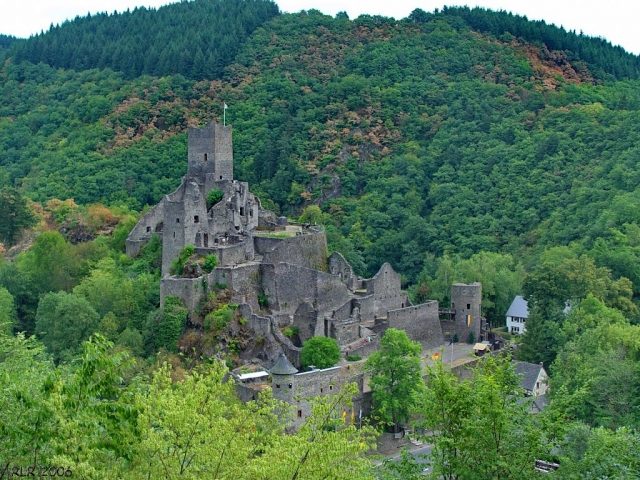
The Niederburg is located on a rock in the Lieser Valley below the Oberburg, a stone's throw away. However, it is separated from the Oberburg by the small river Lieser, which surrounds the Niederburg on three sides. This valley location once had the advantage of being able to control traffic and, in case of conflict, to block it.
In 1173 (according to other sources 1133), the Niederburg is first mentioned in documents. It is the ancestral seat of the Manderscheid family, who became significant for the Eifel (and partly beyond) in the Middle Ages, ruling here as bailiffs of Echternach Abbey on Luxembourg territory. Over time, large areas of the Gau Bedense (Bitburg), including the district of Niedermanderscheid, had been granted to the abbey from royal possessions.
A significant expansion of the castle and its fortifications took place under Wilhelm V von Manderscheid, who also extended them over the district of Niedermanderscheid.
From 1346 to 1348, the castle was besieged by troops of the aforementioned Elector Balduin of Trier, but it survived the siege unconquered.
Finally, in 1457, Dietrich III von Manderscheid was granted the title of Imperial Count. He had three sons, so after his death, the Manderscheid family divided into the lines Manderscheid-Kail (son Wilhelm), Manderscheid-Schleiden (son Cuno), and Manderscheid-Blankenheim (son Johann), according to the parts of the original dominion that fell to them. The Niederburg remained in the possession of the Lords of Manderscheid-Blankenheim, who, however, no longer inhabited it and allowed it to fall into disrepair. The last ruler from the Manderscheid-Blankenheim line was Countess Augusta, before she and her family had to flee in 1794 from the approaching French troops to the lands of her husband, the Count of Sternberg, in Bohemia. The castle was destroyed by the French.
Today
The ruins of the Niederburg have been owned by the Eifelverein since 1899 and are being slowly but continuously restored by them.
It can be visited − daily during the summer months −. Group tours are possible upon request. The castle can also be booked for private events, such as weddings.
On the last weekend of August each year, a medieval festival takes place at the castle and the adjacent tournament field, attracting approximately 15,000 visitors.
Take Mobile History with you
You are reading this text for free. Premium adds what matters on the road: descriptions read aloud, sites found through your camera, whole regions taken offline.
- Every description, including the ~17,700 Premium sites
- Audio guide: have descriptions read to you on location
- AR finder: see sites through your camera, with distance and bearing
- Unlimited saved sites
14 days free, then from €2.99 a month. Cancel anytime.
Source: Wikipedia · Licence: CC BY-SA 4.0 · Image: Rainer Gindele
This description draws on the facts documented in the linked Wikipedia article; Wikipedia content is licensed under CC BY-SA 4.0. Wording and editing: Mobile History.
Location: 50.0915, 6.8176