The remains of the Castle can be visited
CastleStockach
Nellenburg Castle
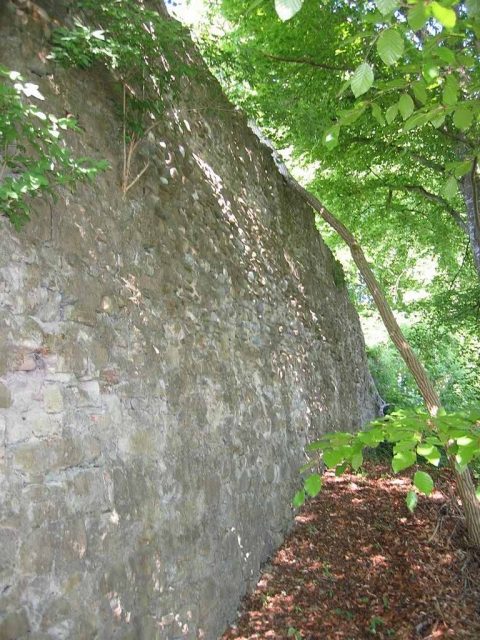
The Nellenburg is an early medieval castle ruin west of Stockach in the Konstanz district, Baden-Württemberg. It formed the center of power of the Landgraviate of Nellenburg. The ruin of the former spur castle (613 m above sea level) is located about 2 kilometers west above the old town of Stockach on a molasses spur, not far from the Nellenburg mountain (624 m above sea level). This is Stockach's local mountain, which was strategically located at the western end of Lake Constance in the Middle Ages and today borders a nature reserve.
Just under 300 meters east of the castle ruin, slightly lower, lies the "young Nellenburg" with the mountain inn "Nellenburg", also in an exposed location. The "Four-Country Panorama" can be seen on a very clear day, with views of Lake Constance and Hegau, the Austrian, Swiss, and even the French Alps.
The Nellenburg had been the seat of the Counts of Nellenburg since the mid-10th century and was first mentioned in 1056 as "castellum meum Eberhardi comitis Nellenburc". However, a Gottfridus de Nellenburg is already attested in 958, meaning the castle already existed in the 10th century. Its founding period, however, is still unknown, as is its building history.
Its owner, Eberhard Count of Nellenburg (* 1010 at Nellenburg Castle, † January 25, 1078 in Schaffhausen (Switzerland)), a relative of Emperors Conrad II and Henry III, founded the Benedictine monastery of All Saints in Schaffhausen in 1049, while the supervision of the "lower landscape" Landgraviate of Nellenburg came from the 3 castles on the Hohenstoffeln, the ruin of Hohenstoffeln.
Around 1050, the Nellenburg family shifted the center of their rule from the Zürichgau to the High Rhine to protect their newly created centers, the All Saints Monastery in Schaffhausen and Nellenburg Castle.
As a result of the Investiture Controversy, Count Burkard († 1105), the last of the older line of Nellenburg, lost the castle, which passed to his nephew Count Dietrich in 1105 and parts of the land to Count Adalbert of Mörsberg. The von Bürgeln form the so-called middle line of Nellenburg.
In 1170, the County of Nellenburg came into the possession of the Counts of Veringen through marriage, who, after a division of inheritance in 1216, founded the younger line of Nellenburg until 1422.
In 1291, Duke Albrecht of Austria besieged the Nellenburg, then the seat of Count Mangold II of Nellenburg (-Veringen), who had participated in the uprising of Swabian nobles against Habsburg. The round main tower collapsed due to undermining.
In 1422, the Nellenburg also passed through marriage into the possession of its heirs, the Lords of Tengen, who were henceforth known as Counts of Tengen. They sold the Landgraviate of Nellenburg in 1465 for 37,905 guilders to Archduke Sigismund of Austria (Habsburg).
Stockach was the main town of the Landgraviate of Nellenburg until the mid-15th century and then passed into Habsburg possession. For 340 years, from 1465 to 1805, Stockach with the County of Nellenburg belonged to Further Austria.
In 1499, Stockach was besieged by the Confederates, and the chronicle mentioned that the Swiss camp was shelled by the Nellenburg garrison and its cannons.
As building accounts and records show, the castle was in poor condition in the 16th century. In 1565, it was stated that the castle was "poorly built and not at all suitable for a princely residence". In 1571, a large section of the wall collapsed, and not all rooms of the castle were habitable anymore.
Either in 1639 or 1642, during the Thirty Years' War (1618–1648), the Nellenburg was "badly damaged and ruined" by troops of the Württemberg commander of Hohentwiel, Konrad Widerholt, so that buildings fell into "remarkable" disrepair. The well was filled in to make the castle unusable for defense.
By 1668/69, some buildings of the castle had been rebuilt. A "Urbar" (land register) in the Stockach city archive reports that there were now seven rooms, nine chambers, two kitchens with ovens, three cellars, and a vault. In addition, there was the castle chapel of St. Gangolf and outbuildings in the outer bailey. The well had since been cleared again.
In 1669, residential buildings outside the Nellenburg were mentioned for the first time, creating the so-called "young Nellenburg". Since the end of the 17th century, it served as a residence for house administrators and head hunters of the Nellenburg.
In 1760, a description of the Landgraviate of Nellenburg states: "But now the castle, due to its age and because no more repair costs are to be spent, is quite ruinous and in a dilapidated state."
Following the order of the responsible district office ("Oberamt Nellenburg" with administrative seat Stockach) to demolish the dilapidated castle, including the "chapel located there", this largely happened in 1782/83. Stones from the castle were used for road and bridge construction in the region.
The castle, greatly reduced in size by the demolitions and a fire in the 1830s, was inhabited in the 1840s by "impoverished people" who had their homes in the ruins.
In 1886, the Stockach Beautification Association erected a wooden observation tower in the ruins of the main castle. In 1922, this was dismantled due to dilapidation.
From 1926 until the end of 2010, the former estate residence housed an inn. In the mid-19th century, it came into the possession of the Counts of Langenstein, the noble family from near Orsingen.
At the beginning of 2007, Axel Graf Douglas of Langenstein became the new owner. He planned to have the old shed next to the house demolished. Soon after, however, Patrick Graf Douglas acquired the Nellenburg for his sons Benedikt Graf Douglas and Christopher Graf Douglas. He intends to build two more residential houses on the Nellenburg hilltop. There is a fundamental need for renovation of the existing buildings on the Nellenburg.
Description+
Nellenburg
Of the former Nellenburg, only remnants of the main tower, the valley-side front wall, and remnants of the wall to the forecourt have been preserved. The ruin is freely accessible.
Young Nellenburg
The young Nellenburg is a historically significant estate. The center of the residential building, erected in the 19th century, is the guest room, characterized by dark wooden beams on the ceiling, wooden corner benches, and the central tiled stove. However, the kitchen and guest room were swapped at that time. The apartments are located above the guest room.
Legend of the beautiful Nella+
As Christianity began to spread around the lake, it happened that Count Mangold got lost while hunting in the thicket of the forest. After a long time, he saw a small flicker of fire and there saw a group of men sitting, dreamily listening to the harp sounds of a maiden.
It was the pagan sacrificial site of the beautiful Nella. In holy zeal, he smashed the sacrificial stone to pieces, but was captured and thrown into the dungeon. Sentenced to death, the beautiful Nella took a liking to him and had him pardoned. He then asked for Nella's hand and succeeded in converting her to the Christian faith. When she asked for baptism, a clear spring gushed from the ground, which subsequent generations named Nellabach. Mangold, however, built a castle on this spot, which bore the name Nellaburg in honor of his wife.
Coat of Arms+
The coat of arms shows three blue deer antlers one above the other on a golden shield. For more on the coat of arms, see → Coat of Arms of Württemberg.
Take Mobile History with you
You are reading this text for free. Premium adds what matters on the road: descriptions read aloud, sites found through your camera, whole regions taken offline.
- Every description, including the ~17,700 Premium sites
- Audio guide: have descriptions read to you on location
- AR finder: see sites through your camera, with distance and bearing
- Unlimited saved sites
14 days free, then from €2.99 a month. Cancel anytime.
Source: Wikipedia · Licence: CC BY-SA 4.0 · Image: http://de.wikipedia.org/wiki/Datei:Nellenburg_3.JPG
This description draws on the facts documented in the linked Wikipedia article; Wikipedia content is licensed under CC BY-SA 4.0. Wording and editing: Mobile History.
Location: 47.8486, 8.9847