The remains of the Castle can be visited
CastleNeidenfels
Neidenfels Castle
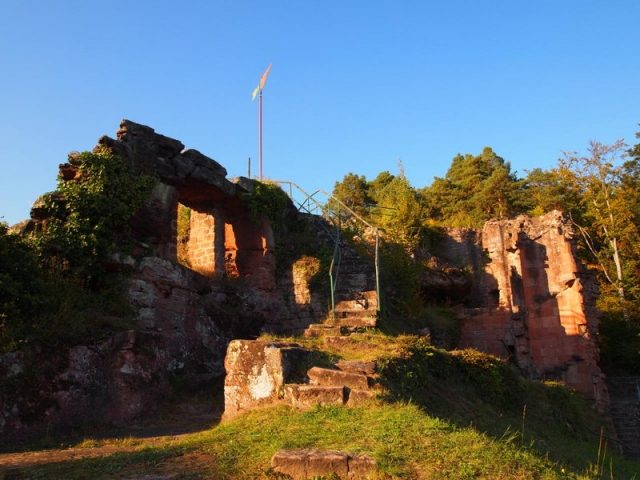
Neidenfels Castle is the ruin of a hilltop castle on a 258 m above sea level rock formation on the "Schlossberg" above the village of Neidenfels in the district of Bad Dürkheim in Rhineland-Palatinate.
The castle was built around 1330 by Count Palatine Rudolf II, as a successor to Lichtenstein Castle on the neighboring ridge. The first documented mention was in 1338.
Feudal lords were the Lords of Lichtenstein, Gerhard and Johannes von Odenbach, Wachenheim and Moosbach. Johann von Wachenheim lent the Count Palatine 500 gold guilders in 1356 for the expansion of Neidenfels. In 1409, the fief holders were Dieter II. Landschad von Steinach and his wife Irmgard; they were to invest 400 guilders in the castle. A year later, upon his accession to power, Elector Ludwig III enfeoffed the Nobles of Steinhausen with Neidenfels, followed by the Angellocher family.
Cavalry Colonel Peter Beutterich, diplomat and government member, received the Neidenfels property from Elector Johann Casimir, the "Hunter from Kurpfalz", in 1577 and became his "Foreign Minister".
The castle was blown up by the French in 1689 during the Palatinate War of Succession. In 1749, forester Glöckle had vineyard terraces built on the castle hill using stones from the castle, but without success.
The Neidenfels municipal council accepted the castle as a donation in 1935, and preservation measures began.
Extensive preservation measures worth 300,000 DM took place in 1986.
Naming
There are various theories about the origin of the name Neidenfels. Two of them are considered particularly likely.
1st Theory
The word Neidenfels is based on the Old German words: Nydenfelz, Nydenfelß, Nidenfels, which means as much as Niederfels or lower rock and is derived from the Old German word Nid=Nida=below. This probably referred to the rock on which Neidenfels Castle is located, which, compared to the higher rock of Lichtenstein Castle, was lower, i.e., below.
2nd Theory
In Middle High German/Old High German, "nid" (OHG), "nit" (MHG) is translated as "zeal and wrath of a warrior". It is assumed that the name is a reference to the envy of the neighbors, which had to be fended off. This was probably due to the function of Neidenfels Castle as a combat/defensive castle.
Legends+
According to legend, Lichtenstein Castle was still opposite and was inhabited by a brother of the lord of the castle, who initially got along quite well. But after some time, the owner of Neidenfels became envious, developing resentment and hatred towards his brother. Since he shied away from a duel, he treacherously shot him with an arrow through the window. From then on, only Neidenfels Castle remained and gave the place its name.
When the castle was already a ruin and the eerie place was avoided by the population, two young shepherds led their goats to the pasture in front of the castle one evening. When the bells of St. Nicholas Chapel rang, they wanted to round up their flock and go home. But the two most valuable goats were missing. One of the brothers ventured through the bushes to the castle. At a rock crevice, he met a white woman. She did not return the goats, but filled his bag with something heavy. However, he was not allowed to look at what it was until he was home. When he met his brother again, the latter desperately wanted to know what was in the bag, but he did not show it to him. The brother was too curious and reached into the bag and pulled out part of the contents; it was goat dung. The brother, however, waited until he was home to look at the rest in the bag and discovered gold.
Take Mobile History with you
You are reading this text for free. Premium adds what matters on the road: descriptions read aloud, sites found through your camera, whole regions taken offline.
- Every description, including the ~17,700 Premium sites
- Audio guide: have descriptions read to you on location
- AR finder: see sites through your camera, with distance and bearing
- Unlimited saved sites
14 days free, then from €2.99 a month. Cancel anytime.
Source: Wikipedia · Licence: CC BY-SA 4.0 · Image: http://www.wehrbauten.de/thread.php?threadid=1338
This description draws on the facts documented in the linked Wikipedia article; Wikipedia content is licensed under CC BY-SA 4.0. Wording and editing: Mobile History.
Location: 49.3917, 8.0458