The remains of the Castle can be visited
CastleDrei Gleichen - Mühlberg
Mühlburg Castle
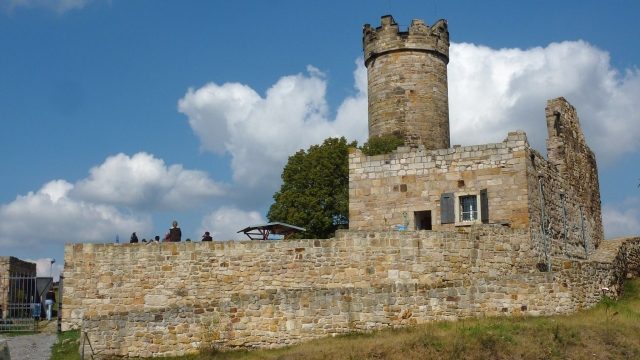
The Mühlburg, also known as Mühlberg, located on a spur of the Schlossleite above the village of Mühlberg, is the oldest castle of the Drei Gleichen and is considered the oldest preserved building in Thuringia.
With a document dated May 1, 704, the Thuringian Duke Hedan II gifted the Castello Mulenberge, along with estates in Mulenberge (Mühlberg), Arnestati (Arnstadt), and Monhora (Großmonra), to the missionary and bishop Willibrord of Utrecht. Whether this castle already stood at the site of the present Mühlburg is not certain, especially since it was not a masonry structure. Its prehistory probably dates back to the time of the Thuringian Kingdom and its subjugation in 531 by the Franks.
Timeline:
- In the year 1000, the spur castle came into the possession of the Counts of Orlamünde.
- In 1088, Emperor Henry IV besieged the castle and, at the same time, the Gleichen Castle on the other side of the valley, but without success.
- In 1130, the castle, as part of the inheritance of the extinct male line of the Counts of Weimar-Orlamünde, along with Gleichen Castle, came into the possession of the Archbishopric of Mainz, which enfeoffed the noble family of the Meinharde with the Mühlburg.
- In 1140, Count Meinhard I of Mühlberg received the castle as a fief.
- In 1211, Count Meinhard III, as a suitor for the Thuringian Landgrave Hermann I's son Ludwig, escorted the four-year-old (!) Elisabeth of Hungary to Wartburg Castle.
The Meinharde, who from then on called themselves Counts of Mühlburg, acquired the neighboring Wachsenburg fortress in 1220. They died out in 1242 with Meinhard III, and Mainz reclaimed the vacant fief.
- In 1248, Count Berthold of Henneberg became the first castle captain.
- In 1310, the people of Erfurt launched an – albeit also unsuccessful – attack on the castle and then bought it in 1357. It was subsequently expanded into a strong bulwark and served until 1590, when the Mühlberg office passed to Saxony-Weimar, to secure the Erfurt trade routes (Copper Road).
- In 1375, the castle bailiff, Edler von Hellbach, and the castle owner, the Count of Gleichen (presumably Ernst II), feuded.
- In 1521, Hermann von Hoff became castle captain and accompanied Martin Luther to the Diet of Worms.
- In 1592, the Duke of Weimar acquired the castle and sold it in 1635 to the Duke of Altenburg.
- In 1665, Mainz again took over the office with the now heavily dilapidated castle, before it passed in 1815 as an enclave to the Kingdom of Prussia, surrounded by Gotha territory.
- In 1802, the town and castle fell to Prussia as a result of the Reichsdeputationshauptschluss (Imperial Deputation Main Resolution).
- In 1806, the castle came under French rule.
- In 1815, the castle returned to Prussia and, along with Gleichen Castle and other possessions, passed into the private ownership of Field Marshal Baron Freiherr von Müffling.
- From 1903 to 1907, the keep was converted into an observation tower and fitted with battlements.
- Around 1930, the then castle warden, Richard Opel, succeeded in finding the remains of the walls of the medieval Radegundis Chapel, which he excavated to man height.
- In 1945, the walls were unknowingly removed, so that today only the foundations are visible.
- Since the early 1970s, the castle has been gradually restored by the citizens of Mühlberg. Today it houses a small museum and can be visited.
- In June 1987, the 1400th anniversary of Radegundis' death was commemorated, and a memorial stone was placed within the foundations of the chapel. A Radegundis Chapel was also established in the tower of Mühlberg's St. Lukas Church, where an ecumenical service with a subsequent procession to the former chapel on the Mühlburg takes place annually on the Sunday after August 13.
The Mühlburg gained some fame through Gustav Freytag, whose novel "Das Nest der Zaunkönige" from the novel series "Die Ahnen" is set at the castle. However, the Mühlburg never played a significant role in the history of Thuringia and was not owned by a family that, like the Zaunkönige, could engage in a dispute with the German king. The Gustav-Freytag-Wanderweg (Gustav Freytag hiking trail), which connects the Mühlburg with the other two castles of the Drei Gleichen (Gleichen Castle and Wachsenburg Castle), was named after the poet.
Description+
One enters the castle from the south, from the ridge between the Mühlburg and the Wachsenburg, the Schlossleite. A wooden bridge leads over the neck ditch surrounding the castle, part of the rampart ditch, which is one of the most powerful of its kind in Thuringia. Behind the neck ditch, one encounters the remains of the Zwinger wall, then the ring wall and the wall of the core castle. Above everything towers the keep. These four obstacles made it difficult for attackers and were, in the 13th century, state-of-the-art in terms of defensive technology for a heavily fortified castle.
The gatehouse, as part of the Zwinger wall, is only preserved in remnants.
Within the core wall, the castle was built on natural rock. This made undermining virtually impossible.
Not far from the castle, at the beginning of the Schlossleite ridge, stands a chapel dedicated to St. Radegundis. The age of the foundations of the predecessor chapel, on which it is built, has not yet been definitively researched.
Usage+
On the castle grounds, there is a museum about pottery and household items from the Middle Ages, as well as a restaurant. The tower can be climbed during opening hours. From it, the other two castles can be seen. Furthermore, there is an operational mailbox and a well on the premises.
In summer, an open-air cinema organized by the Mühlberg Art and Culture Association takes place on the castle grounds.
Take Mobile History with you
You are reading this text for free. Premium adds what matters on the road: descriptions read aloud, sites found through your camera, whole regions taken offline.
- Every description, including the ~17,700 Premium sites
- Audio guide: have descriptions read to you on location
- AR finder: see sites through your camera, with distance and bearing
- Unlimited saved sites
14 days free, then from €2.99 a month. Cancel anytime.
Source: Wikipedia · Licence: CC BY-SA 4.0 · Image: Joachim Schneeleopard
This description draws on the facts documented in the linked Wikipedia article; Wikipedia content is licensed under CC BY-SA 4.0. Wording and editing: Mobile History.
Location: 50.8689, 10.8322