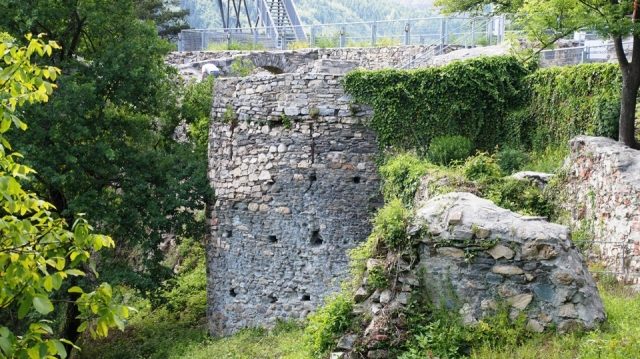
The remains of the Castle can be visited
CastleLeoben
Massenburg Castle
As early as 960, a simple wooden fortified structure stood here, belonging to the Counts of Leoben. Margrave Aribo might have been the builder of the first fortress. From the Aribonen, it passed to the Traungauer. Thus, it was princely property from the beginning and remained so throughout its entire history. Its administration and defense were initially undertaken by princely ministerials, who named themselves after Leoben.
In 1260, King Ottokar II relocated the settlement of Leoben to the more defensible Murschleife. To better protect the south side, the so-called Oberhaus was built on the Massenberg. The name was chosen to distinguish it from the princely castle.
In 1312, the brothers Wigand IV and Heinrich renounced their pledge rights over the "Oberhaus von Leoben". Only after the Massenburger family moved away was the castle referred to by its name. It was then mostly administered by princely liegemen, among whom the Timmersdorfer were primarily counted. At the beginning of the 15th century, Peter Grader is mentioned as the administrator of the castle. In 1440, the dominion was given as a fief to Christof Hofmann zu Formbach. The next administrators or feudal tenants were Hans von Malti (1494), Hans Gerhab (1502), and Hans Haug (1514). The latter was supposed to repair the already heavily neglected fortified structure. However, in 1518, he received St. Peter-Freienstein Castle, so Emperor Maximilian I could hand over the Massenburg as a pledge to Veit Zollner. When Zollner received the dominion as an hereditary life estate in 1528, he began to expand and enlarge the castle.
In 1664, Hans Ludwig Zoller had to temporarily pledge the Massenburg to Admont Abbey. Through the second marriage of Maria Johanna Franziska von Zollner, Hartmann Ludwig Berchtold von Neuhaus became lord of the Massenburg. However, the actual power was held by Johann Ernst Freiherr von Teufenbach, his wife's lover. He eventually attacked the old lord von Neuhaus and forced him to leave the castle. After Ludwig Berchtold's death, his widow married her lover in 1694.
When his tax arrears became too large, the dominion was seized. It was handed over to Maria Anna Countess Wurmbrand in 1711. Under the Counts Wurmbrand, the Massenburg experienced its second heyday. However, inheritance disputes and rapidly changing ownership led to its rapid decline. In 1806, Alois Count Trautmannsdorf was the castle lord. His son Weichart was followed in 1845 by Franz Karl Count Wurmbrand, then in 1855 by Karl Count Stürckh, and finally in 1872 by Karl Leopold Count Galler.
Around 1810, the castle was still an imposing complex. Shortly thereafter, however, it was allegedly already dilapidated, which prompted Count Alois von Trautmannsdorf to have it completely demolished around 1820. When Count Karl Leopold Stürckh received the Massenburg as a princely fief for the last time in 1860, only its foundations remained. It was not until 1937 that the city of Leoben remembered its historical heritage and had the remaining structural elements uncovered and partially reconstructed. As late as 1942, the strategically favorable location of the former castle was used to set up an air observation post here. This was bombed by Russian aircraft, causing further destruction.
Today, the ruin site is owned by the municipality of Leoben. They had a renewed restoration carried out in 2000.
Take Mobile History with you
You are reading this text for free. Premium adds what matters on the road: descriptions read aloud, sites found through your camera, whole regions taken offline.
- Every description, including the ~17,700 Premium sites
- Audio guide: have descriptions read to you on location
- AR finder: see sites through your camera, with distance and bearing
- Unlimited saved sites
14 days free, then from €2.99 a month. Cancel anytime.
Source: Wikipedia · Licence: CC BY-SA 4.0 · Image: http://www.wehrbauten.at
This description draws on the facts documented in the linked Wikipedia article; Wikipedia content is licensed under CC BY-SA 4.0. Wording and editing: Mobile History.
Location: 47.3755, 15.0968