The remains of the Castle can be visited
CastleSeelbach
Lützelhardt Castle
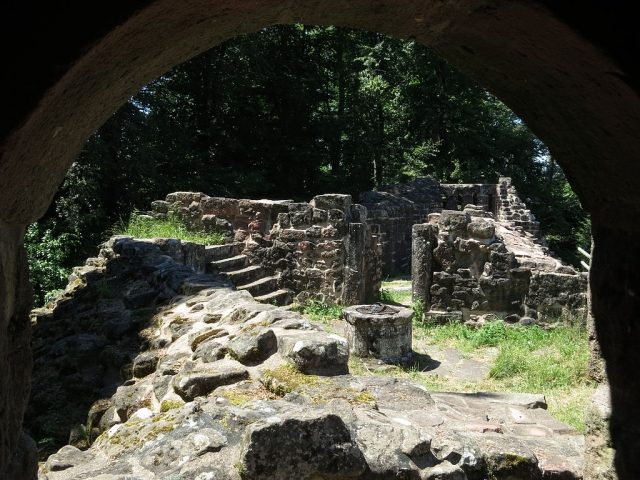
Lützelhardt Castle, also spelled Lützelhard, is the ruin of a medieval castle complex east of Seelbach in the Ortenau district of Baden-Württemberg. The former rock castle is located at an altitude of approximately 460 meters. Its name derives from the Old High German lucilinhart (small forest), which is a very common castle name in the German-speaking world.
Originally, the construction likely served to secure the pass road into the Kinzig Valley. From the 11th century onwards, the southern Ortenau increasingly fell under the influence of the Zähringer. The construction of the castle in the early 12th century is likely attributable to this lineage. It was probably managed by a Zähringer ministerial family. However, there are few written records. In the course of disputes between the Staufer and the Bishops of Strasbourg, the castle was probably destroyed around 1235 by the neighboring Geroldsecker, who belonged to the episcopal party. Afterwards, the security of the pass road was taken over by the newly built Hohengeroldseck Castle.
Lineage
In the 12th century, Zähringer ministerials bearing the name "von Lützelhardt" are repeatedly mentioned. A branch of this family or this ganerbschaft rose to imperial ministerial status around the middle of the 12th century. A Konrad von Lützelhardt became one of the most important officials of the Staufer imperial administration in Italy. For him, the name Mosca-in-Cervello or Mosca-in-Cerebro (Fly-in-Brain) is handed down. Especially during the conquest of the Kingdom of Sicily by Henry VI, Konrad von Lützelhardt, as Margrave of Molise, was of central importance as a military leader. Descendants of this Konrad also appear in the 13th century and call themselves de Lucinardo. They soon appear in opposition to Emperor Frederick II. Their trace is lost in the late 13th century.
Legend
The castle is associated with the legend of the Gruselhorn, according to which a Lord of Geroldseck was abducted to Lützelhardt, discovered his whereabouts through a familiar horn call, and was then able to free himself. Afterwards, Lützelhardt was said to have been destroyed.
Description+
The three parts of the castle lie on three differently sized, up to 10-meter-high rocks and were originally probably connected by a palisade. The rising walls of the castle largely date back to excavations and reconstructions from 1926 to 1929. Particularly impressive are the remains of the main house with Romanesque palas windows and a dragon relief. Inside the main house is a medieval cistern. Numerous finds are preserved in the museum of the city of Lahr.
Take Mobile History with you
You are reading this text for free. Premium adds what matters on the road: descriptions read aloud, sites found through your camera, whole regions taken offline.
- Every description, including the ~17,700 Premium sites
- Audio guide: have descriptions read to you on location
- AR finder: see sites through your camera, with distance and bearing
- Unlimited saved sites
14 days free, then from €2.99 a month. Cancel anytime.
Source: Wikipedia · Licence: CC BY-SA 4.0 · Image: http://de.wikipedia.org/wiki/Datei:Burgruine_L%C3%BCtzelhardt_%281%29.JPG
This description draws on the facts documented in the linked Wikipedia article; Wikipedia content is licensed under CC BY-SA 4.0. Wording and editing: Mobile History.
Location: 48.3161, 7.9530