To be privately owned
CastleLöcknitz
Löcknitz Castle
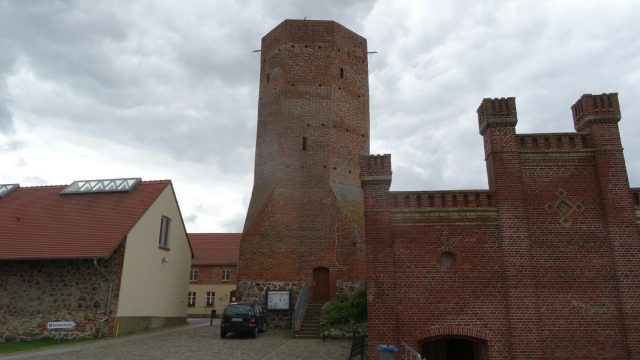
Löcknitz Castle is a castle in the municipality of Löcknitz in the southeast of Mecklenburg-Vorpommern, of which today only remnants, such as the octagonal keep, remain.
The Slavic castle "Lokenitza" was originally probably built from a pile dwelling with beams and surrounded by a ring wall with palisades and moats, protecting the ford through the Randow. In the 13th century, a German castle made of masonry was then erected. The villages of Bismark (today part of the municipality of Ramin), Plöwen, and Bergholz also belonged to the castle at that time.
As early as around the year 1124, a Slavic castellan "Conrad de Lokeniz" is known, but without further details or a direct connection to Löcknitz. In a deed of gift from Duke Bogislaw II of Pomerania from the year 1212, a "Thomas de Lokenitz" is listed as a witness, probably as the episcopal Vogt of Löcknitz Castle. According to the church statutes of the Diocese of Cammin, the "castrum Lokenitze cum opido" probably belonged to the table lands of the bishop there from the founding of the diocese in 1175 until 1385.
Löcknitz was often contested due to its location at the ford on the Randow river and on the border between Pomerania and Brandenburg. From the earliest times until 1250, it belonged to Pomerania. With the Treaty of Landin, Löcknitz then changed hands in a territorial exchange to the March of Brandenburg, where it remained until 1390. From 1390 to 1468, it again belonged to Pomerania. In 1390, the Löcknitz castle fief had been pledged to the Lords of Wussow, who kept it until 1416. By 1433 at the latest, Löcknitz was in the possession of the von Heydebreck family. In 1468, Löcknitz was reconquered by the Electorate of Brandenburg, and in 1472 and 1479, Brandenburg's possession of Löcknitz was confirmed in the Treaty of Prenzlau. Since then, Löcknitz Castle belonged as an independent administrative district (Amt) to the Uckermark region in Brandenburg until 1818. Elector Albrecht III Achilles of Brandenburg still enfeoffed Werner von der Schulenburg in 1479 with the hereditary captaincy over Löcknitz Castle and appointed him as Amtmann of the Löcknitz Amt. Both remained in the possession of the von der Schulenburg family until 1688. In 1557, Joachim von der Schulenburg had a new Renaissance-style castle or manor house with a chapel and a church built directly next to the castle. During the Thirty Years' War (1618–1648) and the occupation of Löcknitz by Sweden from 1636 to 1650, the von der Schulenburg family had been expelled from their possession. In the course of a long-standing legal dispute between the von der Schulenburg family and the Elector of Brandenburg from the end of the Thirty Years' War until 1688 regarding the ownership of Löcknitz Castle, the Elector had already created facts in 1685, transforming Löcknitz into an electoral domain and rejecting all claims of the von der Schulenburg family.
After the end of the Thirty Years' War (1618–1648), Löcknitz lay largely in ruins; essentially, only the castle with the palace and the fortress, as well as the castle mill, remained. The rivers Welse and Randow now formed the new border between Brandenburg and Swedish Pomerania. As a result, Löcknitz, with its fortified castle, became an important Brandenburg border fortress against Sweden after 1650.
During the Second Polish-Swedish War (Second Northern War) from 1655 to 1660, the border fortress of Löcknitz served in 1659 as an important starting point for the campaign of Brandenburg-Prussia, fighting on the Polish side, against Swedish Pomerania.
In the Swedish-Brandenburg War from 1674 to 1679, fighting between Swedish and Brandenburg troops again occurred in the Löcknitz area in 1675. During the Swedish invasion of Brandenburg in 1674/75, the fortified Löcknitz Castle, with its 180-man garrison under the command of the Brandenburg Colonel Götze, was surrendered to the Swedish troops under the command of the Swedish Sergeant Major Jobst Sigismund on May 14/15, 1675, after a one-day bombardment, with the assurance of free withdrawal and without offering significant resistance. For this, Götze was later sentenced to death by a court-martial and executed in Berlin on March 24, 1676. Elector Frederick William, the "Great Elector," recaptured the fortified Löcknitz Castle from the Swedes in 1675/76.
After the Great Northern War from 1700 to 1721, Löcknitz and its fortress were no longer on the border but in the hinterland. As a result, Löcknitz's centuries-old strategically important location at the ford through the Randow, as well as the castle, had become militarily insignificant for Prussia. In 1715, Löcknitz Castle with its palace and fortifications was still armed with 18 cannons, but the operating crews were already missing. The last fortress commander of Löcknitz known for the year 1717 is Lieutenant Colonel Heinrich von Blankenburg. Until the peace treaty in 1720, Löcknitz Castle with the palace and fortifications had been kept in a defensible state. In the same year, however, it was abandoned and gradually fell into disrepair in the following years.
Despite Löcknitz being in the hinterland, it was not spared from hostilities during the Seven Years' War from 1756 to 1763. Löcknitz suffered severe destruction due to the fighting in this war; in 1760, apart from the palace, remnants of the fortress, and the Amt, there were only 25 residential houses left.
In the course of the Napoleonic Wars from 1792 to 1813 and the Wars of Liberation from 1813 to 1815, large parts of the Löcknitz domain's lands were still parceled out in 1807 and then sold, including the palace, to private owners.
The palace was fundamentally renovated in 1851 and apartments were set up, which were used until the palace was closed by building authorities in 1958. After that, it stood empty, fell into disrepair, and was blown up in 1985. Today, only parts of the castle complex, such as the octagonal keep, some outbuildings, wall remnants, and the cellar vaults, remain. The keep and the cellar vaults are used by the Löcknitz Tourist, Local History, and Castle Association. The remains of the former castle complex, especially the outbuildings, are in private ownership and not publicly accessible.
Take Mobile History with you
You are reading this text for free. Premium adds what matters on the road: descriptions read aloud, sites found through your camera, whole regions taken offline.
- Every description, including the ~17,700 Premium sites
- Audio guide: have descriptions read to you on location
- AR finder: see sites through your camera, with distance and bearing
- Unlimited saved sites
14 days free, then from €2.99 a month. Cancel anytime.
Source: Wikipedia · Licence: CC BY-SA 4.0 · Image: Jörg Heldt
This description draws on the facts documented in the linked Wikipedia article; Wikipedia content is licensed under CC BY-SA 4.0. Wording and editing: Mobile History.
Location: 53.4532, 14.2044