The remains of the Castle can be visited
CastleJena - Lobeda
Lobdeburg Castle
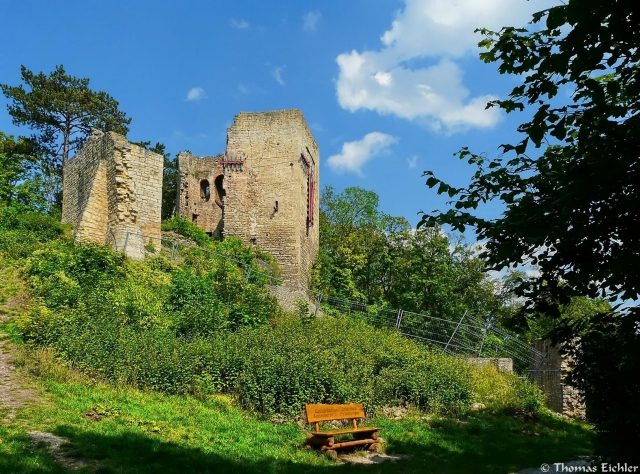
The Lobdeburg is a castle ruin near Lobeda, a district of Jena. The name Lobdeburg is claimed by three different structures, namely the upper, middle, and lower castles. The middle of the three castles is considered the actual Lobdeburg.
The middle Lobdeburg is located on an outcrop of the Wöllmisse, a plateau, between the towns of Lobeda and Bürgel. From here, the middle Saale valley, Rodatal, and Leutratal could be monitored. The upper Lobdeburg, actually only an outer bailey to seal off the main castle from the plateau, is only preserved in the form of the remains of a ring wall. The lower Lobdeburg is no longer visible today. It was most likely located at the lower end of the market. In its place, the name passed in modern times to the former Thünaische estate, which is now located on the northeastern edge of the locality.
Further castles were built in the immediate vicinity of the town of Lobeda, in Kunitz (Kunitzburg), Burgau, and above Kahla (Leuchtenburg). The Tautenburg also seems to be a Lobdeburg foundation; at least the dominion of Dornburg-Tautenburg was in Lobdeburg hands as an imperial fief in the 13th century.
The Lobdeburg was first mentioned in 1166. The castle was most likely built by the Lords of Auhausen, appointed as ministerials by the Emperor, who named the castle after the town of Lobeda. One reason for this was probably the good experiences the Emperor had already had with other ministerials belonging to the family group in the area. Shortly thereafter, the branch of the family residing here called themselves "von Lobedeburg". In 1185, the construction of the castle was completed. In 1340, it came into the possession of the Wettins. In 1450, Duke Wilhelm of Saxony conquered the castle in the Saxon Fratricidal War. Until 1591, the Puster family owned the castle. Subsequently, the decay of the complex began, and the stones were used for the construction of the Saale bridge near Burgau.
In the course of regional development, the Lords of Lobdeburg were probably responsible for the planned layout of the city of Jena. The first archaeologically secured finds in the old town area of Jena also date back to the second half of the 12th century.
Since 1912, there has been the Lobdeburg-Gemeinde 1912 e.V. The association, together with the Jena Monument Office, takes care of the preservation and renovation of the castle and its surroundings. Within the association, there is a working group "Ruine Lobdeburg". Since reunification, emergency securing work has begun on the important monument of Romanesque secular architecture. For example, the palas received a steel corset. In addition to some smaller investigations, the Jena city archaeologist Matthias Rupp is working on a comprehensive building-historical documentation of the "middle" Lobdeburg.
Take Mobile History with you
You are reading this text for free. Premium adds what matters on the road: descriptions read aloud, sites found through your camera, whole regions taken offline.
- Every description, including the ~17,700 Premium sites
- Audio guide: have descriptions read to you on location
- AR finder: see sites through your camera, with distance and bearing
- Unlimited saved sites
14 days free, then from €2.99 a month. Cancel anytime.
Source: Wikipedia · Licence: CC BY-SA 4.0 · Image: Thomas Eichler
This description draws on the facts documented in the linked Wikipedia article; Wikipedia content is licensed under CC BY-SA 4.0. Wording and editing: Mobile History.
Location: 50.8906, 11.6203