The remains of the Castle can be visited
CastleJudenburg
Liechtenstein Castle
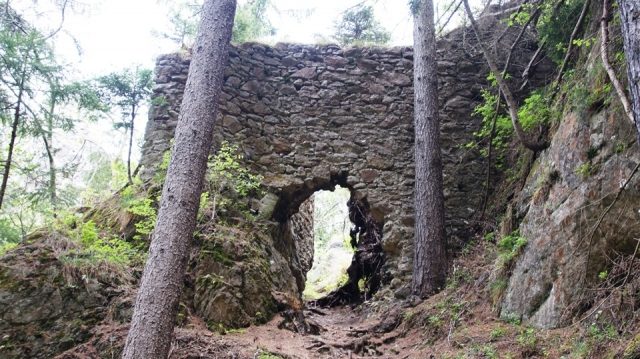
Nothing is known about the founding of the castle. However, it is likely to have existed as a wooden fortification as early as the 11th century. The first verifiable owner, Dietmar von Liechtenstein, appeared in 1140. These were ministeriales, first of the Eppensteiners, then of the Carinthian dukes, the margraves of Styria, and finally of the later territorial princes. However, they owned the castle as free property.
In 1383, the castle was divided between the brothers Hans and Andreas von Liechtenstein. Hans received the upper part of the castle, Andreas the lower. Only in the first quarter of the 15th century was Rudolf von Liechtenstein able to regain sole possession of the lordship. With his son Lienhard, the Liechtenstein branch of the family died out in 1437.
His nephew Hans von Stubenberg inherited the estate. However, he still had to pay off several co-heirs, which he did not quite succeed in, as Konrad von Kraig was still residing at Liechtenstein in 1459. After further divisions of inheritance, the castle was sold to Emperor Frederick III in 1465. He appointed Konrad Färber as administrator. Five years later, the lordship was leased to Reinprecht Hinterpuchler. In 1471, Paul Ramung was entrusted with the administration. His successor as caretaker was Balthasar Thannhauser in 1480. He successfully defended Liechtenstein against the troops of Matthias Corvinus during the Hungarian War. Liechtenstein was probably abandoned after the retreat of the Hungarians towards the end of the 15th century, but it still served as a beacon station in 1532.
In 1559, Wilhelm von Herberstein received the fiefdom over the lordship. In 1582, Georg Bernhardt Urschenbeck acquired it. In 1610, the name Katzenstein appeared for Liechtenstein Castle, but this name did not prevail. In 1625, the lordship passed to Hans Jakob Putterer, who sold it to Seckau Abbey in 1635. The by then completely dilapidated castle found new buyers in 1711 with the hammer lords Franz von Fraydenegg, Kaspar Majackh, and Marx Egger. In 1727, Johann Franz Priembsch von Königsbrunn followed. In 1814, Prince Johann I von und zu Liechtenstein bought the lordship. The similarity in name with the Styrian Liechtensteins of the 12th to 15th centuries is probably rather coincidental.
Take Mobile History with you
You are reading this text for free. Premium adds what matters on the road: descriptions read aloud, sites found through your camera, whole regions taken offline.
- Every description, including the ~17,700 Premium sites
- Audio guide: have descriptions read to you on location
- AR finder: see sites through your camera, with distance and bearing
- Unlimited saved sites
14 days free, then from €2.99 a month. Cancel anytime.
Source: Wikipedia · Licence: CC BY-SA 4.0 · Image: http://www.wehrbauten.at
This description draws on the facts documented in the linked Wikipedia article; Wikipedia content is licensed under CC BY-SA 4.0. Wording and editing: Mobile History.
Location: 47.1666, 14.6753